 how-to
Flexible Cleaning Schedules for Office Buildings
Table of Contents
- Why Flexible Cleaning Schedules Matter for Modern Offices
- Assessing Your Office Cleaning Needs
- Hybrid Office Cleaning Requirements and Task Allocation
- Commercial Cleaning Frequency Standards and Best Practice
- Creating an Office Cleaning Checklist Template
- Implementing Occupancy-Based and Variable-Day Scheduling
- Measuring ROI and Operational Efficiency Gains
- Frequently Asked Questions
Last Updated: September 28, 2026
Why Flexible Cleaning Schedules Matter for Modern Offices
The modern office is nothing like it was five years ago. Hybrid work has transformed how buildings get used. Some days your office is full. Other days it's half-empty. Fixed cleaning schedules made sense when everyone came in five days a week. They don't anymore.
Flexible cleaning schedules for office buildings adapt to how your space is actually used. Instead of cleaning the same way every single day, you adjust based on occupancy. You clean more thoroughly on busy days. You scale back on quieter ones. This approach cuts waste, improves hygiene, and saves money.
At Lion Cleaning Group, we've worked with facility managers across the UK who have seen the benefits of flexible cleaning schedules. They found that aligning cleaning efforts with actual usage can lead to more efficient resource allocation and improved hygiene.
The challenge most facilities face is figuring out where to start. How do you measure occupancy? Which areas need daily attention? How do you actually schedule around fluctuating patterns? Below, we'll show you exactly how to build a flexible cleaning schedule that works for your building.
Assessing Your Office Cleaning Needs
Before you change anything, you need to understand what your building actually needs. This starts with two questions: How full is your office on any given day? Which areas matter most?
Measuring occupancy patterns
Your occupancy pattern is the foundation of everything. Track how many people use your building each day for two to four weeks. Look at patterns by day of the week. Mondays often see higher occupancy than Fridays in hybrid offices.
Use simple tools to measure:
- Badge access logs from your building entry system
- Desk booking data if you use hot-desking software
- Parking occupancy counts
- Manual headcount during peak hours
Once you have the data, you'll spot the pattern. Many offices see 30-40% occupancy on Mondays, climbing to 60-70% by mid-week, then dropping again Friday. Some see the opposite. Your pattern is unique to your business.
Document these numbers. They become your baseline for scheduling decisions.
Identifying high-priority cleaning areas
Not every part of your office needs the same level of attention. Some areas are touched by dozens of people daily. Others sit empty most of the time.
High-priority areas include:
- Reception and entry points
- Toilet facilities and washrooms
- Kitchen and break areas
- Lift buttons and handrails
- Shared meeting room tables and chairs
- Door handles throughout the building
Lower-priority areas might include:
- Individual desk spaces (especially in hot-desking setups)
- Rarely-used storage rooms
- Hallways with minimal foot traffic
- Outdoor areas unless they're customer-facing
The key insight here: focus your effort where people actually are. If occupancy is low, don't deep-clean empty desks. Concentrate on the spaces where germs spread fastest.
Hybrid Office Cleaning Requirements and Task Allocation
Hybrid working creates a specific challenge. You can't predict exactly who will be in the building or when. Your cleaning schedule needs to be flexible enough to handle that uncertainty while maintaining standards.
Daily tasks versus weekly deep cleans
A practical approach separates tasks by frequency. Daily tasks keep the building hygienic day-to-day. Weekly deep cleans handle what daily cleaning misses.
Daily tasks focus on high-touch surfaces and visible dirt:
- Emptying bins in all areas
- Restocking toilet paper, soap, and hand towels
- Wiping down high-touch surfaces (door handles, lift buttons, handrails)
- Spot-cleaning visible spills or marks
- Cleaning toilet seats and urinals
- Mopping entrance areas where dirt accumulates
Weekly deep cleans go deeper:
- Vacuuming all carpeted areas thoroughly
- Cleaning under and behind furniture
- Washing windows and glass partitions
- Deep-cleaning kitchen appliances
- Sanitising meeting room chairs and tables
- Cleaning air vents and light fixtures
The split lets you maintain hygiene daily without the cost of a full deep clean every single day. On low-occupancy days, you can skip some daily tasks. On high-occupancy days, you might add extra passes through high-traffic areas.
High-touch surface disinfection protocols
High-touch surfaces are where germs concentrate (Checking your browser). These areas need regular attention, especially in shared spaces.
Your disinfection protocol should identify which surfaces need attention and how often:
- Door handles: at least twice daily in high-occupancy areas
- Lift buttons: three times daily minimum
- Toilet flush handles: after each use or at minimum twice daily
- Handrails: twice daily
- Shared desk equipment (printers, scanners): daily
- Meeting room tables and chairs: after each use or daily
- Kitchen appliances and handles: twice daily
The frequency depends on occupancy. On days when occupancy is above 60%, increase the frequency. On days below 40%, you can maintain once-daily passes for most surfaces.
Environmentally friendly products are used by Lion Cleaning Group. They are designed to meet hygiene standards while being safer for staff and building users.
Commercial Cleaning Frequency Standards and Best Practice
The cleaning frequency your office needs depends on several factors: industry type, occupancy levels, customer-facing areas, and regulatory requirements.
Most office buildings benefit from a baseline of daily cleaning for high-traffic and high-touch areas, with weekly deep cleans. Some industries need more frequent sanitisation. Healthcare facilities, for example, require more rigorous disinfection protocols than general offices.
For a typical hybrid office, this framework works well:
- High-touch surfaces: daily disinfection
- Common areas (kitchens, toilets, breakrooms): daily cleaning
- Floors in high-traffic zones: daily mopping
- General office areas: twice-weekly vacuuming
- Deep cleans of all areas: weekly
- Carpet shampooing and window cleaning: monthly
- HVAC vent cleaning and deep sanitisation: quarterly
The best practice approach is to adjust these frequencies based on your occupancy data. If your office hits 70% occupancy on Tuesdays and Wednesdays, those days get your full cleaning schedule. If occupancy drops to 20% on Fridays, you scale back to essential tasks only.
This flexibility is what makes modern cleaning schedules work. You're not locked into a one-size-fits-all approach.
Creating an Office Cleaning Checklist Template
A good checklist ensures nothing gets missed and gives your cleaning team clear direction. It also creates accountability and makes it easy to spot where standards might slip.
Your checklist should break down by area and frequency.
| Area | Daily Task | Frequency | Notes |
|---|---|---|---|
| Entrance/Reception | Sweep, mop, bin empty | Daily | Increase frequency on high-occupancy days |
| Toilet Facilities | Clean, disinfect, restock | Daily | Check after lunch and end of day |
| Kitchen/Breakroom | Wipe surfaces, clean appliances | Twice daily | Morning and evening |
| High-touch surfaces | Disinfect door handles, lifts, rails | Daily minimum | 2-3 times on high-occupancy days |
| Meeting rooms | Wipe tables, chairs, check bins | Daily | Clean after scheduled bookings |
| Office floors | Vacuum carpets, mop hard floors | 2x weekly | Daily in high-traffic zones |
| Windows/Glass | Clean interior surfaces | Weekly | Monthly deep clean outside |
| Deep clean all areas | Full sanitisation | Weekly | Saturday or after-hours |
Implementing Occupancy-Based and Variable-Day Scheduling
This is where theory becomes practice. You've measured occupancy and identified priorities. Now you build a schedule that adapts to actual usage patterns.
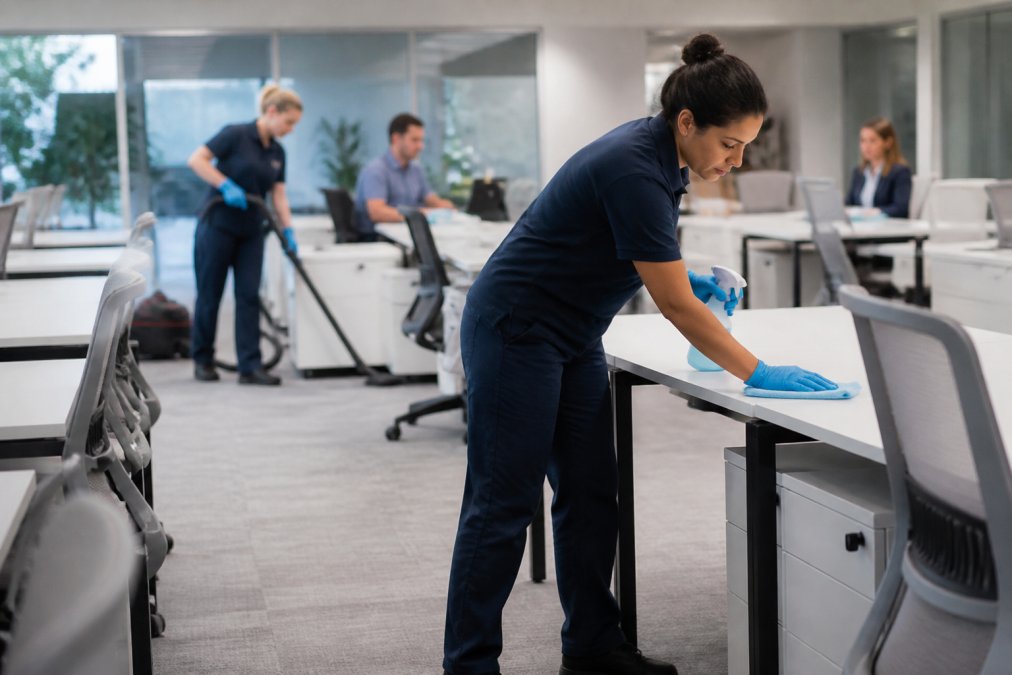
Adapting schedules to fluctuating office occupancy
Start with your occupancy data. Plot it by day of the week and time of day if possible. You'll see patterns emerge.
Most hybrid offices follow one of these patterns:
- Peak mid-week (Monday-Wednesday high, Thursday-Friday low)
- Consistent mid-week, quiet Fridays
- Unpredictable (varies week to week based on projects)
On high-occupancy days (60%+ occupancy):
- Full daily cleaning of all areas
- Three passes on high-touch surfaces
- Extra attention to break areas and toilets
- Immediate spot-cleaning of spills
On medium-occupancy days (40-60% occupancy):
- Standard daily cleaning schedule
- Two passes on high-touch surfaces
- Focus on areas where people actually are
- Skip deep cleaning of empty zones
On low-occupancy days (below 40% occupancy):
- Maintenance cleaning only (bins, toilets, high-touch surfaces)
- Skip some daily tasks in quiet areas
- Use the time for weekly deep-clean tasks
- Reduce team size if possible
Managing downtime and resource allocation
Flexible scheduling only works if you manage resources efficiently. You can't have a full team standing around on quiet days, and you can't scramble to find staff on busy ones.
The solution is variable staffing:
- Core team: always present, handles essential daily tasks
- Flex team: scheduled based on occupancy forecast
- Specialist team: handles weekly deep cleans and detailed work
Measuring ROI and Operational Efficiency Gains
Flexible scheduling delivers financial and operational benefits. Measuring them shows whether the approach is working and where you might adjust.
Track these metrics:
- Cost per square metre per week (should decrease as you optimise)
- Staff hours used per week (should align more closely with actual need)
- Cleanliness audit scores (should stay consistent or improve)
- Occupant satisfaction with cleanliness (survey quarterly)
- Absenteeism due to illness (track over time)
- Energy use for cleaning equipment and supplies (should decrease)
Frequently Asked Questions
How often should an office building be cleaned?
Commercial cleaning frequency standards depend on occupancy levels, foot traffic, and industry type. Most offices require daily cleaning of high-touch areas such as door handles, lift buttons, and kitchen surfaces, combined with weekly deep cleans of carpets and less-frequented zones. Hybrid offices may benefit from occupancy-based schedules that adjust cleaning intensity on days when fewer staff are present, reducing unnecessary resource allocation while maintaining workplace hygiene standards.
What should be included in a professional office cleaning checklist template?
A comprehensive office cleaning checklist template must cover daily tasks (emptying bins, sanitising surfaces, mopping floors), weekly tasks (carpet cleaning, window wiping, deep-cleaning bathrooms), and monthly preventative maintenance. For hybrid workplaces, prioritise high-touch surfaces. Include task frequency, assigned staff, and sign-off procedures to ensure accountability.
What are the benefits of flexible cleaning schedules for hybrid offices?
Flexible cleaning schedules for hybrid offices align cleaning intensity with actual occupancy levels, and maintain consistent disinfection protocols on days when staff are present. Variable-day scheduling allows facility managers to redirect resources to high-priority areas and supports workplace hygiene.
How do you adapt cleaning schedules for fluctuating office occupancy?
Track occupancy data weekly to identify patterns in when staff are present, then adjust task frequency accordingly. On high-occupancy days, increase cleaning of high-touch surfaces and common areas. On low-occupancy days, prioritise preventative maintenance and deep cleans of less-used zones. Use occupancy-based cleaning to shift resources toward areas that need them most and maintain hygiene standards.