 ultimate-guide
Preventing Staff Illness With Professional Cleaning
Table of Contents
- How Professional Cleaning Prevents Staff Illness
- Reducing Employee Sick Leave Through Cleaning
- High-Touch Surface Sanitisation in the Workplace
- Commercial Cleaning Health and Safety Standards
- Indoor Air Quality and Respiratory Health
- The ROI of Professional Cleaning Services
- Sustainable Cleaning and Employee Wellbeing
- Frequently Asked Questions
Last Updated: September 20, 2026
How Professional Cleaning Prevents Staff Illness
Preventing staff illness with professional cleaning is one of the most overlooked levers for reducing workplace absenteeism and maintaining productivity. When a workspace isn't cleaned to clinical standards, pathogens accumulate on surfaces, in the air, and on shared equipment. The result: employees catch infections more easily, take sick leave more frequently, and your operation suffers.
The connection is direct. High-touch surfaces like door handles, light switches, and desk phones become vectors for bacterial transmission. A single contaminated surface touched by dozens of people daily becomes a pathogen distribution point. Professional cleaning eliminates this risk through systematic sanitisation protocols and validated disinfection frequencies.
Fewer pathogens in the environment means fewer infections. Fewer infections mean fewer people calling in sick. The reason isn't complicated: fewer pathogens in the environment means fewer infections. Fewer infections mean fewer people calling in sick.
Reducing Employee Sick Leave Through Cleaning
Employee sick leave costs British businesses significantly. When staff absence increases, productivity drops, customer service suffers, and remaining employees become overloaded. The hidden cost of preventable illness is substantial.
Professional cleaning directly reduces employee sick leave by lowering the pathogenic load in shared spaces. When bathrooms are cleaned multiple times daily, break rooms are sanitised between uses, and high-touch surfaces are disinfected on a validated schedule, the transmission of respiratory infections, stomach bugs, and other contagious illnesses drops measurably.
The mechanism is straightforward: fewer viable pathogens on surfaces means fewer people become infected. This isn't about making spaces look clean, it's about reducing the actual microbial load through evidence-based disinfection. A professional service uses appropriate cleaning chemicals, applies them at correct concentrations, and follows contact times that actually kill pathogens rather than just wiping surfaces.
The improvement accelerates as staff confidence in workplace hygiene grows and fewer people arrive at work already ill.
High-Touch Surface Sanitisation in the Workplace
High-touch surfaces are the primary transmission route for infections in shared workplaces. These are surfaces touched by many people throughout the day: door handles, light switches, lift buttons, desk phones, keyboard and mouse, bathroom taps, and communal equipment.
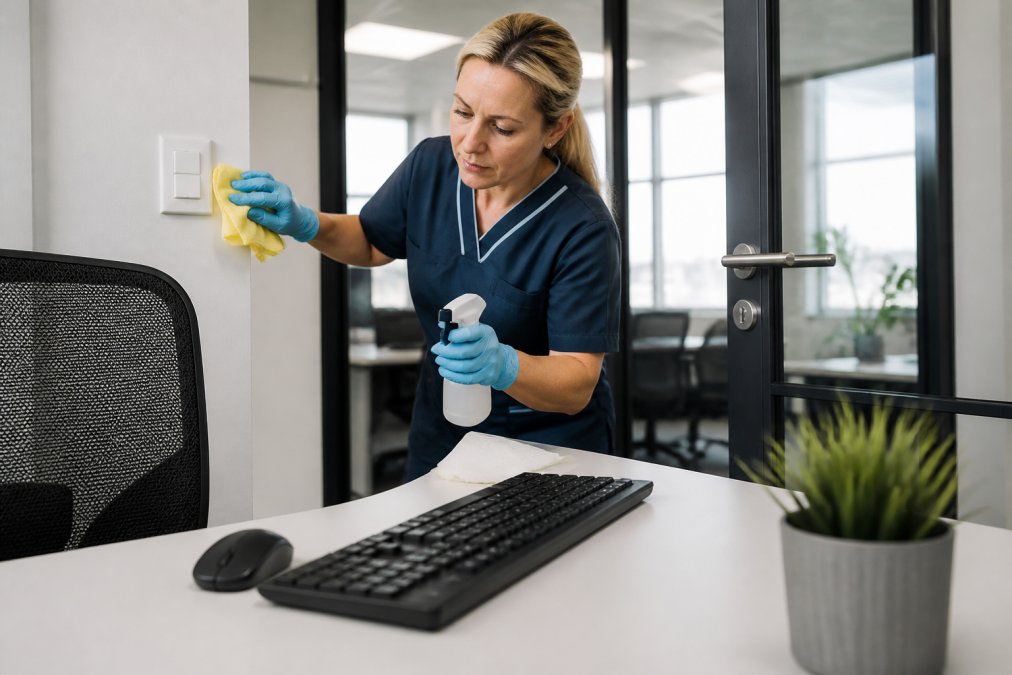
Pathogen reduction on these surfaces requires more than standard cleaning. A damp cloth removes visible dirt but leaves viable pathogens behind. Effective sanitisation requires contact with an appropriate disinfectant for a specified duration, typically 30 seconds to several minutes depending on the product and target pathogen.
Professional cleaning services understand disinfection frequency requirements for different surfaces and environments. High-touch surfaces in healthcare settings require different protocols than office spaces, which differ from retail environments. A validated approach targets the specific pathogens likely in each setting.
Cross-contamination between areas is a common failure point in amateur cleaning. A cleaner using the same cloth to wipe multiple surfaces actually spreads pathogens rather than containing them. Professional teams use colour-coded cloths, change them frequently, and follow protocols that prevent cross-contamination between zones.
The result is measurable: viable pathogen counts drop significantly on properly sanitised surfaces. This directly translates to fewer infections among staff.
Commercial Cleaning Health and Safety Standards
Cleaning itself poses occupational health risks if not managed properly. Cleaning chemicals can irritate respiratory systems, cause skin reactions, and create hazardous fumes when mixed incorrectly. Staff exposure to these risks must be controlled through proper training, ventilation, and safe handling procedures.
In the UK, the Control of Substances Hazardous to Health Regulations (COSHH) require employers to assess chemical risks and implement control measures (Control of Substances Hazardous to Health (COSHH)). This includes ensuring cleaning staff understand the hazards of products they use, proper dilution rates, required personal protective equipment, and ventilation needs.
Professional cleaning services carry COSHH compliance as a core responsibility. Their staff receive training on chemical safety, use appropriate protective equipment, and follow manufacturer guidance on application and contact times. This protects both cleaning staff and building occupants.
Environmentally friendly cleaning products have become increasingly effective at pathogen reduction. Lion Cleaning Group uses products that deliver disinfection efficacy without the respiratory irritation or environmental impact of traditional harsh chemicals. These products meet health and safety standards whilst reducing exposure risks for staff and occupants.
Proper waste management is another critical standard. Used cleaning materials, chemical containers, and potentially contaminated waste require appropriate disposal. Professional services manage this responsibility, ensuring compliance with environmental and occupational health regulations.
Indoor Air Quality and Respiratory Health
Workplace air quality directly affects respiratory health and staff wellbeing. Airborne pathogens, dust, allergens, and chemical residues accumulate in poorly maintained spaces. Staff working in these environments experience more respiratory infections, allergies, and general illness.
Professional cleaning reduces airborne pathogens through several mechanisms. Regular surface cleaning removes dust and allergen sources that become airborne. Proper ventilation during and after cleaning prevents chemical residues from lingering in the air.
Respiratory health becomes particularly critical in shared spaces like open-plan offices, meeting rooms, and break areas where air is recirculated. A single person with a respiratory infection can contaminate the shared air, affecting colleagues throughout the day. Cleaning protocols that address both surfaces and air quality reduce this transmission pathway.
Many organisations have upgraded their approach to indoor air quality since 2020, recognising the link between air quality, infection prevention, and employee wellbeing. Professional cleaning services that understand this connection, and can articulate their approach to both surface and air hygiene, deliver measurable health benefits.
Humidity control is another factor. Excessive moisture encourages mould and bacterial growth; excessive dryness irritates respiratory systems. Professional facilities management addresses these factors as part of comprehensive hygiene protocols.
The ROI of Professional Cleaning Services
The financial case for professional cleaning extends beyond appearance. When you calculate the true cost of employee sick leave, lost productivity, overtime for remaining staff, customer service impact, and reduced output, professional cleaning becomes a cost-saving measure rather than an expense.
Building a cost-benefit model for your workplace:
Start with your baseline. Calculate your organisation's average sick leave cost per employee per year. The true cost to your business includes lost output, temporary cover, and management overhead.
Next, estimate your current infection-related absence rate. Track respiratory infections, stomach bugs, and other contagious illnesses separately from other absence types. This gives you a baseline transmission rate.
Then, research professional cleaning costs for your facility size. Larger facilities benefit from economies of scale. Healthcare settings and food-handling environments typically require more intensive protocols and cost more.
Now apply the reduction factor. Use a conservative figure for your initial calculation.
Worked example:
- 50-person office
This calculation excludes secondary benefits: improved employee morale, reduced presenteeism (staff working whilst ill), lower staff turnover, and improved customer perception. Many organisations find these intangible benefits justify the investment even if infection-related absence reduction is modest.
Variables that improve ROI:
High-touch, high-occupancy environments (call centres, open-plan offices, retail, education, healthcare) see faster payback because infection transmission is higher. Organisations with high baseline sick leave see more dramatic improvements. Seasonal factors matter: winter months typically show 40-60% higher respiratory infection rates, so cleaning investments show faster ROI in autumn and winter.
Customer-facing businesses benefit from a secondary ROI: improved hygiene perception increases customer confidence and retention. A retail business or hospitality venue that visibly invests in professional cleaning often sees measurable improvements in customer satisfaction scores and repeat business.
Sustainable Cleaning and Employee Wellbeing
Sustainable cleaning practices, using environmentally responsible products and methods, align with both employee wellbeing and corporate responsibility. But the wellbeing benefit extends far beyond chemical safety: the psychological impact of a visibly clean, well-maintained workspace directly influences employee stress, confidence, and mental health.
The psychology of workplace cleanliness:
Research in occupational psychology consistently shows that employees working in clean, orderly environments report lower stress levels, higher job satisfaction, and greater sense of control over their work conditions.
Sustainable products and respiratory confidence:
Visible cleanliness and retention:
Environmental responsibility and staff pride:
Frequently Asked Questions
What are the most common high-touch areas that spread office illness?
Door handles, light switches, lift buttons, desks, keyboards, and communal kitchen equipment are the primary vectors for bacterial and viral transmission. These surfaces are touched dozens of times daily by multiple staff members, making them critical points for cross-contamination. Regular sanitisation of high-touch surfaces significantly reduces pathogen load and infection prevention in shared workspaces.
How often should commercial premises be deep cleaned to prevent illness?
Daily sanitisation of high-touch surfaces combined with weekly deep cleaning is the standard practice for most offices. During periods of heightened illness risk, increased frequency may be necessary. Professional cleaning schedules should be tailored to your facility's foot traffic, number of staff, and occupancy patterns. Consistent preventative maintenance reduces viral load and bacterial transmission more effectively than sporadic deep cleans.
What are the legal responsibilities of employers regarding workplace hygiene?
Under the Health and Safety at Work etc. Act 1974 and the Control of Substances Hazardous to Health (COSHH) Regulations, employers must provide a safe, hygienic workplace. This includes implementing cleaning schedules, using approved disinfection methods, and maintaining occupational health standards. Professional cleaning services ensure compliance with these regulations whilst reducing liability and demonstrating duty of care to employees.
Can environmentally friendly cleaning products effectively kill bacteria and viruses?
Modern eco-friendly disinfectants are formulated to meet stringent efficacy standards whilst minimising environmental impact. They effectively reduce bacterial transmission and viral load when used correctly at appropriate concentrations. The key is using products validated against relevant pathogens and maintaining proper contact times. Professional cleaners understand which sustainable products work best for specific surfaces and infection prevention goals.