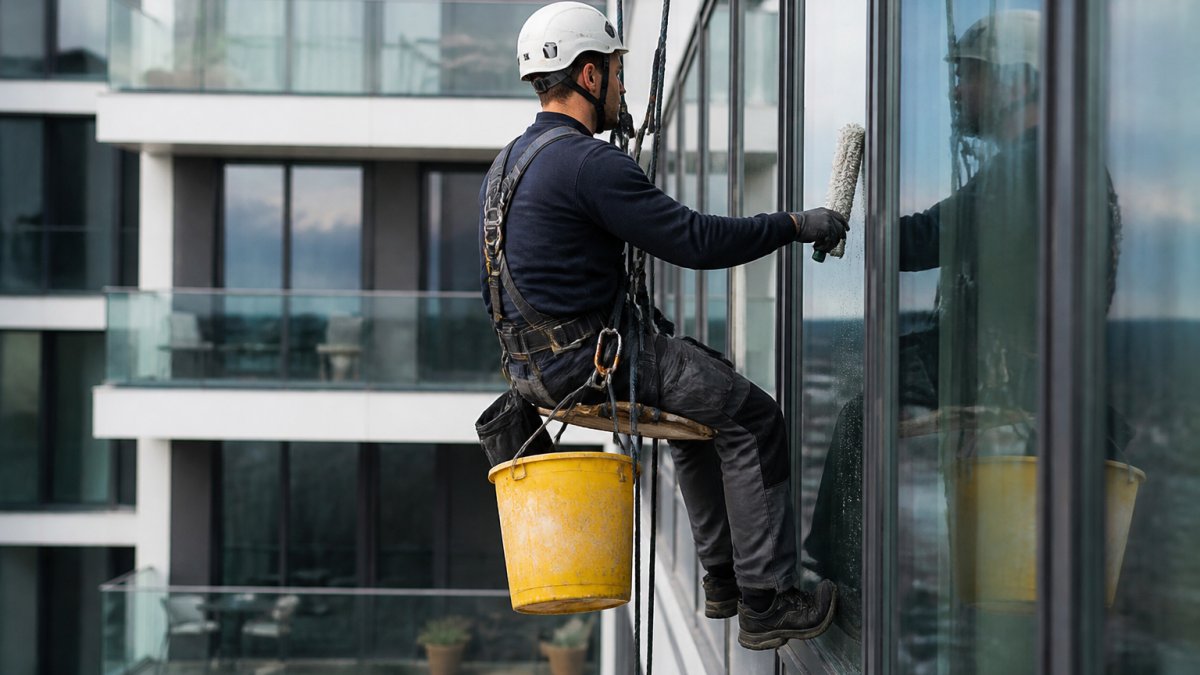
 how-to
Risk Assessment for Working at Height Cleaning
Table of Contents
- What is a Risk Assessment for Working at Height Cleaning?
- Work at Height Regulations 2005 Summary and Your Legal Obligations
- HSE Hierarchy of Control for Working at Height
- Common Hazards in Working at Height Cleaning
- Window Cleaning Safety Equipment Requirements
- Risk Assessment Template for Window Cleaning
- Control Measures and Safe Working Practices
- Frequently Asked Questions
Last Updated: 2 October 2026
What is a Risk Assessment for Working at Height Cleaning?
A risk assessment for working at height cleaning is a systematic process of identifying hazards, evaluating the risks they pose, and implementing control measures to keep your team safe. When your building has windows above ground level, this assessment becomes essential.
Working at height means any work where a person could fall more than 2 metres and suffer injury. For window cleaning on apartment blocks, offices, or commercial properties, this applies to most exterior work. The assessment isn't a one-time box to tick, it's an ongoing evaluation that changes with weather, building condition, and equipment wear.
Lion Cleaning Group conducts these assessments before every high-rise cleaning project. The process identifies what could go wrong, who might be affected, and what controls prevent harm. It's straightforward but thorough.
Work at Height Regulations 2005 Summary and Your Legal Obligations
The Work at Height Regulations 2005 (as amended) is the UK law that governs all work at height. It applies to any work where a person could fall and suffer injury. Your legal obligation is clear: you must ensure the safety of anyone working above ground level on your property.
Under these regulations, you must:
- Avoid work at height where reasonably practicable
- Use the proper equipment and procedures when height work is necessary
- Plan and supervise all work at height
- Ensure workers are competent and properly trained
- Inspect and maintain all equipment regularly
The Health and Safety Executive (HSE) enforces these regulations. Failure to comply can result in enforcement action, fines, or prosecution. More importantly, it puts your staff and contractors at real risk.
For property managers in Greater Manchester and across the UK, this means vetting your cleaning contractors carefully. Ask whether they operate under these regulations. Ask for evidence of risk assessments, training records, and equipment maintenance logs. A contractor who cannot show these documents is operating illegally.
HSE Hierarchy of Control for Working at Height
The HSE sets out a clear hierarchy for controlling risks at height. This hierarchy should guide every decision you make about how to manage the work safely.
The hierarchy works like this:
- Elimination - Remove the need for work at height altogether. Can the window be cleaned from ground level? Can permanent protective systems be installed?
- Engineering controls - Use equipment or design to reduce the risk. This includes guardrails, safety nets, or work platforms.
- Administrative controls - Implement procedures and training. Use permits to work, supervision, and competency checks.
- Personal protective equipment (PPE) - Use harnesses, helmets, and lanyards as a last resort when other controls cannot eliminate the risk.
Most window cleaning at height relies on a combination of engineering controls and administrative controls. PPE alone is never enough.
The hierarchy matters because it forces you to think systematically. Don't jump to "buy harnesses and rope." Start by asking whether the work is necessary at all. If it is, ask what engineering controls can help. Only then should you rely on PPE and procedures.
Common Hazards in Working at Height Cleaning
Understanding the specific hazards on your building helps you plan effective controls. Hazards aren't theoretical, they're the real conditions your team faces.
Fall risks and exposure
Falls are the primary hazard in height work. A person can fall from a ladder, platform, or whilst secured to a rope if the equipment fails or the attachment point gives way.
Common fall scenarios include:
- Loss of balance on a ladder or platform
- Slip on wet or dirty surfaces
- Equipment failure (harness, lanyard, or anchor point breaking)
- Entanglement of rope or lanyard
- Failure to clip in or use equipment correctly
Each scenario requires a different control. A wet surface calls for improved grip or non-slip footwear. An unsecured rope requires a backup lanyard. Incorrect use requires better training and supervision.
Weather and environmental factors
Wind, rain, and temperature affect safety at height. Strong winds can push a person off balance. Rain makes surfaces slippery. Ice in winter creates hazardous conditions.
Weather hazards include:
- High winds increasing fall risk
- Rain reducing grip and visibility
- Frost or ice on surfaces
- Extreme heat affecting concentration and physical capability
- Poor visibility in fog or low light
Your risk assessment must specify wind speed limits for work. Many contractors stop work above 40 km/h wind speed. Rain may require work to stop or additional safety measures like non-slip footwear.
Equipment failure and maintenance
Harnesses, ropes, lanyards, and anchor points all wear out. A harness used regularly may degrade faster than one used occasionally. Rope exposed to UV light becomes brittle. Metal anchor points corrode in damp conditions.
Equipment hazards include:
- Worn or damaged harnesses
- Frayed or degraded rope
- Corroded metal fittings
- Unsuitable anchor points
- Inadequate backup systems
Window Cleaning Safety Equipment Requirements
Working at height demands specific equipment. The right gear, properly maintained and correctly used, is your primary defence against falls.
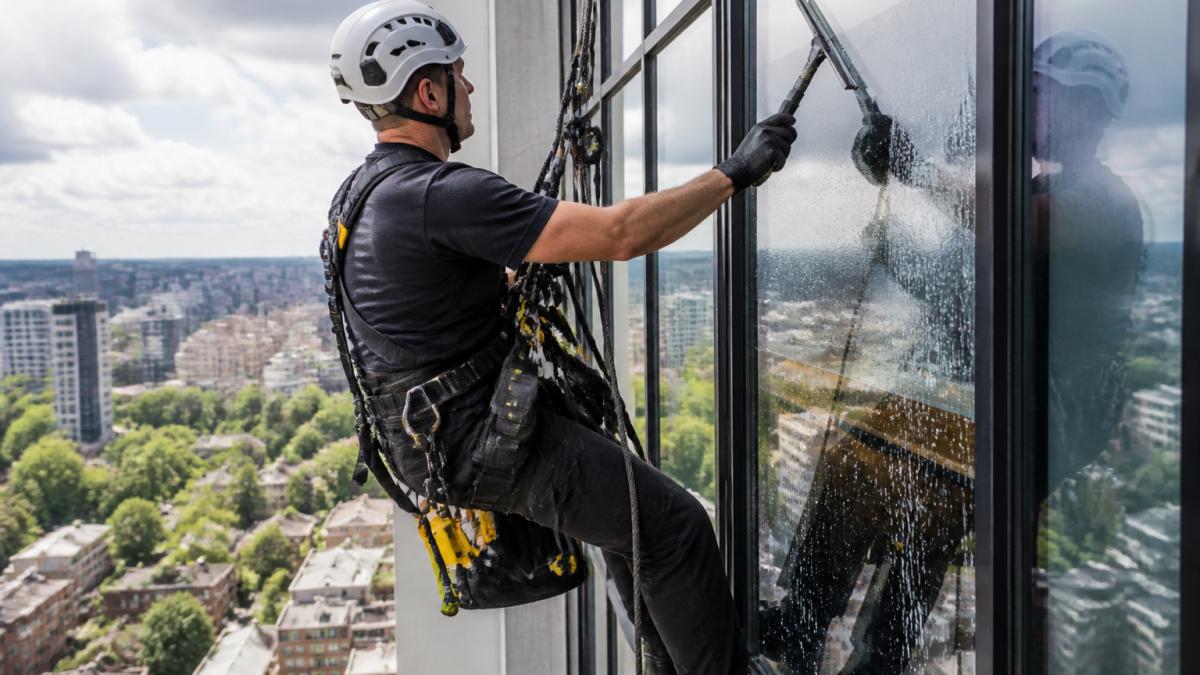
Essential equipment includes:
- Safety harness - A full-body harness distributes fall forces across the body, reducing injury. It must fit properly and be inspected regularly.
- Lanyard or rope - Connects the harness to a secure anchor point. A shock-absorbing lanyard reduces the force of a sudden stop.
- Anchor point - A fixed structure strong enough to hold a falling person. Building design, roof edges, or temporary systems can serve as anchor points.
- Helmet - Protects against head injury from falling objects or impact during a fall.
- Non-slip footwear - Reduces slip risk on wet or dirty surfaces.
- Gloves - Improve grip and protect hands from cuts or abrasion.
Equipment alone doesn't ensure safety. It must be:
- Correctly selected for the task
- Properly fitted and adjusted
- Regularly inspected and maintained
- Used by trained personnel
- Combined with other control measures
Risk Assessment Template for Window Cleaning
A practical risk assessment follows a simple four-step structure. You can adapt this template for your building and cleaning schedule.
Step 1: Identify the hazards
Walk the building and list everything that could cause harm during window cleaning. Don't assume, look at the actual conditions.
- Height and fall distance
- Building surfaces (smooth glass, slippery ledges, rough concrete)
- Weather exposure (wind, rain, temperature)
- Building features (protruding ledges, sharp edges, unstable surfaces)
- Nearby hazards (power lines, traffic, pedestrians below)
- Access routes (stairs, roof access, external platforms)
Step 2: Decide who might be harmed and how
Identify everyone affected by the work and describe how they could be injured.
Affected people include:
- Window cleaners performing the work
- Supervisors or managers overseeing the work
- Other building occupants or staff
- Members of the public below the work area
- Maintenance staff who may use the same anchor points later
Step 3: Evaluate the risks and existing controls
For each hazard, assess the current level of risk and what controls already exist.
Use a simple scale:
- High risk - Serious injury likely if hazard occurs
- Medium risk - Injury possible but not certain
- Low risk - Minor injury likely
Step 4: Record your findings and action plan
Document the assessment in writing. Include:
- Hazards identified
- People at risk
- Current controls and their effectiveness
- Any additional controls needed
- Who is responsible for each action
- When actions will be completed
- Date of next review
Keep records for at least three years. They demonstrate compliance with regulations and provide evidence if an incident occurs.
A simple one-page form works well:
| Hazard | Who is at risk | Current controls | Additional controls needed | Responsible person | Target date |
|---|---|---|---|---|---|
| Fall from height | Window cleaners | Harness, lanyard, anchor point inspection | Additional backup lanyard for work above 10m | Supervisor | 15 October 2026 |
| Wet surfaces | Window cleaners | Non-slip footwear | Daily surface inspection before work | Team lead | Ongoing |
| Equipment failure | Window cleaners | Annual harness inspection | Monthly visual inspection log | Safety officer | Ongoing |
Control Measures and Safe Working Practices
Effective control measures include:
Pre-work inspection Inspect all equipment before every job. Check harnesses for tears or worn stitching. Examine ropes for fraying or brittleness. Test anchor points for stability. Document findings. If anything fails inspection, remove it from service immediately.
Frequently Asked Questions
What are the legal requirements for working at height cleaning in the UK?
The Work at Height Regulations 2005 require employers to ensure anyone working at height is properly trained, supervised, and equipped. You must conduct a risk assessment before work begins, identify all hazards, and implement control measures following the HSE hierarchy. The Health and Safety Executive (HSE) enforces these regulations, and failure to comply can result in enforcement action and fines. Your risk assessment must be documented and reviewed regularly.
What must be included in a risk assessment template for window cleaning?
A thorough risk assessment for window cleaning should identify specific hazards (falls, weather exposure, equipment failure), determine who might be harmed, evaluate existing controls, and document findings with action plans. It must assess the building's condition, access points, weather patterns, and worker competence. Include details of the equipment to be used. The assessment should be reviewed annually or whenever working conditions change.
How does the HSE hierarchy of control apply to working at height cleaning?
The HSE hierarchy prioritises elimination first (avoid the work), then substitution (use safer methods), engineering controls (guardrails, platforms), administrative controls (procedures, training), and finally personal protective equipment as a last resort. For window cleaning, this means exploring if work can be done from ground level, using alternative methods, installing permanent controls, and only relying on personal protective equipment when higher controls aren't feasible. Each level must be considered before moving to the next.
What window cleaning safety equipment requirements must be met?
All equipment must comply with relevant British Standards and be regularly inspected and maintained. Essential items include harnesses, lanyards, helmets, and anchor points. Rope access work requires IRATA certification. Equipment must be certified, stored correctly, and replaced after damage or expiry. Any defective equipment must be removed from service immediately. Staff must receive training on proper use and care of all safety equipment.