
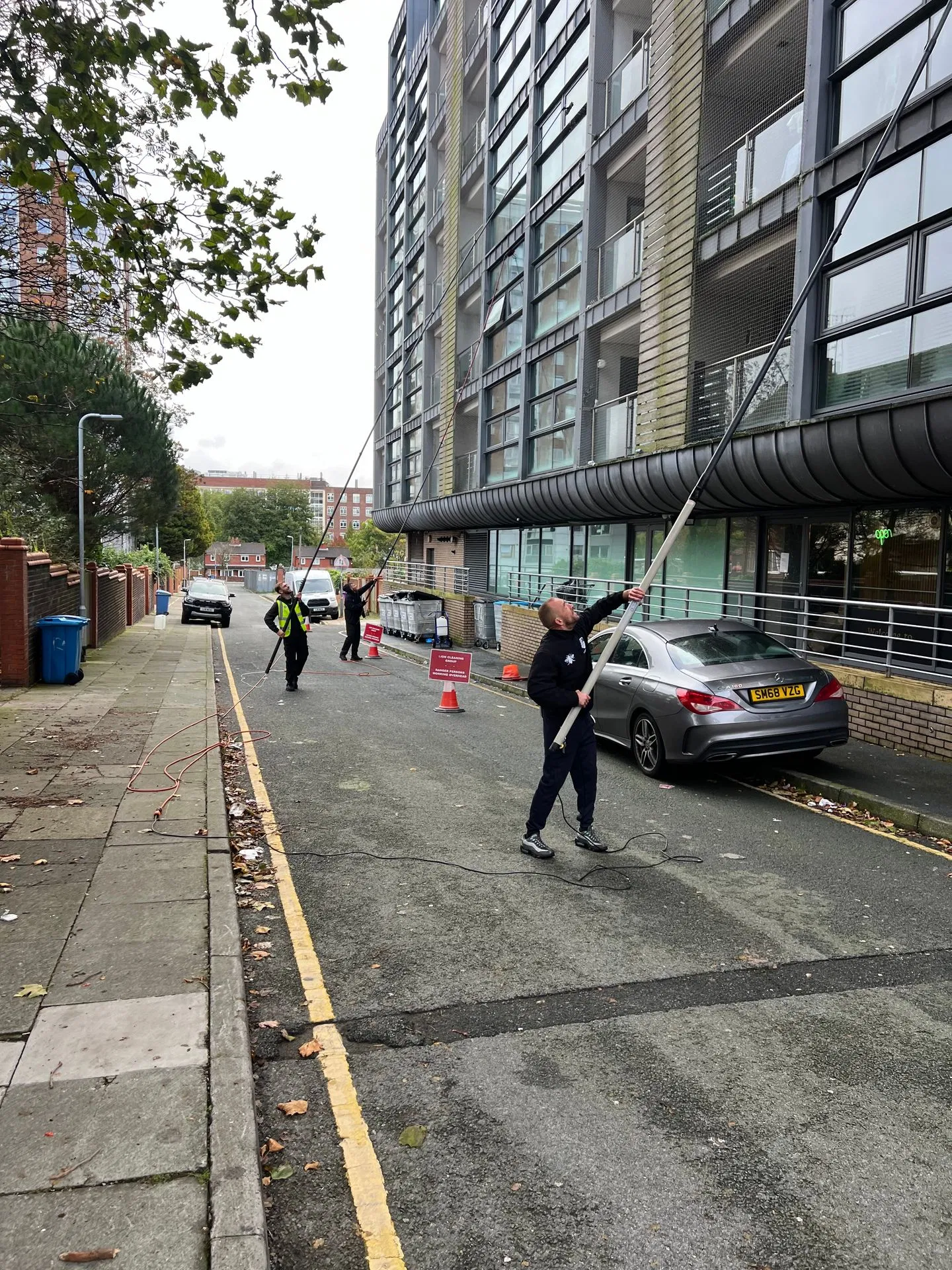
Water-fed pole window cleaning lets trained operatives clean many commercial windows from ground level, using a telescopic pole, brush and purified water. Where the glass is visible and reachable, it can be a practical way to maintain a façade without putting a worker on a ladder, platform or rope.
It is not the right method for every window. Building layout, obstructions, ground conditions and the task itself all matter. Here’s how the system works, where it tends to suit, and when another access method may be more appropriate.
How does water-fed pole window cleaning work?
A water-fed pole has a brush at its tip and a hose that carries treated water from a tank or water-treatment unit. The operative brushes the glass and frames, then rinses them with purified water.
The water is usually treated using reverse osmosis (RO), de-ionisation (DI), or both. RO removes most dissolved minerals; DI removes remaining charged particles. A meter can be used to check the water’s total dissolved solids (TDS). If the mineral content is too high, the rinse may leave marks as the water dries.
Because properly treated water contains very little mineral residue, it can usually dry naturally without the spots associated with untreated tap water. The brush does the physical cleaning; the pure-water rinse carries loosened dirt away. Detergent and squeegee drying are not usually needed for routine maintenance cleans.
Water quality is only part of the result. The brush needs to reach the glass at a workable angle, and the operative must be able to see the areas being cleaned. Heavy deposits, paint, building residue or other unusual contamination may need a different treatment.
When is it suitable for commercial window cleaning?
Water-fed pole cleaning is often suitable for low- to mid-rise façades where the windows can be reached safely from a clear, stable area at ground level. It can work well for office buildings, apartment blocks, showrooms and other premises with broad, relatively unobstructed elevations.
Our water-fed pole cleaning service is listed with ground-level reach up to 20 metres. That is a guide to the service, not a promise that every window at that height can be reached on every site. Pole length, wind, ground layout and the shape of the façade can all affect what is practical.
The Health and Safety Executive (HSE) identifies telescopic water-fed poles as one example of a way to avoid work at height where reasonably practicable. But pole work still needs planning. Hoses can create trip hazards, wet paths can become slippery, and overhead power lines need careful consideration. Long poles can also be tiring to control, particularly in wind.
Before recommending this method, we consider factors such as:
- Whether every target window is visible from the ground.
- Canopies, balconies, deep recesses, trees or other obstructions.
- The surface and space available for the operative and equipment.
- Pedestrian and vehicle movements, and where hoses will run.
- Overhead electrical hazards and expected weather conditions.
- The type of dirt on the glass and frames.

When is a water-fed pole not the right choice?
A pole may not reach windows hidden behind balconies, overhangs or deep architectural features. It may also be unsuitable where the operator cannot see the glass clearly from ground level, or where a pole would have to be extended across a busy route or near an electrical hazard.
The condition of the façade matters too. Loose or damaged building materials could be disturbed by brushing. Some glass or exterior surfaces may need a closer inspection or a different cleaning method. If the issue is more than routine dirt, we assess the surface and agree an appropriate approach before work starts.
A practical point for block managers is that pole cleaning does not remove the need to coordinate with residents or building users. We agree the working area and timing, manage hose routes and use suitable signs or barriers where needed. This helps reduce avoidable disruption and makes the job easier to manage around entrances, paths and parking.
Water-fed poles compared with rope access, MEWPs and BMUs
No single method suits every building. For commercial window cleaning, the access decision depends on the layout, height, task and site conditions, not height alone.
| Method | Often suitable when | Points to consider |
|---|---|---|
| Water-fed pole | Windows are visible and reachable from ground level, with a clear working area. | Obstructions, long-pole control, hoses, pedestrians and overhead hazards. |
| Rope access | The façade is high or complex and suitable roof access and anchor arrangements are available. | Requires specialist planning, competent technicians and a rescue plan. |
| MEWP or cherry picker | A stable machine position is available and close access to the façade is useful. | Ground bearing, space, reach, traffic management and operator competence. |
| BMU or cradle | A building has suitable installed façade-access equipment. | Equipment condition, availability and safe operating arrangements. |

Where a pole cannot reach or clean the glass effectively, we may assess rope access, powered access or a building maintenance unit. Our rope access teams include IRATA-certified technicians, and our powered-access work is carried out by IPAF-licensed operators. We also plan the job around the building, including safe access and suitable controls for people below.
Sometimes a combination is the practical answer: water-fed poles for the accessible elevations, with specialist access reserved for recessed or higher sections. Our rope access cleaning guide explains more about how that option works.

How we plan a water-fed pole clean
We follow a straightforward process so you know what has been assessed and what to expect.
- Site survey and access plan. We review the building height, layout, surfaces and surroundings. We check whether the windows are visible and reachable from the ground, and consider pedestrian routes, vehicles and other site-specific risks.
- Quote and schedule. We explain the recommended method and agree a suitable time. We can discuss working around residents, staff, customers or other building activity.
- Cleaning and completion check. Our team carries out the agreed work and checks the result. We provide a written report on completion.
For scheduled commercial window cleaning, the survey also helps establish which areas can be cleaned by pole and which may need a different approach. The right schedule will depend on the building, its location and how quickly the glass becomes soiled.
Frequently asked questions
How high can water-fed poles reach?
The practical reach depends on the pole and the site. Lion Cleaning Group lists water-fed pole reach up to 20 metres from ground level. HSE and Federation of Window Cleaners guidance discusses systems reaching up to around 24 metres, but that should not be treated as a guaranteed working height. The actual safe reach may be lower due to obstructions, wind, ground conditions or the angle needed to reach the glass.
Do windows need to be squeegeed after a pure-water clean?
Usually, no. When the water is properly purified and the glass has been thoroughly rinsed, it can dry naturally with little mineral residue. The finish still depends on water quality, the condition of the glass and the cleaning method.
Is water-fed pole cleaning safe?
It can help avoid working at height when windows can be reached from the ground, but it is not risk-free. The HSE and Federation of Window Cleaners guidance highlights issues including overhead power sources, trailing hoses, wet surfaces and weather. A site-specific assessment helps identify suitable precautions before work begins.
Can water-fed poles clean every window on a building?
No. Balconies, canopies, deep recesses and other features can block access. Where windows are not visible or reachable from the ground, we assess other options such as a MEWP, rope access or a building maintenance unit.
Is water-fed pole cleaning right for my building?
It may be a good fit if the target windows are visible from a clear ground-level working area and the cleaning is routine. A survey is the best way to check. The HSE’s guidance on window cleaning at height explains the need to plan work properly and use competent people and suitable equipment. You can also read the water-fed pole safety guide.
Arrange a site survey
If you manage a commercial building, apartment block, showroom or office in Greater Manchester or the wider North West, tell us the location, approximate height and which windows need cleaning. We’ll arrange a free site survey, assess whether water-fed pole cleaning is suitable and provide a clear quote. For larger projects, we also consider work elsewhere in the UK.
Request a quote from Lion Cleaning Group or call 0161 885 3189.