Author: Ryan Marriott

  • Commercial Window Cleaning: What Building Managers Should Expect From a Professional Service

    Commercial Window Cleaning: What Building Managers Should Expect From a Professional Service

    For a building manager, commercial window cleaning involves more than getting the glass clean. The contractor needs to understand the building, choose an appropriate access method, plan around people using the site and make clear what the service includes.

    A professional service should begin with a site assessment, not a guess based on the number of windows. Height, façade design, ground conditions and the surrounding area can all affect how work is carried out. Here’s what to expect when arranging commercial window cleaning in Greater Manchester or across the North West.

    Start with a site-specific survey

    Before quoting, we assess the building and the areas to be cleaned. That includes the height and layout of the façade, the type and condition of the glazing, available roof or ground access, and any nearby entrances, roads or pedestrian routes.

    It also helps to establish the exact scope. For example, does the clean include external glass only, or internal windows too? Are frames, sills, doors, canopies or signage included? If the building has sections that need different access methods, those should be identified before the schedule and price are agreed.

    You can help us plan by sharing:

    • The building address, approximate height and type of property.
    • Which elevations or windows need cleaning.
    • Known access arrangements, such as a BMU, roof access or restricted ground space.
    • Site rules, resident or tenant requirements, and preferred working hours.
    • Any particular concerns, such as traffic, deliveries or sensitive areas below the work.

    We use this information to assess the job and prepare a suitable access plan and quote.

    Expect the access method to suit the building

    There is no single method that suits every commercial building. The right choice depends on what needs cleaning and what the site allows.

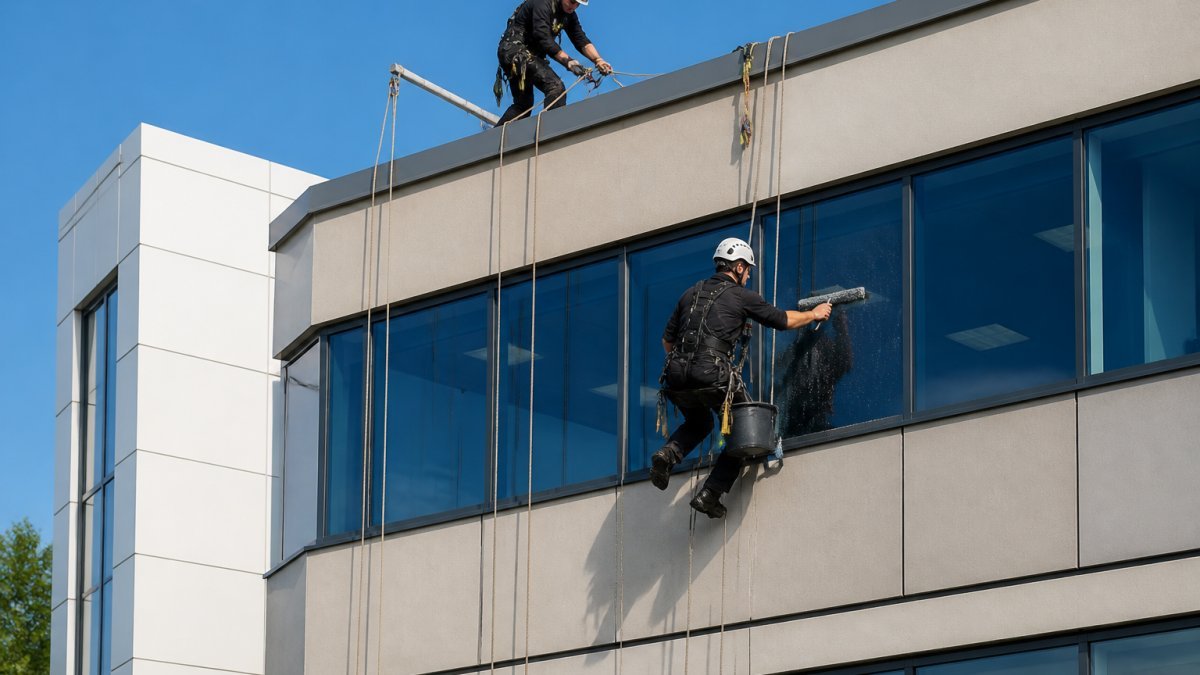
    Powered access operator cleaning a commercial building façade from a MEWP

    • Water-fed poles use purified water and are often suitable for low- to mid-level windows that can be reached from the ground. Where appropriate, this can avoid the need to work at height. See our guide to water-fed pole window cleaning.
    • MEWPs and cherry pickers provide a raised work platform where the machine can be positioned safely and has suitable reach. Ground conditions, obstacles, space and the need to manage people below all matter.
    • Building maintenance units (BMUs) can be used on buildings with suitable installed roof rigs or cradles. The equipment and access arrangements need to be appropriate for the specific work.
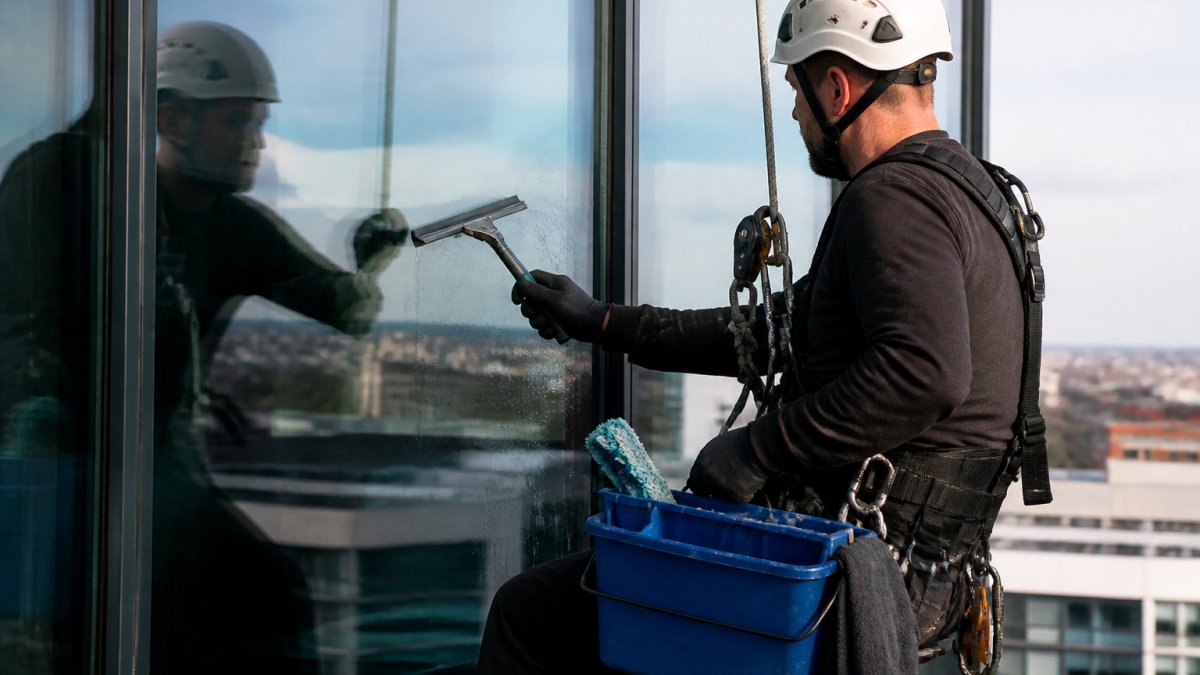
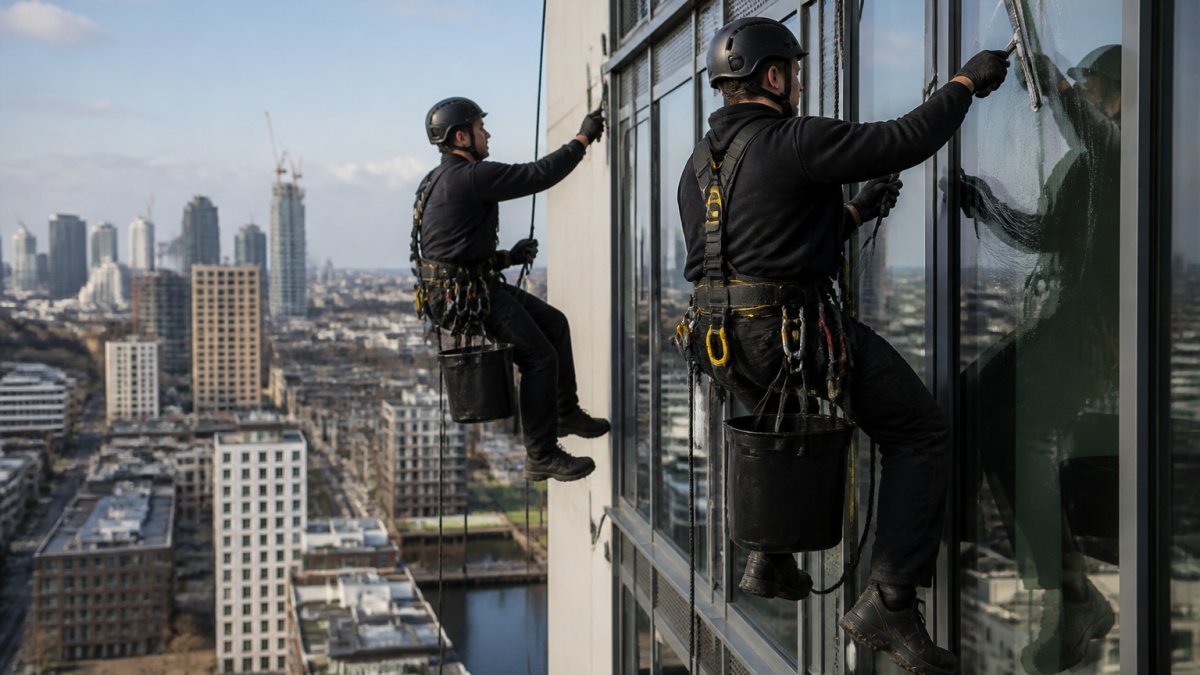
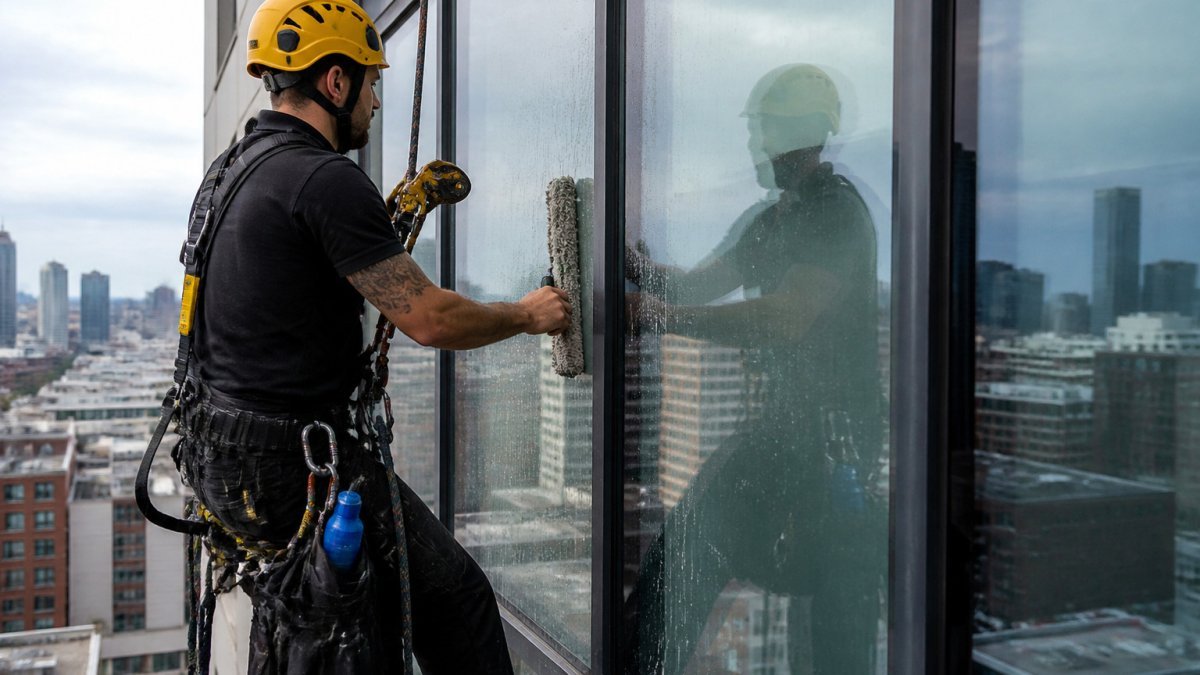
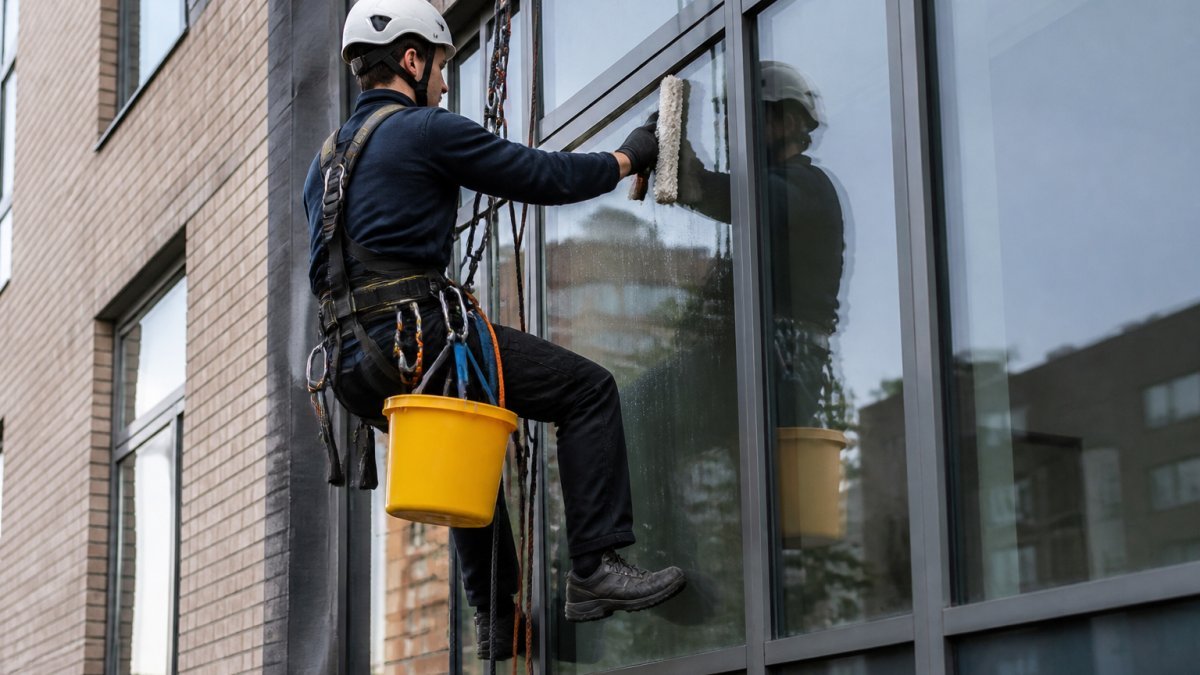
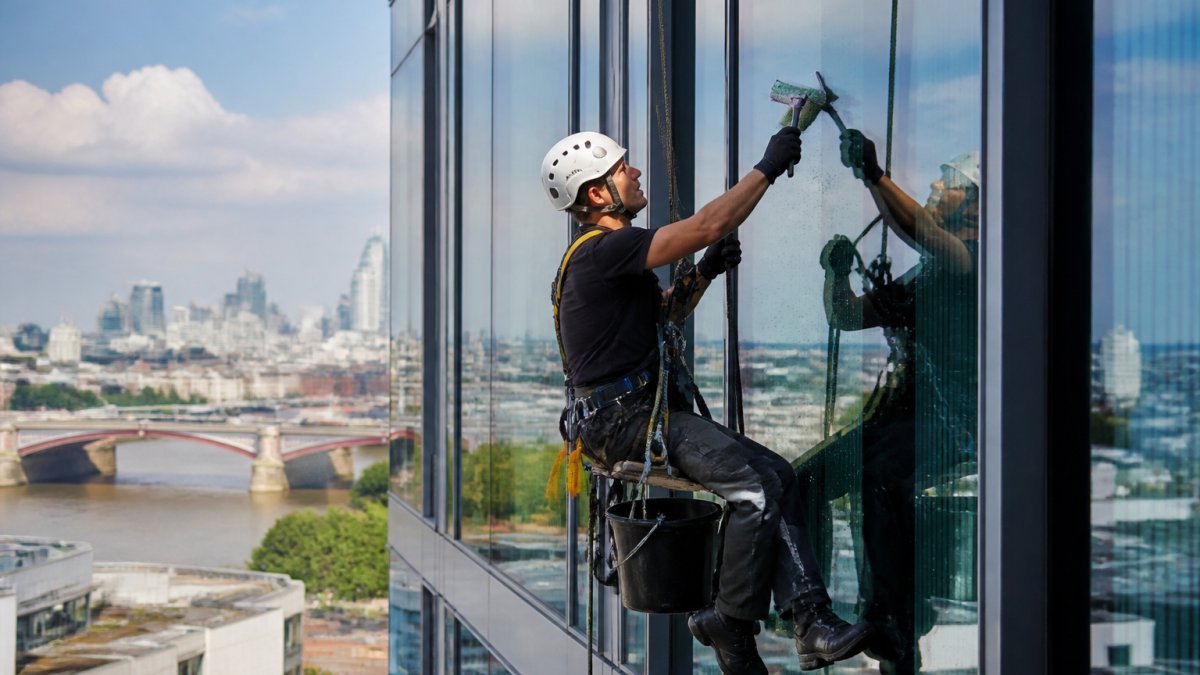
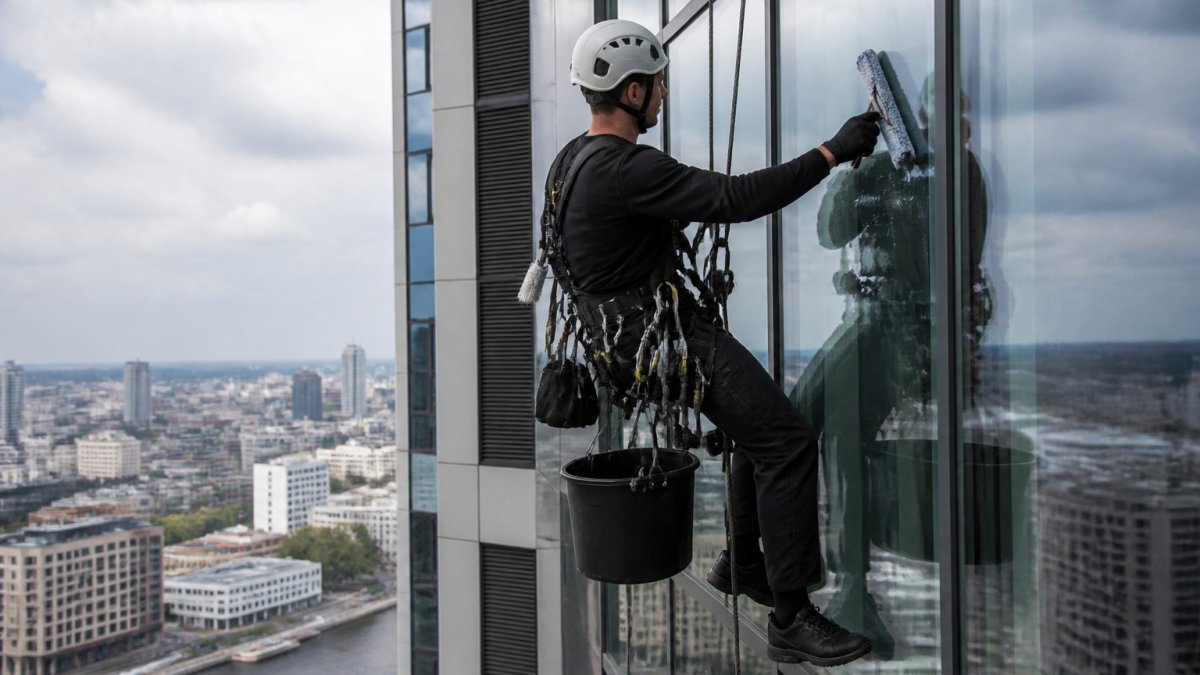
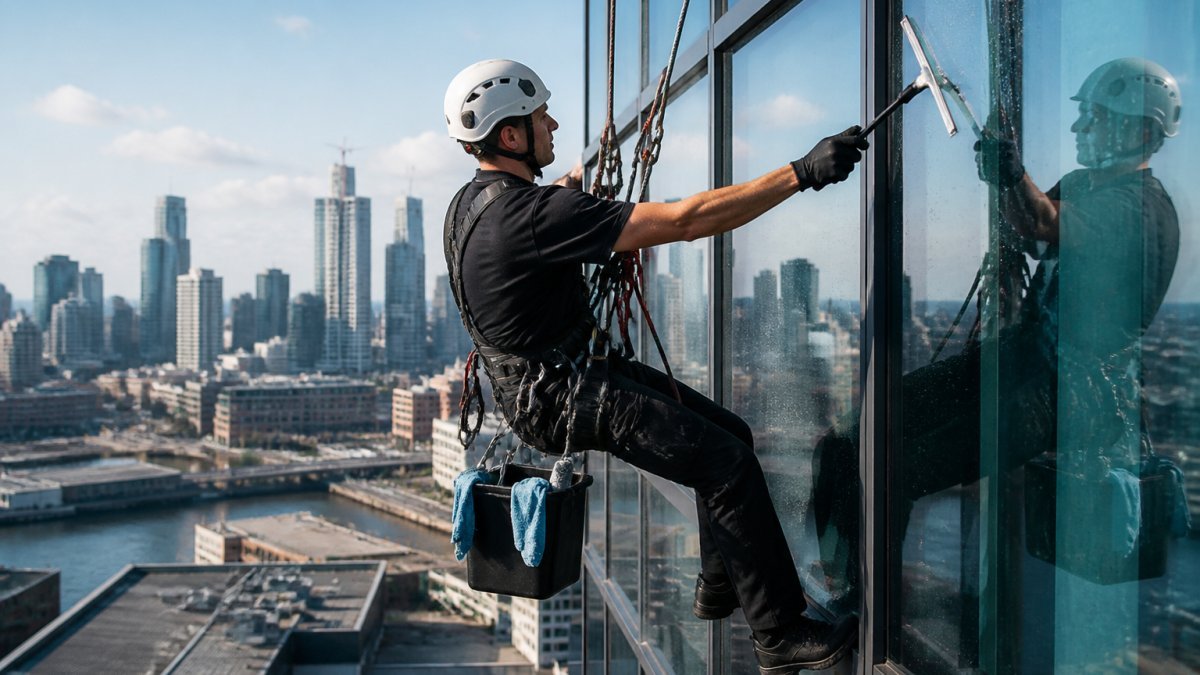
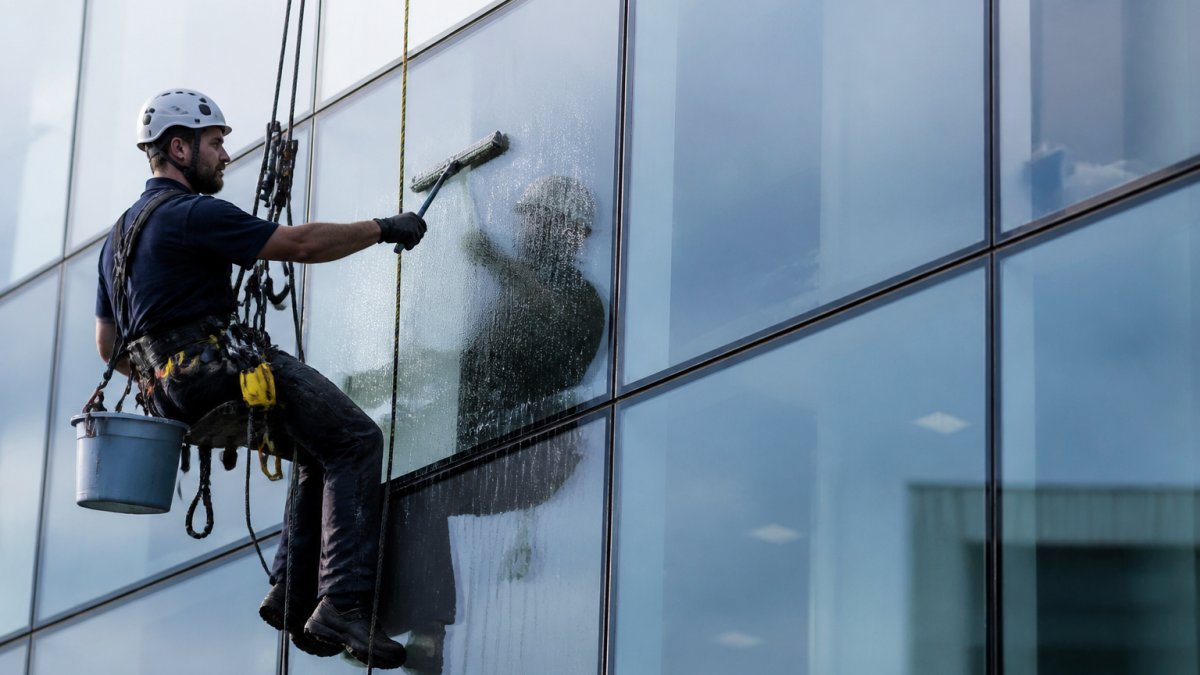
    • Rope access can be considered for tall or complex façades where other access is impractical. It requires suitable access and anchorage arrangements, competent technicians and a planned rescue procedure.

    Some buildings benefit from a combination of methods. For example, water-fed poles may suit lower sections, while a MEWP or rope access is needed for areas that cannot be reached from the ground.

    We assess access case by case. Our guide to rope access versus cherry picker cleaning explains some of the practical considerations.

    Safety planning should be clear before work starts

    The contractor should be able to explain how the work will be managed, who will carry it out and how risks to workers and other people will be controlled. This is particularly important where work takes place above entrances, pavements, parking areas or occupied spaces.

    The Health and Safety Executive says work at height should be avoided where reasonably practicable. If it cannot be avoided, the work should be properly planned and carried out by competent people using suitable equipment. Its window-cleaning guidance also highlights the need to consider site conditions, weather, access, people below and emergency arrangements.

    Before work begins, ask what arrangements apply to your building. These may include a risk assessment and method statement, barriers or signage, controls for tools and equipment, and a plan for responding to changing weather. For suspended access or other specialist work, emergency and rescue arrangements should be planned in advance.

    Building managers also have useful information to share. Tell the contractor about site restrictions, known hazards, opening hours, delivery schedules and any required resident or tenant notices. Coordinating these details helps the team plan the work around the people who use the building.

    Check training, equipment and accountability

    The team’s competence should match the access method and the work being undertaken. Lion Cleaning Group uses IRATA-trained rope access technicians and IPAF-licensed operators for powered access work. We are accredited by SafeContractor, CHAS and Constructionline.

    You should also expect a contractor to explain what equipment will be used and how the site will be managed while cleaning is under way. Ask for relevant insurance information and confirmation that the proposed method, equipment and team are suitable for the job. Accreditations and training are useful checks, but they do not replace a site-specific plan.

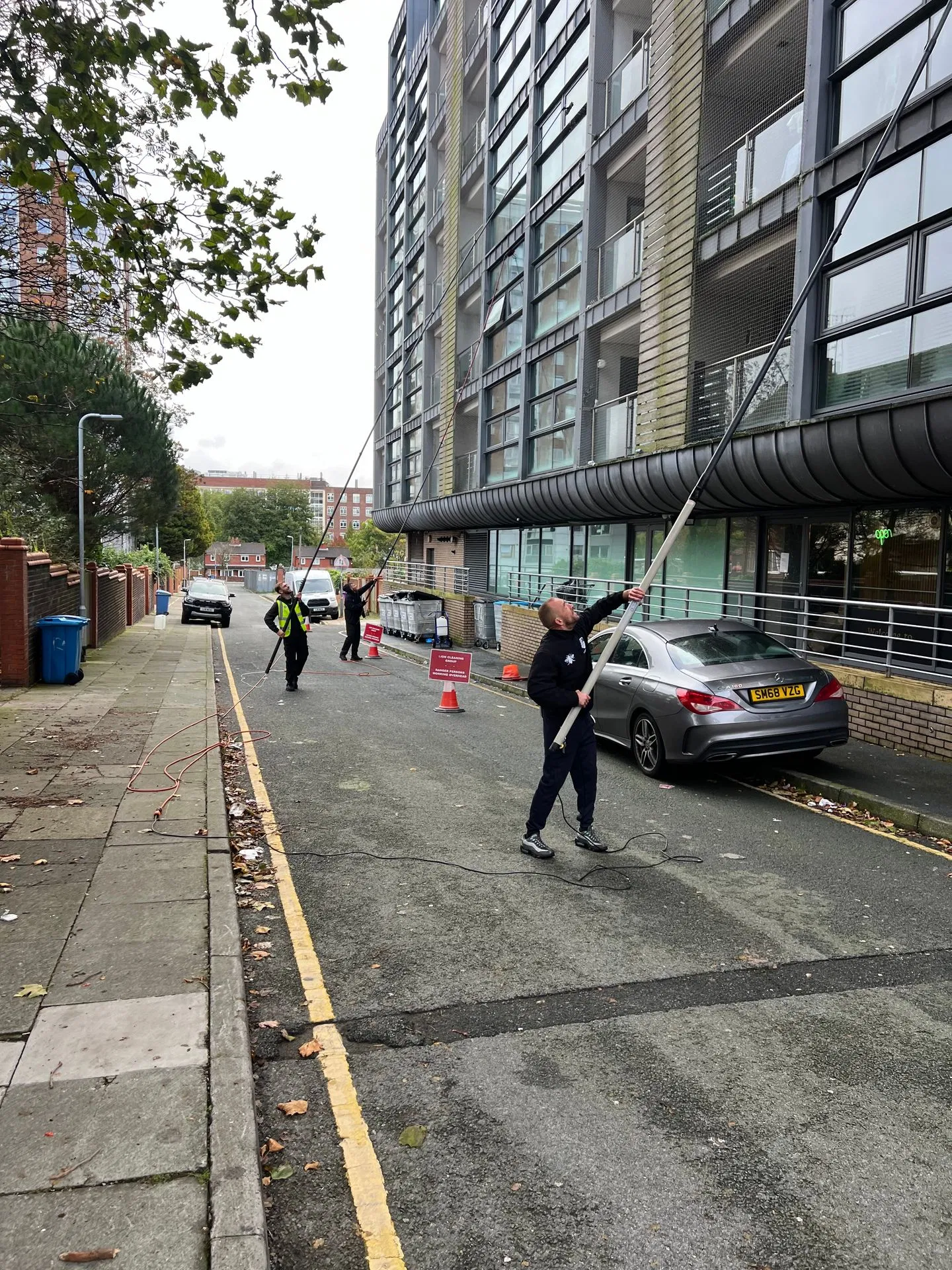
    Technicians using water-fed poles to clean windows on an apartment block

    Agree the cleaning scope and schedule

    Cleaning frequency depends on exposure, building use and the standard you want to maintain. A busy shopfront may need attention weekly or fortnightly, while a commercial office might be scheduled every four to eight weeks. A lower-exposure building may be suitable for a less frequent cycle. Apartment blocks often begin with a six- to twelve-week interval, then adjust based on resident feedback and how quickly the glass becomes dirty.

    These are planning guides, not fixed rules. In Manchester and other urban locations, traffic, construction dust and local surroundings can affect how quickly windows need cleaning. Entrance glazing may need more frequent attention than upper floors. A site review can help set a schedule that fits your building rather than applying the same interval everywhere.

    Confirm whether the agreement covers one-off work or a regular maintenance programme, which areas are included, and how visits will be recorded. For occupied buildings, agree how and when residents, staff or tenants will be notified. Our guide to apartment block window cleaning in Manchester covers some of these coordination needs.

    How commercial window cleaning is priced

    There is no reliable single rate for commercial window cleaning. A quote may depend on the size and number of windows, building height, access method, condition of the glass, cleaning frequency and site logistics. MEWP hire, restricted access, traffic arrangements or out-of-hours work can also affect the cost.

    When comparing quotes, check that they cover the same areas and level of service. Confirm what is included, how often the work will take place, and whether there are additional charges for access or site arrangements. A survey-based quote should make the proposed scope and method easier to understand.

    What happens after the clean?

    A clear service should include a way to check that the agreed work has been completed. We finish with a quality inspection and provide a written report. This gives the building manager a record of the visit and a straightforward route for raising any concerns.

    Our process has three steps:

    1. Site survey and access plan: We assess the building, recommend a suitable approach and provide a quote.
    2. Scheduled clean: We carry out the agreed work, coordinating with you and working around site hours where possible.
    3. Inspection and report: We check the completed work and provide a written record.

    Frequently asked questions

    How often should commercial windows be cleaned?

    It depends on the building’s exposure, use and appearance requirements. Shopfronts may need weekly or fortnightly cleaning; offices may suit a four- to eight-week cycle; and lower-exposure buildings may need less frequent visits. Review the schedule after a few cleans and adjust it to suit the results.

    What does commercial window cleaning cost?

    The price depends on the building, the areas included, the access method and how often cleaning is required. High-level work or restricted sites usually need a survey before a meaningful quote can be provided. Ask for a breakdown of scope, access and any additional site costs.

    What is the difference between commercial and domestic window cleaning?

    Commercial window cleaning is planned around business premises, larger or more complex façades, access equipment and the people using the site. It may involve managing public areas, coordinating with tenants and working at height. The methods and planning depend on the building rather than simply the number of panes.

    Can you clean windows outside normal working hours?

    We can discuss scheduling around your business or building operations. Suitable times depend on the site, the access method, any noise or safety restrictions and the availability of the team.

    Which access method is right for my building?

    That depends on the façade, height, available roof and ground access, and the areas to be cleaned. We survey the site and explain the options before recommending an approach.

    Arrange a commercial window cleaning survey

    Lion Cleaning Group provides commercial window cleaning across Greater Manchester and the North West, with nationwide coverage for larger projects. We work with block managers, facilities teams, property managers and building owners on one-off cleans and scheduled maintenance.

    Tell us the building location, approximate height and what needs cleaning. We’ll arrange a site survey and discuss a practical plan. Visit Lion Cleaning Group or contact our team to get started.
  • Rope Access vs. Cherry Picker Window Cleaning: Which Is Better for Your High-Rise Building?

    Rope Access vs. Cherry Picker Window Cleaning: Which Is Better for Your High-Rise Building?

    Choosing between rope access and a cherry picker is not simply a question of how tall your building is. The best option depends on the façade, available roof and ground access, the size of the cleaning area and how the work can be carried out safely.

    For block managers, facilities managers and building operators, the decision affects more than access. It can influence cost, scheduling, disruption to residents or visitors, and how reliably the work can be repeated.

    We assess each building individually. Here’s how the two methods compare, and what we consider before recommending one.

    What is the difference?

    Rope access window cleaning uses technicians working from ropes secured at roof level or another suitable anchorage. Our rope access work is carried out by IRATA-certified technicians, with the access and safety arrangements planned for the specific building.

    Cherry picker window cleaning uses a mobile elevating work platform, or MEWP. The machine lifts an operator in a work platform so they can reach the façade. Our powered access work is carried out by IPAF-licensed operators using equipment selected for the job.

    Both methods can suit commercial and residential buildings. Neither is automatically the safer, faster or cheaper choice. The right method depends on the site.

    A powered access operator cleaning the glass façade of a commercial building

    When rope access is often the better fit

    Rope access can be practical when a building’s layout makes it difficult to position a machine close to the façade. This may include tall or irregular elevations, recessed windows, awkward rooflines or areas where the ground below is restricted.

    It can also be useful where the building has little space for a cherry picker, or where setting one up would interfere with entrances, parking, public routes or other site activity. Rope access has a smaller ground footprint than a MEWP, although a suitable work area and controls for people below are still needed.

    Before recommending rope access, we consider whether the building has suitable roof access and anchorage arrangements, whether the façade can be reached as planned, and what rescue arrangements the job requires. A site-specific plan matters: not every roof or anchor point is suitable.

    Rope access may suit your building if:

    • The façade is complex, stepped or difficult to reach from the ground.
    • There is limited space for a machine or its working area.
    • A MEWP would need frequent repositioning to reach separate sections.
    • Suitable roof access and anchorage can be established for the work.

    For more detail on the method, see our guide to IRATA rope access cleaning.

    When a cherry picker or MEWP can be the better fit

    A MEWP can be efficient when the target windows are at a suitable height and the machine can be positioned close enough to the façade. It provides a stable platform for the operator and can work well when a large, repetitive area can be cleaned from one or a small number of positions.

    Ground conditions are a key part of the decision. The machine needs a suitable place to stand and enough room to manoeuvre and operate. The site also needs to accommodate the machine’s reach, its setup and any barriers or exclusion zone required below.

    A building’s surroundings can change what is practical. A machine may be limited by restricted access, parked vehicles, landscaping, overhead obstructions, uneven ground or the need to keep a route open. Where a cherry picker must be moved repeatedly, set-up and repositioning time can affect the programme.

    A MEWP may suit your building if:

    • The façade is reachable from an appropriate machine position.
    • There is suitable ground and enough room to set up.
    • Cleaning can be completed efficiently from a small number of positions.
    • The working platform is useful for the specific task and façade.

    You can read more about our powered access and cherry picker cleaning services.

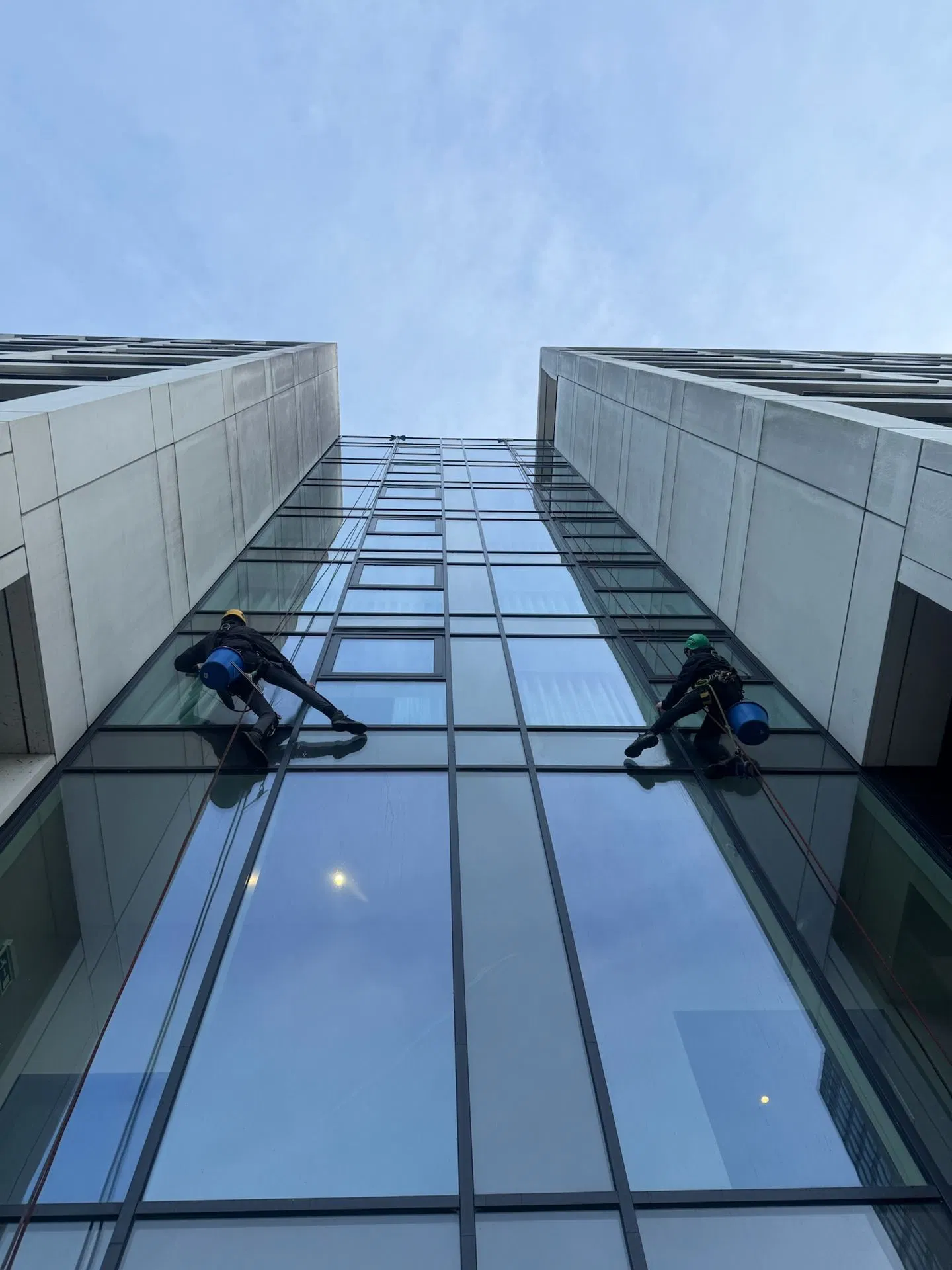
    Two rope access technicians working on a high-rise glass façade

    How the methods compare

    Consideration Rope access Cherry picker or MEWP
    Façade layout Often suits complex, irregular or recessed elevations. Often suits reachable elevations with a clear machine position.
    Ground space Usually needs less space at ground level, but still needs controls around the work area. Needs space for access, setup and operation, including any required barriers.
    Access requirements Requires suitable roof access, anchorage and a planned rescue arrangement. Requires a suitable route, machine position and equipment matched to the required reach.
    Repeated access Technicians can move along a façade using the planned rope system. Can be productive when a platform can reach a large area without frequent moves.
    Site disruption May reduce the need for large machinery at ground level. May affect parking, walkways or traffic, depending on the site.

    The HSE’s guidance on window cleaning explains why work at height must be planned and carried out by competent people using suitable methods and equipment. In practice, our recommendation also considers the building’s layout, surroundings and cleaning requirements.

    Which method costs less?

    There is no reliable rule that rope access or a cherry picker is always cheaper. The total cost depends on what the building requires, not just the name of the access method.

    For a MEWP, cost considerations may include the machine needed to reach the façade, delivery and collection, the time it can remain in position, and any access or traffic arrangements. For rope access, the job depends on the specialist team, the rigging and safety arrangements, roof access and the number of working positions needed.

    The amount of glass, its condition, the number of elevations and the planned cleaning frequency can also affect the price. A MEWP may be efficient where a large area is accessible from a suitable position. Rope access may make more sense where machinery cannot reach conveniently or would require extensive repositioning.

    When comparing quotes, check that they cover the same elevations, cleaning scope, access method and site arrangements. Our guide to commercial window cleaning prices explains why access is an important part of a site-specific quote.

    Can a building use both methods?

    Yes. A mixed approach can be practical when different parts of a building have different access needs. For example, a MEWP might suit a reachable lower elevation, while rope access is more appropriate for a taller or recessed section.

    We may also consider other methods where suitable. Some windows can be cleaned with water-fed poles from the ground, while buildings with installed access equipment may be suited to a building maintenance unit. The choice depends on whether the method can reach and clean the required areas safely and effectively.

    A powered access platform positioned beside a high-rise commercial building

    How we recommend an access method

    We start with a free site survey. We review the building height and layout, the windows to be cleaned, available roof and ground access, and any nearby pedestrian or vehicle activity.

    From there, we prepare an access plan and quote based on the site. We agree the method and schedule with you before work begins, and we can discuss how to reduce disruption to residents, staff, customers or visitors.

    After the clean, we complete a quality inspection and provide a written report. Our process is designed to make the scope, access method and next steps clear before the work starts.

    Frequently asked questions

    Is rope access safer than a cherry picker?

    Neither method is automatically safer in every situation. The appropriate choice depends on the building, access conditions, task and planned controls. We assess the site and use trained, suitably qualified people with equipment and arrangements suited to the work.

    Is a cherry picker suitable for high-rise window cleaning?

    It can be, if the machine can reach the required windows and there is a suitable route and place to set it up. The building’s height is only one consideration; ground conditions, obstacles, available space and working reach also matter.

    Is rope access window cleaning cheaper?

    Not necessarily. Rope access may avoid some machine access and positioning requirements, while a MEWP may be efficient for a large area that is easy to reach. The overall cost depends on the building, work scope and site logistics. A survey is the best way to compare options fairly.

    Can rope access clean a building with an irregular façade?

    It can be suitable for some complex elevations, provided the façade can be accessed and the necessary roof, anchorage and safety arrangements are in place. We assess the building before confirming whether rope access is appropriate.

    How do I choose between rope access and a cherry picker?

    Share the building location, approximate height, which elevations need cleaning and any known access restrictions. We’ll survey the site, assess the available options and explain the recommended approach.

    Arrange a free site survey

    If you manage a high-rise block, office, hotel or other commercial building, tell us where it is and what needs cleaning. We’ll assess the access and provide a clear plan and quote. Lion Cleaning Group works across Greater Manchester and the North West, with nationwide coverage for larger projects.

    Request a quote from Lion Cleaning Group or call 0161 885 3189.

  • Water-Fed Pole Window Cleaning: How It Works and When It’s Right for Your Building

    Water-Fed Pole Window Cleaning: How It Works and When It’s Right for Your Building

    Water-fed pole window cleaning lets trained operatives clean many commercial windows from ground level, using a telescopic pole, brush and purified water. Where the glass is visible and reachable, it can be a practical way to maintain a façade without putting a worker on a ladder, platform or rope.

    It is not the right method for every window. Building layout, obstructions, ground conditions and the task itself all matter. Here’s how the system works, where it tends to suit, and when another access method may be more appropriate.

    How does water-fed pole window cleaning work?

    A water-fed pole has a brush at its tip and a hose that carries treated water from a tank or water-treatment unit. The operative brushes the glass and frames, then rinses them with purified water.

    The water is usually treated using reverse osmosis (RO), de-ionisation (DI), or both. RO removes most dissolved minerals; DI removes remaining charged particles. A meter can be used to check the water’s total dissolved solids (TDS). If the mineral content is too high, the rinse may leave marks as the water dries.

    Because properly treated water contains very little mineral residue, it can usually dry naturally without the spots associated with untreated tap water. The brush does the physical cleaning; the pure-water rinse carries loosened dirt away. Detergent and squeegee drying are not usually needed for routine maintenance cleans.

    Water quality is only part of the result. The brush needs to reach the glass at a workable angle, and the operative must be able to see the areas being cleaned. Heavy deposits, paint, building residue or other unusual contamination may need a different treatment.

    When is it suitable for commercial window cleaning?

    Water-fed pole cleaning is often suitable for low- to mid-rise façades where the windows can be reached safely from a clear, stable area at ground level. It can work well for office buildings, apartment blocks, showrooms and other premises with broad, relatively unobstructed elevations.

    Our water-fed pole cleaning service is listed with ground-level reach up to 20 metres. That is a guide to the service, not a promise that every window at that height can be reached on every site. Pole length, wind, ground layout and the shape of the façade can all affect what is practical.

    The Health and Safety Executive (HSE) identifies telescopic water-fed poles as one example of a way to avoid work at height where reasonably practicable. But pole work still needs planning. Hoses can create trip hazards, wet paths can become slippery, and overhead power lines need careful consideration. Long poles can also be tiring to control, particularly in wind.

    Before recommending this method, we consider factors such as:

    • Whether every target window is visible from the ground.
    • Canopies, balconies, deep recesses, trees or other obstructions.
    • The surface and space available for the operative and equipment.
    • Pedestrian and vehicle movements, and where hoses will run.
    • Overhead electrical hazards and expected weather conditions.
    • The type of dirt on the glass and frames.

    An operative using a mobile elevated work platform to clean a large glazed commercial building

    When is a water-fed pole not the right choice?

    A pole may not reach windows hidden behind balconies, overhangs or deep architectural features. It may also be unsuitable where the operator cannot see the glass clearly from ground level, or where a pole would have to be extended across a busy route or near an electrical hazard.

    The condition of the façade matters too. Loose or damaged building materials could be disturbed by brushing. Some glass or exterior surfaces may need a closer inspection or a different cleaning method. If the issue is more than routine dirt, we assess the surface and agree an appropriate approach before work starts.

    A practical point for block managers is that pole cleaning does not remove the need to coordinate with residents or building users. We agree the working area and timing, manage hose routes and use suitable signs or barriers where needed. This helps reduce avoidable disruption and makes the job easier to manage around entrances, paths and parking.

    Water-fed poles compared with rope access, MEWPs and BMUs

    No single method suits every building. For commercial window cleaning, the access decision depends on the layout, height, task and site conditions, not height alone.

    Method Often suitable when Points to consider
    Water-fed pole Windows are visible and reachable from ground level, with a clear working area. Obstructions, long-pole control, hoses, pedestrians and overhead hazards.
    Rope access The façade is high or complex and suitable roof access and anchor arrangements are available. Requires specialist planning, competent technicians and a rescue plan.
    MEWP or cherry picker A stable machine position is available and close access to the façade is useful. Ground bearing, space, reach, traffic management and operator competence.
    BMU or cradle A building has suitable installed façade-access equipment. Equipment condition, availability and safe operating arrangements.

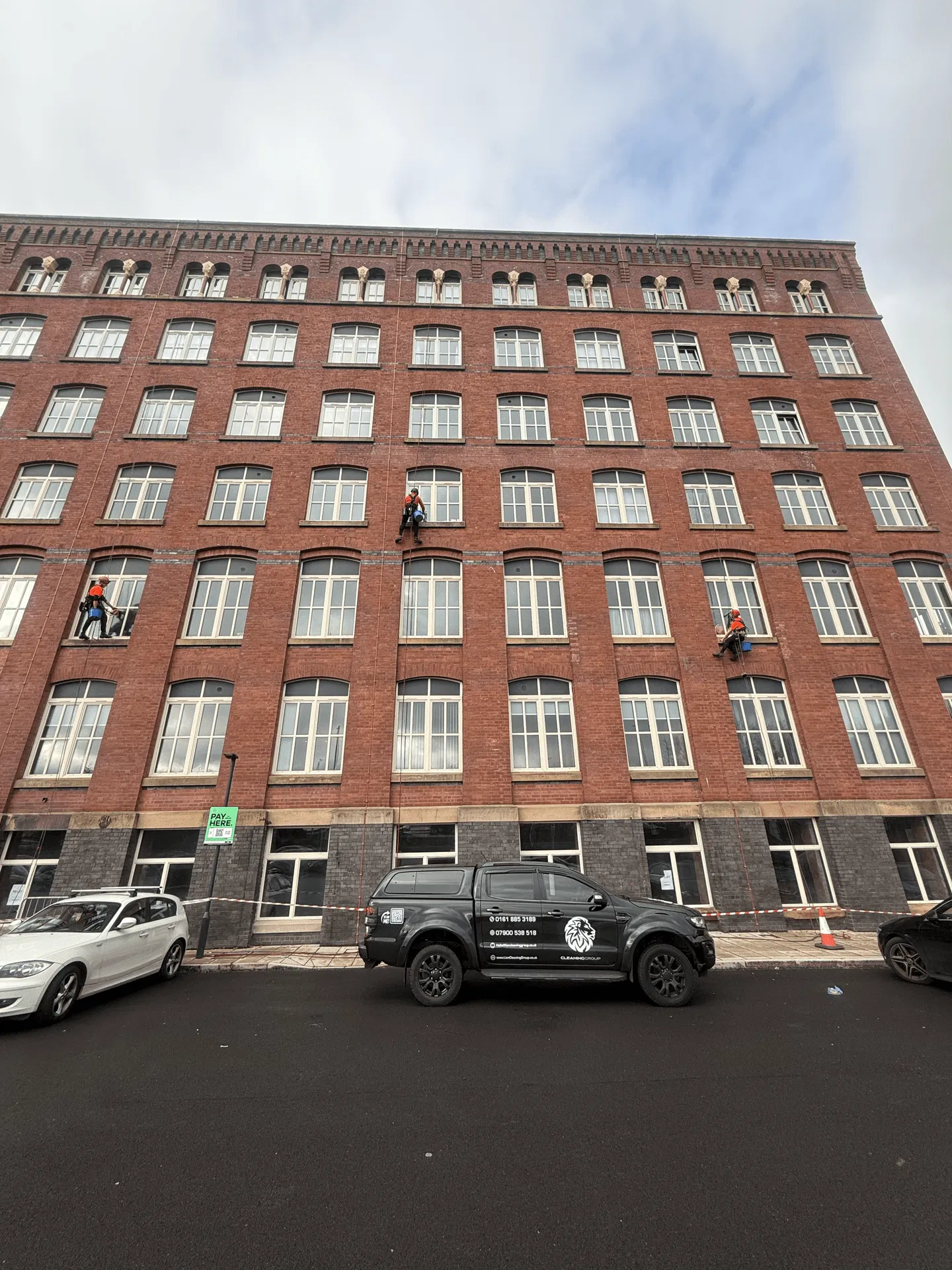
    Rope access technicians working on the façade of a multi-storey building

    Where a pole cannot reach or clean the glass effectively, we may assess rope access, powered access or a building maintenance unit. Our rope access teams include IRATA-certified technicians, and our powered-access work is carried out by IPAF-licensed operators. We also plan the job around the building, including safe access and suitable controls for people below.

    Sometimes a combination is the practical answer: water-fed poles for the accessible elevations, with specialist access reserved for recessed or higher sections. Our rope access cleaning guide explains more about how that option works.

    A building maintenance unit cradle positioned on a high-rise glass façade

    How we plan a water-fed pole clean

    We follow a straightforward process so you know what has been assessed and what to expect.

    1. Site survey and access plan. We review the building height, layout, surfaces and surroundings. We check whether the windows are visible and reachable from the ground, and consider pedestrian routes, vehicles and other site-specific risks.
    2. Quote and schedule. We explain the recommended method and agree a suitable time. We can discuss working around residents, staff, customers or other building activity.
    3. Cleaning and completion check. Our team carries out the agreed work and checks the result. We provide a written report on completion.

    For scheduled commercial window cleaning, the survey also helps establish which areas can be cleaned by pole and which may need a different approach. The right schedule will depend on the building, its location and how quickly the glass becomes soiled.

    Frequently asked questions

    How high can water-fed poles reach?

    The practical reach depends on the pole and the site. Lion Cleaning Group lists water-fed pole reach up to 20 metres from ground level. HSE and Federation of Window Cleaners guidance discusses systems reaching up to around 24 metres, but that should not be treated as a guaranteed working height. The actual safe reach may be lower due to obstructions, wind, ground conditions or the angle needed to reach the glass.

    Do windows need to be squeegeed after a pure-water clean?

    Usually, no. When the water is properly purified and the glass has been thoroughly rinsed, it can dry naturally with little mineral residue. The finish still depends on water quality, the condition of the glass and the cleaning method.

    Is water-fed pole cleaning safe?

    It can help avoid working at height when windows can be reached from the ground, but it is not risk-free. The HSE and Federation of Window Cleaners guidance highlights issues including overhead power sources, trailing hoses, wet surfaces and weather. A site-specific assessment helps identify suitable precautions before work begins.

    Can water-fed poles clean every window on a building?

    No. Balconies, canopies, deep recesses and other features can block access. Where windows are not visible or reachable from the ground, we assess other options such as a MEWP, rope access or a building maintenance unit.

    Is water-fed pole cleaning right for my building?

    It may be a good fit if the target windows are visible from a clear ground-level working area and the cleaning is routine. A survey is the best way to check. The HSE’s guidance on window cleaning at height explains the need to plan work properly and use competent people and suitable equipment. You can also read the water-fed pole safety guide.

    Arrange a site survey

    If you manage a commercial building, apartment block, showroom or office in Greater Manchester or the wider North West, tell us the location, approximate height and which windows need cleaning. We’ll arrange a free site survey, assess whether water-fed pole cleaning is suitable and provide a clear quote. For larger projects, we also consider work elsewhere in the UK.

    Request a quote from Lion Cleaning Group or call 0161 885 3189.

  • What Belongs on a High-Rise Window Maintenance Checklist?

    What Belongs on a High-Rise Window Maintenance Checklist?

    Last Updated: 30 October 2026

    Quick Summary

    A high-rise window maintenance checklist should cover pre-start safety checks, anchor points and fall protection, ground control and public protection, the cleaning schedule, a post-work inspection, and a written record of every visit. Build it section by section so you can hand it to a contractor or use it to review theirs.

    • Confirm the access method for each elevation: rope access, powered access or water-fed pole.
    • Anchor point locations and their last inspection dates belong on the checklist.
    • Size the exclusion zone to the work above and post barriers at every entry point.
    • Record defects with photos and get sign-off from the contractor and your site contact.
    • Ask any contractor about IRATA certification before they work on your building.

    Table of Contents

    Why a High-Rise Window Maintenance Checklist Matters

    A high-rise window maintenance checklist is a written record of what gets checked, cleaned and signed off on a tall building's glass, frames and access systems. It turns a vague instruction to "get the windows done" into a repeatable job that a property manager can schedule, inspect and audit.

    At Lion Cleaning Group, we work at height on apartment blocks, offices and managed portfolios across the UK. The checklist is where that work starts.

    Why does it matter so much? Because high-rise window maintenance sits at the meeting point of three risks: people working at height, the public below, and the building's long-term condition. A missing line on a checklist is how a seal gets missed for two years, or how a contractor turns up with the wrong access method for your façade.

    Below, we break down exactly what belongs on the checklist, section by section, so you can hand it to a contractor or use it to review the one they bring.

    High-Rise Window Cleaning Safety Checks Before Any Work Starts

    Safety checks come first, before a single squeegee touches glass. A high-rise window cleaning safety check confirms the building is ready for the work, the access method suits the facade, and the crew has a clear plan for the day.

    The Health and Safety Executive guidance on working at height is clear that working at height should be planned, supervised and carried out by competent people. That principle should show up on the checklist as a set of pre-start items:

    • Confirm the access method for each elevation: rope access, powered access or water-fed pole
    • Check weather conditions and wind speed against the limits for the method in use
    • Verify the crew's training and certification for the access method
    • Confirm the building's own rules on access, keys and site induction
    • Walk the route from the access point to the work area

    Anchor Points, Access Equipment and Fall Protection

    Anchor points, harnesses, ropes and fall protection are the equipment that keeps a technician safe at height. Each item needs checking before use and recording afterwards.

    Property managers often ask who signs off anchor points. Before signing off anchor points and fall protection, read this guide to risk assessment for working at height cleaning. The honest answer is that it is a shared responsibility: the building owner or manager should know where the anchors are and their inspection history, and the contractor should verify them before attaching.

    Your checklist should capture:

    • Anchor point locations, and when each was last inspected
    • Harness, helmet and connector condition
    • Rope condition, age and retirement dates
    • Powered access equipment inspection records, where used
    • A named person responsible for the final sign-off

    Ground Control and Public Protection

    Ground control is the part of the job the public actually sees, and it is where most complaints start. Cones, barriers and exclusion zones keep pedestrians, residents and vehicles clear of the work area below.

    Build these into the checklist:

    • Exclusion zone marked and sized to the work above
    • Barriers and signage in place at every entry point
    • A banksman or ground person on duty while work is live
    • Residents and building users told in advance
    • Vehicles and deliveries rerouted away from the drop zone

    Watch out: a barrier that covers the pavement but not the building entrance is a common gap. Anyone stepping out mid-job is directly under the work.

    Building a Property Manager Window Cleaning Schedule

    A property manager window cleaning schedule sets out how often each building's windows are cleaned, by which method, and on what notice. The right frequency depends on the building, not a one-size template. For guidance on how often commercial buildings should have window cleaning, see our article.

    As a starting point, the checklist should record:

    • Cleaning frequency for each elevation and each glass type
    • Access method planned for each visit
    • Seasonal adjustments, such as more frequent cleans on busy road frontages
    • Access windows that suit the building, not just the contractor
    • Notice period for residents and tenants

    Flexibility is where many schedules fall down. If your building has events, deliveries or a busy entrance, the schedule should allow the crew to work around them rather than forcing a fixed slot.

    Get a Quote →

    Schedule item What to record Why it matters
    Frequency Visits per year, per elevation Sets realistic expectations
    Access method Rope, powered access or pole Matches method to facade
    Access windows Days and times that suit the building Avoids clashes with events
    Notice Days of advance warning to residents Reduces complaints
    Seasonal notes Extra cleans for road grime or pollen Keeps glass readable year-round

    The Window Cleaning Inspection Checklist for Property Managers

    A window cleaning inspection checklist is what you use to check the finished work, not the process. It answers one question: is this building actually clean, and is anything damaged or deteriorating?

    Walk the building with the contractor, or review their report, and check:

    • Glass is free of streaks, smears and dried water spots
    • Frames, seals and gaskets are intact and free of mould or cracking
    • Cladding and facade panels are clean and undamaged
    • Sills, ledges and recesses are clear of debris
    • Any cracked panes, failed seals or loose fixings are flagged, not ignored

    The inspection is also your early-warning system. A seal that is starting to fail shows up as water marks or condensation between panes. Catching that on an inspection saves a much bigger repair later.

    When to Bring In Rope Access Window Cleaning

    Rope access window cleaning uses technicians suspended on ropes to reach glass that ladders, poles or platforms cannot safely reach. It suits tall, complex or awkward facades where setting up powered access is impractical or costly. Read rope access window cleaning: what property managers need to understand what it involves.

    Two technicians performing high-rise window maintenance on a modern apartment block facade.
    Two technicians performing high-rise window maintenance on a modern apartment block facade.

    Bring in rope access when:

    • The building is too tall or too irregular for water-fed poles
    • Powered access would block entrances, roads or loading bays
    • The facade has recesses, balconies or set-backs that platforms cannot reach
    • You need a fast, targeted clean on one elevation

    Lion Cleaning Group's team is IRATA-trained, which is the certification to ask any contractor about before they work on your building.

    What to Record After Every High-Rise Window Maintenance Visit

    A visit is not finished when the crew packs up. The record you keep afterwards is what protects you at the next budget review, the next audit, or the next contractor handover.

    Record these after every visit:

    • Date, time and duration of the work
    • Elevations and areas cleaned
    • Access method used and equipment checked
    • Any defects spotted, with photos
    • Sign-off by the contractor and by your site contact

    Keep the records together, building by building. When a manager asks why a facade needs attention, or a new contractor takes over, that file answers the question in minutes rather than a day of phone calls.

    Book a High-Rise Window Maintenance Visit

    If your building's windows have been put off for months, the checklist above is the place to start. It gives you a clear brief to hand to any contractor, and a way to check the work when it is done.

    At Lion Cleaning Group, we handle high-rise window maintenance for apartment blocks, offices and managed portfolios across the UK. Our team is IRATA-trained, and we work at height as specialists.

    Get started with Lion Cleaning Group and put your high-rise window maintenance on a schedule you can actually rely on.

    Frequently Asked Questions

    What should a high-rise window maintenance checklist include?

    A working checklist covers four things: pre-work safety checks (anchor points, harnesses, ground control), the property manager window cleaning schedule, a window cleaning inspection checklist for the glass and frames, and a record of what was done after each visit. Add the access method used, who attended site, and any defects spotted so you have a clear paper trail for the next booking.

    How often should high-rise windows be cleaned?

    Most apartment blocks and office buildings sit well on a four- to eight-week cycle, but it depends on the site. Buildings near busy roads, construction or trees collect dirt faster and may need monthly visits. Quieter sites can stretch to quarterly. Walk the elevations with your provider after the first clean and set the interval from what you actually see rather than a fixed guess.

    What safety checks are needed for high-rise window cleaning?

    High-rise window cleaning safety checks should confirm anchor points are tested and certified, harnesses and ropes are in date, and the team holds current IRATA certification. Ground control matters too: barriers, signage and a clear drop zone keep residents and pedestrians out of the work area. Ask for these checks in writing before the first visit so you know the standard is being met every time.

    When should a property manager arrange specialist rope access window cleaning?

    Rope access window cleaning suits buildings where cradles, MEWPs or ladders cannot reach safely, or where setting up access equipment would cost more than the clean itself. It is also the practical choice for angled façades, atriums and cladding that needs close inspection. If your block has awkward elevations or limited ground space, ask a rope access team to survey before you commit to a schedule.

  • How Often Should Commercial Windows in Trafford Be Cleaned?

    How Often Should Commercial Windows in Trafford Be Cleaned?

    Last Updated: October 28, 2026

    Quick Summary

    Commercial window cleaning in Trafford has no single schedule that suits every building, because frequency depends on exposure, use and access. Busy-road frontages and entrances often need monthly cleaning, while many office blocks settle on every six to eight weeks and upper-floor glazing in quieter spots can often go quarterly.

    • Glass next to a main road collects traffic film and exhaust residue faster than glass in a quieter location.
    • Ground-floor retail frontages are judged by customers at street level, so they usually need attention more often.
    • Many buildings split the work, cleaning lower levels monthly and upper glazing quarterly or six-monthly.
    • Rope access suits tall or hard-to-reach glazing and can make high-level cleaning part of a planned routine.
    • A useful quote request includes the building address, storey count, window count and how often you want the work repeated.

    Table of Contents

    Commercial window cleaning in Trafford is not a fixed schedule that suits every building. A managed office block on a busy road, a residential apartment complex with glazed balconies, and a retail unit with a shopfront need very different intervals. The right frequency depends on the building, its exposure and how the owner wants it to look. This guide sets out the common intervals and the reasons behind them.

    Why Commercial Window Cleaning Frequency Varies by Building

    Frequency is driven by exposure more than by the calendar. Glass next to a main road collects traffic film and exhaust residue faster than glass in a quieter cul-de-sac. Buildings near trees pick up sap, pollen and bird mess. A south-facing facade bakes dust onto the glass in summer, while a north-facing one can grow green staining in damp months.

    The use of the building matters as much. A ground-floor retail frontage is judged by customers at street level, so it usually needs attention more often than upper floors. A block of offices that wants a professional impression at reception may need the same. Upper-floor glazing that few people look at can often wait longer, although it still needs to be kept clear for safety and daylight.

    Access also shapes the plan. Where the work can be done from ground level or with a water-fed pole, cleaning is quicker and cheaper to repeat. Where the glazing is high and needs rope access, each visit takes more planning, so many owners choose a set cycle they can budget for.

    Typical Cleaning Intervals for Offices, Apartment Blocks and Managed Sites

    Most commercial buildings in the area settle on one of a few intervals. Monthly cleaning suits frontages on busy roads and buildings where the entrance shapes first impressions. Every six to eight weeks works for many office blocks with moderate exposure. Quarterly cleaning is common for upper-floor glazing and buildings in quieter locations, although it means dirt can build up between visits.

    Ground-Level Versus High-Level Window Cleaning in Trafford

    Ground-level work covers windows that can be reached from the pavement. High-level work covers upper floors and tall facades, where rope access is used.

    IRATA-trained technician performing commercial window cleaning on a high-rise building facade
    IRATA-trained technician performing commercial window cleaning on a high-rise building facade

    Many commercial buildings in Trafford use both. The ground floor and lower levels may be cleaned from the ground on a monthly basis, while the upper glazing is cleaned from above on a quarterly or six-monthly basis. Splitting the job like this can keep the overall budget steady without letting the visible parts of the building slip.

    Consider the building's shape before choosing a method. Recessed windows, setbacks and mixed materials all affect how the glass is reached.

    Get a Quote →

    When Rope Access Is the Right Method

    Rope access is used when windows sit too high for ground-level equipment, or when the facade is awkward to reach from a platform (Specialist access equipment). Our team is IRATA-trained, which means cleaners are trained and assessed to work safely on ropes. The method lets us reach large glazed areas without setting up scaffolding, which can be useful where access is limited or where a building is already in use.

    Rope Access Window Cleaning Trafford: When It Makes Sense

    Rope access suits tall or hard-to-reach glazing in Trafford, including office towers, apartment blocks with large windows and buildings with complex facades. It can also reduce disruption, because the work does not need the same ground-level set-up that a platform or scaffold would. For buildings that are cleaned on a regular cycle, rope access can make high-level glass part of a planned routine rather than an occasional job.

    What Affects the Price: Building Size, Access and Scope

    For a figure that reflects your site, please contact us for a quote.

    What to Include in a Commercial Window Cleaning Quote Request

    A useful quote request gives us enough detail to plan the job safely and accurately. Include the building's address and the number of storeys, a rough count of windows and whether the glass is on one or more facades. Say which areas you want cleaned, such as external glazing only, entrance glass or internal surfaces, and how often you would like the work repeated.

    Booking Your Trafford Window Cleaning Schedule with Lion Cleaning Group

    To discuss your building or request a quote, get in touch with the Lion Cleaning Group team.

    Frequently Asked Questions

    How often should commercial windows be cleaned in Trafford?

    The right interval depends on exposure and how visible the building is to clients or residents.

    What does commercial window cleaning in Trafford include?

    A typical visit covers internal and external glass, frames, sills and, where agreed, cleaning of glazed balustrades or curtain walling. Ground-level work uses pure water systems and poles, while higher elevations may need access equipment or rope access. Scope is agreed before work starts, so you know exactly which windows and surfaces are included in each visit.

    When is rope access suitable for commercial window cleaning?

    Rope access is suitable where windows sit above the reach of ground-based equipment or where a building has no safe roof edge for conventional access. Our team is IRATA-trained and works to the industry's rope access standards, with each job planned and inspected before the first rope is set. It is often the most practical method for tall apartment blocks and multi-storey offices.

    What information should I provide when requesting a commercial window cleaning quote?

    For a current figure please contact Lion Cleaning Group directly or visit our website to request a quote.

  • How to Understand Commercial Window Cleaning Prices per Hour

    How to Understand Commercial Window Cleaning Prices per Hour

    Last Updated: 26 October 2026

    Quick Summary

    Commercial window cleaning prices per hour are not a single rate, as they reflect access method, building height, frequency and the safety credentials of the team on site. The method chosen, from water-fed poles to rope access, drives most of the price, so always check which access method each quote assumes.

    • An office with large, unbroken glass panels is faster to clean than an apartment block with balconies and recessed windows.
    • Shopfronts and retail units typically take under one hour per visit, with weekly to monthly frequency suggested.
    • Mid-rise offices using rope access take half to a full day, cleaned monthly to quarterly.
    • Judge providers on training and certification for work at height, not just a claim of experience.
    • Rope access is not always the cheapest option; for a low building, a pole or platform usually costs less.

    Table of Contents

    What Drives Commercial Window Cleaning Prices per Hour

    Commercial window cleaning prices per hour are not a single rate. They reflect access method, building height, frequency and the safety credentials of the team on site.

    Commercial window cleaning is the planned cleaning of exterior glass, frames and adjacent façade surfaces on non-residential buildings, carried out by trained operatives using water-fed poles, mobile access equipment or rope access. The method chosen drives most of the price.

    Access and Height: The Biggest Cost Factor

    A common mistake is comparing quotes without checking which access method each one assumes. A quote built on ladders and hope is not the same job as one built on a properly trained abseil team. Health and Safety Executive guidance on working at height is clear that work at height must be properly planned and supervised, and that cost is baked into any legitimate price.

    Frequency and Building Type

    Building type matters too. An office with large, unbroken glass panels is faster to clean than an apartment block with balconies, railings and recessed windows. Retail units with shopfronts and signage take longer again. For a fuller breakdown of what to budget, see our guide to high level window cleaning cost.

    How to Get an Accurate Commercial Window Cleaning Quote

    Our guide to commercial cleaning quotes explains what a proper quote should contain. For a building in the Cheadle area, we would always survey on site before pricing, because access and elevation vary street to street.

    Choosing the Right Commercial Window Cleaning Frequency

    If you are weighing up how often to schedule, our article on how often commercial buildings should have window cleaning sets out the trade-offs in more detail. The short version: agree a frequency that keeps the glass consistently presentable rather than reacting when it looks bad.

    How Long Does Commercial Window Cleaning Take?

    Building type Typical access method Visit length Suggested frequency
    Shopfront or retail unit Water-fed pole Under 1 hour Weekly to monthly
    Low-rise office Pole or mobile platform 1-3 hours Monthly to quarterly
    Mid-rise office Rope access Half to full day Monthly to quarterly
    Apartment block Rope access Full day Quarterly to twice yearly

    Rope Access Window Cleaning: When It Makes Sense

    Rope access technician cleaning office glass, a key factor for high-rise window cleaning prices.
    Rope access technician cleaning office glass, a key factor for high-rise window cleaning prices.

    Lion Cleaning Group's team is IRATA-trained.

    Get a Quote →

    It is not always the cheapest option. For a low building, a pole or platform will usually cost less. Rope access earns its place on height, access difficulty and buildings where setting up machinery is impractical. Our IRATA rope access cleaning guide explains how the work is carried out at height.

    Comparing Commercial Window Cleaning Services

    Judge providers on four things:

    • Training and certification for work at height, not just a claim of experience
    • Access method matched to your building, not a one-size approach
    • Scope covering frames, sills and cladding where relevant
    • Reliability, evidenced by references from similar buildings

    Book a Clean and Get a Tailored Quote

    Lion Cleaning Group provides commercial window cleaning across the UK, with working-at-height specialists for apartment blocks, offices and managed property portfolios. Our team is IRATA-trained, we use environmentally friendly cleaning products, and we offer flexible scheduling including daily and weekly plans.

    Frequently Asked Questions

    How much does commercial window cleaning cost per hour in the UK?

    Commercial window cleaning prices per hour are not a single fixed rate. They depend on the access method, building height, frequency, and the condition of the windows. High-level work that needs rope access or mobile elevating work platforms costs more per hour than ground-level cleaning because of the equipment, training, and safety planning involved. For an accurate figure for your building, request a site-specific quote from a provider like Lion Cleaning Group.

    Do commercial window cleaners charge by the hour or per visit?

    Most commercial window cleaning is priced per visit or as a fixed contract, not strictly by the hour. The hourly rate is often used as an internal cost calculation, but the quote you receive will reflect the whole job: access, labour, equipment, and frequency. Some providers offer an hourly rate for additional or ad-hoc work. Ask your contractor to break down what is included so you can compare quotes fairly.

    What should be included in a commercial window cleaning quote?

    A clear commercial window cleaning quote should list the access method (rope access, water-fed pole, or platform), the number of visits per year, which windows and frames are included, any signage or cladding cleaning, and how safety compliance is handled. It should also state whether gutters, sills, or internal glass are covered. Lion Cleaning Group's team is IRATA-trained, so rope access work is carried out by certified technicians, and this should be reflected in the quote.

    Does working at height affect a commercial window cleaning quote?

    Yes, working at height is one of the biggest factors in commercial window cleaning prices per hour. High-rise windows need rope access or specialist equipment, trained and certified staff, and careful planning, all of which add to the cost compared with ground-level cleaning. Buildings in Cheadle and across Greater Manchester with multiple storeys will see this reflected in their quote. Lion Cleaning Group specialises in working at height, so the price you receive covers the correct safety measures.


    Getting a commercial window cleaning price per hour that actually reflects your building starts with an accurate survey and the right access method. Lion Cleaning Group brings IRATA-trained teams, flexible scheduling and nationwide coverage to every contract. Get started with Lion Cleaning Group and book a clean built around your building, your access and your schedule.

  • 7 Steps to Maintaining High Level Windows in Cheadle

    7 Steps to Maintaining High Level Windows in Cheadle

    Last Updated: October 25, 2026

    Quick Summary

    Maintaining high-level windows involves using rope access techniques with IRATA-trained teams who descend safely on ropes and harnesses to clean windows at any height on your building's facade. Most commercial buildings in Cheadle benefit from cleaning every 6 to 12 months, depending on location and exposure to dirt and weather.

    • Rope access is the most flexible method for multi-storey buildings with complex facades or tight spaces
    • IRATA-trained operatives have completed rigorous training in rope work, safety procedures, and rescue techniques
    • Most apartment blocks and office buildings need cleaning every 6 to 12 months, though high-traffic areas may need it every 6 months
    • Rope access teams work in pairs with communication systems and can clean a typical apartment block facade in one to two days
    • Confirm your team has current IRATA certification, insurance, and experience with buildings similar to yours before booking

    Table of Contents

    Why Maintaining High Level Windows Matters for Your Building

    High-level windows need regular attention. Without it, they become eyesores that damage your building's appearance and tenant satisfaction. At Lion Cleaning Group, we work with property managers across Greater Manchester who've discovered that clean windows make a real difference to how residents and visitors perceive their buildings.

    The challenge is obvious: you can't simply grab a ladder and clean windows six storeys up. That's where maintaining high-level windows becomes more than just aesthetics. It's a safety issue, a compliance issue, and a practical one. Buildings with neglected high-level windows often face complaints from residents, reduced kerb appeal, and potential damage to frames and seals from accumulated dirt and algae.

    Many property managers put off high-level window cleaning because they're unsure how to do it safely or who to call. The good news is straightforward: modern rope access techniques and trained teams make maintaining high-level windows manageable, predictable, and compliant with working-at-height regulations.

    High-Level Window Cleaning Frequency: Getting the Schedule Right

    How often should you clean high-level windows? The answer depends on your building type, location, and local weather patterns.

    Most commercial buildings in Cheadle benefit from cleaning every 6 to 12 months. Buildings near main roads or in areas with heavy traffic often need more frequent attention because they accumulate more dirt and exhaust residue. Residential apartment blocks typically fall into the same range, though some managing agents clean quarterly for buildings with a strong focus on tenant satisfaction.

    The real variable is your building's exposure:

    • Sheltered urban locations: Annual cleaning often suffices
    • Exposed or high-traffic areas: Every 6 months is more realistic
    • Buildings near construction or industrial sites: Quarterly or twice yearly
    • Coastal or areas with heavy rainfall: Annual, but monitor between cleans

    You'll know it's time when you look up and see visible dirt, algae growth, or water staining. You can read more about how often commercial buildings should be cleaned to help you set a schedule that works for your building type and maintenance standards.

    Weather also plays a role. After a particularly wet winter or during pollen season, your windows may need cleaning sooner than usual. The best approach is to establish a baseline schedule and then adjust based on what you observe between cleans.

    Window Cleaning Access Methods for Multi-Storey Buildings

    Three main methods exist for cleaning windows on multi-storey buildings. Each has practical advantages and limitations.

    Traditional scaffolding works well for buildings undergoing renovation or where access is straightforward. It's reliable but slow and expensive to erect, especially for one-off cleans. Scaffolding also disrupts building access and takes up ground space.

    Water-fed poles with purified water can reach significant heights from ground level. They're quick to deploy and cause minimal disruption. The downside is they don't work well on windows with stubborn algae or mineral deposits, and they require a water supply on site.

    Rope access (abseil cleaning) is the method that handles nearly every scenario. Teams use ropes, harnesses, and safety equipment to suspend themselves at any height on your building's facade. They can clean windows, cladding, and other exterior surfaces with precision. This method works in tight spaces, on complex building shapes, and on windows that need detailed attention.

    For apartment blocks and office buildings in Cheadle with varying heights and facade designs, rope access offers flexibility that other methods can't match. The team works efficiently and safely, without needing ground space or affecting building operations.

    Rope Access Window Cleaning: Safety and Effectiveness

    Rope access window cleaning is a specialist discipline. The teams who do it properly are trained, certified, and equipped to work safely at any height.

    This is where IRATA certification matters. IRATA-trained operatives have completed rigorous training in rope work, safety procedures, and rescue techniques (Membership Requirements). They understand load calculations, equipment inspection, and emergency protocols. When you hire a rope access team with IRATA credentials, you're hiring people who've been tested on the fundamentals of working at height.

    The process itself is straightforward from a client perspective. The team arrives with equipment, sets up anchor points on your roof or building structure, and descends to clean windows systematically. They work in pairs for safety, with communication systems and backup plans in place. Modern rope access teams can clean a typical apartment block facade in a single day or across two days, depending on building size and window condition.

    Lion Cleaning Group's team is IRATA-trained, which means they've met the industry standard for rope access competence. This training isn't just a box to tick. It reflects genuine expertise in working safely at height, managing risks, and delivering consistent results across different building types and conditions.

    The effectiveness comes from precision. Rope access allows cleaners to reach every window, every corner, and every ledge without compromise. They can handle stubborn staining, algae, or mineral deposits that ground-level methods might miss. For buildings with complex geometry or significant height variation, rope access is often the only practical option.

    You can learn more about what rope access window cleaning involves and what property managers should know to help you understand the process before booking.

    Window Cleaning for Apartment Blocks: Resident Considerations

    Apartment blocks present unique challenges. You're managing the expectations of multiple residents, coordinating access, and maintaining standards across dozens or hundreds of windows.

    Residents often worry about privacy and disruption. A rope access team working outside their windows, even briefly, can feel intrusive. The key is communication. Let residents know when the cleaning will happen, which windows will be affected, and how long it will take. Most teams can work early morning or late afternoon.

    Get a Quote →

    Access is another consideration. You'll need roof access to set up anchor points. This means coordinating with residents who might use roof terraces or communal areas. It also means checking that your building's structure can safely support the equipment and operatives. A qualified rope access team will assess this before starting work.

    Frequency matters for apartment blocks. Many managing agents find that cleaning every 6 to 12 months keeps residents satisfied and maintains building standards. Some blocks with high resident turnover or strong community standards clean more often. Others in quieter areas clean less frequently.

    Guidance on maintaining cleaning standards in apartment blocks can help you develop a schedule and process that works for your residents and your budget.

    Water runoff is worth considering. During cleaning, water runs down the facade. Most modern cleaning uses purified water and eco-friendly products, so it's not harmful, but residents should know it's happening. Make sure ground-level areas are clear of parked cars or outdoor seating during the work.

    Essential Equipment and Safety Compliance

    High-level window cleaning requires specific equipment, and every piece serves a safety purpose.

    Ropes and harnesses are the foundation. They're engineered to hold multiple times the weight of a person and are inspected regularly for wear or damage. Teams use redundant systems, meaning if one rope fails, a backup is in place.

    Anchor points are critical. These are fixed to your building's structure and must be inspected and certified to handle the load. A qualified rope access team will assess your building and confirm that suitable anchor points exist or can be safely installed.

    Personal protective equipment (PPE) includes hard hats, gloves, and high-visibility clothing. It protects operatives from minor hazards and makes them visible to others on and around the building.

    Water-fed poles and cleaning solutions vary depending on the job. Most teams now use purified water systems that remove minerals and reduce streaking. Eco-friendly cleaning products are standard, which matters if your building has environmental commitments or if residents are sensitive to chemical use.

    Communication equipment keeps teams in contact. Radio systems or mobile phones ensure that operatives can call for help or coordinate with colleagues.

    Compliance is non-negotiable. Teams working at height must follow the Work at Height Regulations 2005. This means proper planning, risk assessment, suitable equipment, and trained personnel. You should understand the safety and risk assessment requirements for working at height to ensure any team you hire meets these standards.

    When you hire a professional rope access team, this compliance is their responsibility, not yours. But it's worth confirming that they take it seriously. Ask about their training, their equipment inspection schedule, and their approach to safety planning.

    Booking Your High-Level Window Cleaning Service

    Booking high-level window cleaning is simpler than many property managers expect.

    Start by describing your building. How tall is it? What's the facade material? Are there any access challenges? What condition are the windows in? Do you have specific areas of concern?

    Next, discuss frequency and timing. Do you want a one-off clean or an ongoing schedule? What time of year works best for your building? Are there events or seasonal considerations?

    Ask about the team's experience with buildings like yours. Have they cleaned other apartment blocks or office buildings in Cheadle? Do they have references from similar clients? Professional teams are happy to share examples of their work.

    Confirm that the team is IRATA-trained and has current certifications. Ask about their insurance and what it covers. Understand what's included in the service: do they clean frames and sills, or just glass? Do they use eco-friendly products?

    Lion Cleaning Group offers flexible scheduling and works across Greater Manchester and beyond. When you're ready to maintain high-level windows in Cheadle, getting a clear quote and timeline is straightforward. Book a clean to discuss your building's needs and get started.

    Method Best For Access Needs Speed Cost Range
    Water-fed poles Mid-rise, straightforward facades Ground-level water supply Very fast Budget-friendly
    Scaffolding Renovation projects, ground access available Significant ground space Slow Higher setup cost
    Rope access High-rise, complex facades, precision cleaning Roof access, anchor points Moderate to fast Mid-range
    IRATA-trained rope access technician suspended on safety ropes and harness, cleaning high-level windows on a multi-storey residential building facade in Cheadle, with safety equipment visible and building structure in background
    IRATA-trained rope access technician suspended on safety ropes and harness, cleaning high-level windows on a multi-storey residential building facade in Cheadle, with safety equipment visible and building structure in background

    Maintaining high-level windows keeps your building looking sharp and protects your investment. Whether you manage an apartment block, an office building, or a mixed-use property in Cheadle or across Greater Manchester, regular cleaning is worth the effort.

    Frequently Asked Questions

    How often should high-level windows be cleaned?

    Frequency depends on building type, location, and weather exposure. Most apartment blocks and offices benefit from quarterly or bi-annual cleaning. Buildings in exposed locations or near motorways may need more frequent maintenance. Urban areas with higher pollution typically require more regular attention. Your property manager should assess environmental factors and foot traffic patterns to set an appropriate schedule.

    What is the safest way to clean windows on a multi-storey building?

    Professional teams use multiple access methods depending on building design: rope access (abseiling), cradles, or water-fed poles. All work at height must comply with the Work at Height Regulations 2005. Operatives should hold relevant certifications such as IRATA qualifications. Safety harnesses, inspection of equipment before each job, and proper training are non-negotiable. Never attempt high-level window cleaning without qualified personnel and appropriate insurance.

    Can rope access be used for high-level window cleaning?

    Yes, rope access is highly effective for high-level window cleaning, especially on buildings with complex architecture or limited access points. IRATA-trained technicians can clean windows, frames, and external cladding safely. Rope access allows precision work on facades that cradles or other methods cannot reach. It's particularly valuable for apartment blocks and office buildings where building design makes other access methods impractical or unsafe.

    What should a property manager check before arranging high-level window cleaning?

    Verify that the cleaning company holds relevant insurance (public liability and employers' liability). Check that operatives have current IRATA certification or equivalent qualifications. Ask about their safety procedures and equipment inspection protocols. Confirm they understand your building's layout and any resident access requirements. Request references from similar properties they've serviced. Ensure they can work around your building's schedule and any events or maintenance already planned.

  • How often should commercial buildings have window cleaning

    How often should commercial buildings have window cleaning

    Last Updated: 25 October 2026

    Quick Summary

    How often should commercial buildings have window cleaning depends on location, building type, and pollution exposure. Most office buildings benefit from quarterly cleaning, whilst retail premises need weekly or fortnightly attention. High-rise buildings typically require annual or 18-monthly cleaning by rope access specialists.

    • Office buildings in city centres need cleaning every six to eight weeks; quieter locations may manage quarterly
    • Retail and hospitality windows should be cleaned weekly or fortnightly as they directly affect customer perception
    • Apartment blocks typically need two to four times yearly, with ground-floor windows cleaned every six to eight weeks
    • High-rise buildings need annual or 18-monthly cleaning using IRATA-trained rope access teams
    • Buildings near motorways, industrial sites or busy roads accumulate dirt faster and need more frequent cleaning

    Table of Contents

    Why commercial window cleaning frequency matters

    How often should commercial buildings have window cleaning? The answer depends on several factors unique to each property. Getting the frequency right keeps your building looking professional, maintains the integrity of your windows and frames, and ensures a safe environment for staff and visitors.

    Dirty windows aren't just an aesthetic problem. They block natural light, can harbour algae and mould, and may signal poor maintenance to clients and customers. For property managers across Greater Manchester and beyond, establishing a proper cleaning schedule is one of the quickest wins available.

    At Lion Cleaning Group, we work with property managers and facility teams to determine the right cleaning frequency for their specific situation. The factors that drive this decision are straightforward once you understand them.

    Factors that determine how often your building needs cleaning

    Building location and local weather

    Where your building sits matters enormously. Properties in urban areas accumulate grime faster than rural locations. Cheadle and Greater Manchester's industrial heritage means many buildings face higher pollution loads than newer business parks.

    Weather patterns also shape cleaning needs:

    • Heavy rain can leave water marks and mineral deposits
    • Wind carries dust and debris onto glass
    • Frost and salt spray (especially near motorways) corrode frames and cloud glass
    • Acid rain in built-up areas damages glass over time

    A building exposed to prevailing winds or near a busy road will need cleaning more often than one sheltered in a quiet location.

    Building type and use

    Office buildings accumulate different dirt than retail premises. Retail windows get fingerprints, dust from foot traffic, and weather exposure. Office buildings in city centres collect traffic fumes and industrial fallout.

    Residential apartment blocks face their own pressures:

    • Weathering affects all elevations equally
    • Ground-floor windows get splashed by passing vehicles and pedestrians
    • Upper-floor windows collect bird droppings and atmospheric pollution
    • Communal areas need to look inviting to residents

    The type of building directly influences how fast windows degrade.

    Surrounding environment and pollution

    Buildings near motorways, industrial sites, or construction zones need more frequent cleaning. Dust, diesel fallout, and concrete particles settle on glass quickly.

    Proximity to the sea, even in Greater Manchester's inland location, isn't the issue, but proximity to busy roads is. A building on a main arterial route will need cleaning far more often than one on a quiet street.

    Trees and vegetation nearby can also affect cleaning frequency. Pollen, sap, and leaf debris accumulate on windows, especially in spring and early summer.

    How often should office windows be cleaned

    Most office buildings benefit from quarterly window cleaning, four times per year. This keeps windows clear for staff and maintains a professional appearance for clients visiting your premises.

    Some offices need more frequent attention. High-traffic city-centre buildings, particularly those on main roads, often require cleaning every six to eight weeks. Ground-floor windows especially accumulate dirt quickly and may need separate, more frequent cleaning.

    Buildings in quieter locations or with good weather protection might stretch to twice yearly, though this is the exception rather than the rule. You can access flexible cleaning schedules for office buildings to explore options that fit your building's specific needs.

    The real test is simple: when you look at your windows from street level, can you see through them clearly? If the answer is no, it's time to clean them.

    Commercial window cleaning schedule for different building types

    Apartment blocks and residential complexes

    Residential buildings typically need cleaning two to four times per year. Ground-floor windows and communal entrances should be cleaned more frequently, every six to eight weeks, because residents and visitors notice dirt immediately.

    Upper-floor windows can often stretch to quarterly cleaning unless the building faces a busy road or industrial area. Balcony windows and sliding doors accumulate grime faster and may need separate attention.

    For apartment blocks managed across multiple sites, a consistent schedule builds confidence with residents. They know when to expect clean windows and can plan around access if needed.

    Corporate office buildings

    Office buildings in city centres typically need cleaning every six to eight weeks, particularly if they occupy prominent locations where client-facing areas are visible from street level.

    Quieter office parks or suburban locations might manage with quarterly cleaning. The key variable is visibility and foot traffic. High-profile buildings justify more frequent attention.

    Get a Quote →

    Many corporate teams choose monthly cleaning for ground-floor windows and entrance areas, with quarterly schedules for upper floors. This balances budget with the visual impact that matters most to business.

    Retail and hospitality premises

    Retail windows are your storefront. They should be cleaned weekly or fortnightly. Dirty windows directly affect customer perception and can cost you sales.

    Hospitality venues, restaurants, bars, hotels, need similar frequency. Guests form opinions within seconds of arriving. Clean windows are non-negotiable.

    Back-of-house windows and less visible areas can stretch to monthly or quarterly cleaning, but anything customers see should be spotless.

    Different building types require different cleaning frequencies based on their use and visibility.

    Building type Typical frequency Notes
    Apartment blocks and residential Two to four times per year Ground-floor and communal areas every six to eight weeks
    Corporate office buildings Every six to eight weeks City-centre locations; quieter parks may manage quarterly
    Retail and hospitality Weekly or fortnightly Customer-facing windows; back-of-house can be monthly
    High-rise buildings Annually or every 18 months Requires rope access specialists; more thorough when done

    High-rise window cleaning frequency and special considerations

    High-rise buildings present different challenges. Access isn't straightforward, and safety is paramount. Our IRATA-trained teams at Lion Cleaning Group specialise in rope access cleaning for buildings where traditional methods won't work.

    Professional rope access specialist abseiling down a multi-storey commercial building facade with safety harness and equipment, cleaning windows at height with precision
    Professional rope access specialist abseiling down a multi-storey commercial building facade with safety harness and equipment, cleaning windows at height with precision

    High-rise buildings typically need cleaning annually or every 18 months, depending on their location and exposure. The cost and complexity of access means cleaning happens less often than ground-level buildings, but the work is more thorough when it does occur.

    Buildings above five storeys usually require rope access specialists rather than traditional scaffolding or cherry pickers. This is where high-rise window cleaning for tall buildings becomes essential. The frequency you choose depends on:

    • Building height and facade type
    • Exposure to weather and pollution
    • Visibility from street level
    • Budget and maintenance priorities

    Rope access cleaning is efficient. A trained team can clean a multi-storey building in days rather than weeks.

    Commercial window cleaning checklist for property managers

    Property managers need a practical way to track cleaning standards between scheduled visits. A commercial window cleaning audit checklist helps you verify work quality and spot areas needing attention.

    Key items to check:

    • All windows are streak-free and clear
    • Frames and sills are clean and free of debris
    • Ledges and corners are dust-free
    • Entrance doors and glass panels are spotless
    • Signage and glass features are clean
    • No water marks or mineral deposits remain
    • Safety equipment and barriers are removed after work

    Document what you find. If certain areas consistently miss standards, raise it immediately with your cleaning team. Good providers welcome feedback and adjust their approach.

    Signs your building needs cleaning between scheduled visits

    Even with a regular schedule, situations arise where extra cleaning becomes necessary.

    Clean your windows immediately if you notice:

    • Heavy rain has left mineral deposits or water marks
    • Bird droppings or tree sap has accumulated
    • Dust storms or high winds have coated the glass
    • Construction work nearby has left debris
    • Vandalism or graffiti appears on glass
    • Ice or salt spray (from winter weather) has built up
    • Visible algae or mould growth on frames

    Responsive cleaning between scheduled visits protects your building's appearance and prevents long-term damage to frames and seals.

    Booking your commercial window cleaning plan

    Getting the frequency right starts with understanding your building's specific needs. Every property is different. A busy city-centre office building in Cheadle faces different pressures than a quiet suburban office park.

    Guidance on hiring professional window cleaners walks you through selecting a provider that matches your requirements. Look for teams with experience in your building type and the ability to work at height safely if needed.

    The best providers listen to your priorities, deliver consistent quality, and adapt their schedule as your building's needs change. When you're ready to establish a cleaning plan that works for your property, Lion Cleaning Group can help. Our IRATA-trained teams work across residential, corporate, and retail properties nationwide, handling everything from routine cleaning to specialist rope access work on high-rise buildings. Book a clean to discuss your building's needs.

    Frequently Asked Questions

    How often should commercial building windows be cleaned?

    Most commercial buildings benefit from window cleaning every 4 to 12 weeks, depending on location, building type and local weather. Office buildings in city centres typically need cleaning every 4 to 6 weeks due to pollution and foot traffic. Apartment blocks and residential complexes often require 8 to 12 week schedules. High-rise buildings may need more frequent cleaning on lower storeys where dirt accumulates faster. Your property manager or facilities team can assess your specific building's needs.

    What factors affect how often a commercial building needs window cleaning?

    Building location, nearby traffic, weather patterns and surrounding environment all influence cleaning frequency. Buildings near busy roads or industrial areas collect dirt faster and need more frequent cleaning. Coastal locations face salt spray and require regular attention. Weather also plays a role: rainy periods can leave streaks and deposits, whilst dry spells allow dust to settle on glass. The building's use and footfall inside and outside the premises also determine how quickly windows show dirt and smudges.

    How often should office windows be cleaned to maintain professional appearance?

    Office buildings typically need window cleaning every 4 to 6 weeks to maintain a professional appearance and ensure staff have a clear, pleasant view. High-traffic office buildings in city centres may need cleaning every 3 to 4 weeks. Ground-floor windows and those facing busy streets collect more pollution and grime, so these areas may need attention more frequently. Regular cleaning supports employee wellbeing by allowing natural light in and creating a clean, professional workspace that reflects well on your business.

    What should a commercial window cleaning checklist include?

    A thorough checklist should cover interior and exterior glass, frames, sills, and tracks. Include inspection of seals and caulking for damage or deterioration. Check for water spots, streaks or residue from previous weather. Document the date of cleaning, areas covered and any maintenance issues noticed. For high-rise buildings, verify that rope access specialists have current certifications and safety equipment. Record seasonal variations and adjust schedules based on weather patterns. A good checklist helps property managers track maintenance and plan future cleanings efficiently.


    Getting the frequency right means your building stays professional, your staff work in a clean environment, and your property holds its value. Start with the guidelines above, monitor your windows closely, and adjust your schedule based on what you observe. A consistent approach protects your investment and keeps your property looking its best.

  • 7 Checks Before Cleaning a Commercial Building Facade

    7 Checks Before Cleaning a Commercial Building Facade

    Last Updated: October 23, 2026

    Quick Summary

    The 7 checks before cleaning a commercial building facade are access and height requirements, facade materials and compatible methods, whether rope access is right, equipment and water supply, weather and wind speeds at height, permits and ground security, and schedule and post-clean inspection. Run them before any rope goes over the edge.

    • Measure the working height and confirm whether a MEWP or rope access is possible.
    • Match the cleaning method to the surface; high pressure on render can strip it.
    • Choose rope access when the building is too tall, too tight or too awkward for machines.
    • Set a wind limit and stop work when conditions turn at height.
    • Agree a post-clean walk-round with the site contact while the team is still on site.

    Table of Contents

    Why Pre-Cleaning Checks Matter for Commercial Building Window Cleaning

    Seven checks before cleaning a commercial building facade is the difference between a safe, clean result and a costly problem. At Lion Cleaning Group, we run these checks on every high-rise window cleaning job across Cheadle and Greater Manchester. Skip them and you risk damaged cladding, failed anchor points, or a suspended technician in wind that has turned.

    A facade clean is not a bucket-and-ladder job scaled up. It is work at height, often over people, glass and expensive finishes. The checks below take an hour. Getting them wrong takes weeks to put right.

    The 7 checks before cleaning a commercial building facade we cover are:

    • Access and height requirements
    • Facade materials and compatible cleaning methods
    • Whether rope access cleaning is the right approach
    • Equipment and water supply
    • Weather and wind speeds at height
    • Permits, ground security and sign-off
    • Schedule and post-clean inspection

    Below, we explain each check and why it matters on a live site.

    Watch Out
    The most common mistake is treating a facade clean as a ground-level task. A technician working at height on a windy day faces forces a ground crew never feels. Check the weather before anyone clips in, not after.

    Check 1: Confirm the Building's Access and Height Requirements

    Access is the first thing to confirm, because it decides everything else. Measure the working height, note the roof type, and find out whether a mobile elevating work platform (MEWP) or rope access is even possible.

    Walk the perimeter and answer these:

    • What is the exact height to the highest window or cladding panel?
    • Can a MEWP reach the elevation, or is the ground too soft or sloped?
    • Is there safe roof access for rigging, and are anchor points certified?
    • Are there obstacles such as canopies, balconies or planting?

    On tight city-centre sites, a MEWP may not fit. That pushes you toward rope access. Height also changes the equipment: a 30-metre building needs different rope lengths, anchor plans and rescue arrangements from a 10-metre block.

    Get this wrong and the whole job stalls on day one.

    Check 2: Identify Facade Materials and Choose Compatible Facade Cleaning Methods

    Facade materials decide which facade cleaning methods are safe. Glass, aluminium cladding, render, stone and sealed concrete each react differently to water pressure, chemicals and brushes.

    Match the method to the surface:

    • Glass curtain walling: pure water and a squeegee or water-fed pole.
    • Aluminium and composite cladding: low-pressure soft washing with a mild, pH-neutral cleaner.
    • Render and painted finishes: gentle soft wash, never a high-pressure jet.
    • Stone and concrete: test a small patch first, then use a suitable detergent.

    The wrong method leaves marks that cost more to fix than the clean itself. High pressure on render can strip the surface. Harsh chemicals can stain anodised aluminium. A patch test on a hidden panel takes minutes and prevents a very public mistake.

    Check 3: Assess When Rope Access Cleaning Is the Right Choice

    Rope access cleaning is the right choice when a building is too tall, too tight or too awkward for a MEWP or scaffold. Technicians work from ropes and harnesses, so they reach elevations that machines cannot.

    A rope access technician in full harness and helmet suspended on a high-rise office building, cleaning windows with a squeegee, city skyline in the background, bright daylight, professional and safe setup
    A rope access technician in full harness and helmet suspended on a high-rise office building, cleaning windows with a squeegee, city skyline in the background, bright daylight, professional and safe setup

    Choose rope access when:

    • The building is high-rise with no practical machine access.
    • Ground space is limited, such as a narrow city-centre plot.
    • You need spot work on one elevation without full scaffold.
    • Speed matters and scaffold would take days to erect.

    Our team is IRATA-trained, and that matters. IRATA is the recognised industry standard for rope access, with graded certification and rescue training (irata.org). Ask any contractor for their technicians' IRATA levels before they rig a single rope.

    Pro Tip
    Ask to see rescue plans, not just harness certificates. A rope access team without a written rescue plan is not a rope access team you want over your building.

    Check 4: Review the Commercial Window Cleaning Checklist for Equipment and Water

    A commercial window cleaning checklist should confirm every item of equipment and the water supply before the team arrives. Missing gear means a wasted visit.

    Get a Quote →

    Run through the list:

    • Ropes, harnesses and helmets, all in date and inspected
    • Anchor points and rigging kit
    • Water-fed poles, squeegees and scrapers
    • Water purification system and hose reach
    • Signage, cones and barrier tape
    • Two-way radios for the ground and roof crew

    Pure water matters more than people think. Filtered water dries without streaks, so windows come up clear. On a tall building, hose reach and pump pressure need checking too. A short hose or a tired filter shows up as smears halfway up the elevation.

    Check 5: Check Weather Conditions and Wind Speeds at Height

    Weather decides whether the job goes ahead. Wind speeds at height are higher than at ground level, and gusts arrive with no warning.

    Check the forecast and the live conditions:

    • Wind speed and gusts at the working height
    • Rain, which leaves streaks and makes surfaces slippery
    • Temperature, especially near or below freezing
    • Visibility for the ground crew

    Set a wind limit and stick to it. Rope access and MEWP work both have safe operating thresholds, and a facade clean is never worth a fall. If conditions turn, the team stops. That is the correct call, not a delay to apologise for.

    Check 6: Verify Permits, Ground Security and Building Manager Sign-Off

    Permits and sign-off keep the job legal and the public safe. Confirm paperwork and ground security before any rope goes over the edge.

    Confirm these:

    • Building manager sign-off and a named site contact
    • Permission for roof access and rigging points
    • Ground closures, cones and pedestrian barriers
    • Parking suspensions where a MEWP or vehicle needs space
    • Any listed-building or estate conditions

    The ground beneath a facade clean is a work zone. Dropped water, tools or kit can injure people. Barriers and a clear exclusion zone protect the public and the team. Get the site contact's name and number in writing, so a problem on the day has a fast answer.

    Check 7: Agree the Cleaning Schedule and Post-Clean Inspection

    The final check is the plan for the job and how you will check the result. Agree the schedule, then agree how the finished work gets inspected.

    Set these before the first rope drops:

    • Start and finish times, and any quiet hours
    • The order of elevations and access points
    • A post-clean inspection with the site contact
    • A snagging process for any missed spots
    • A written report with photos

    A post-clean walk-round catches missed panes and streaks while the team is still on site. It also gives you a record. If you manage multiple buildings, that record is how you keep standards consistent across the portfolio.

    Check What to confirm Why it matters
    1. Access and height Working height, roof access, MEWP or rope Decides the whole method
    2. Facade materials Surface type and compatible method Prevents damage
    3. Rope access Whether ropes are the right choice Reaches what machines cannot
    4. Equipment and water Kit list and pure water supply Avoids wasted visits
    5. Weather Wind, rain and temperature Keeps the team safe
    6. Permits and security Sign-off, barriers, ground closures Protects the public
    7. Schedule and inspection Times and post-clean walk-round Confirms the result
    Key Takeaway
    The 7 checks before cleaning a commercial building facade come down to one idea: plan the job around the building, the surface and the weather, not around a fixed routine. Every check protects either the team, the building or the public.

    Cleaning a commercial building facade at height is not a job to improvise. If you manage apartment blocks, offices or a property portfolio around Cheadle and need a team that runs these checks every time, Lion Cleaning Group can help. We offer nationwide coverage, IRATA-trained rope access teams and flexible scheduling around your site. Our crews work with environmentally friendly products and hold the safety compliance your building manager will want to see. Get in touch to book a clean and put the checks to work on your building.

    Frequently Asked Questions

    What should be checked before cleaning a commercial building facade?

    Start with access and height requirements, then confirm the facade materials and which facade cleaning methods suit them. Check whether rope access cleaning is needed, review the commercial window cleaning checklist for equipment and water supply, and assess wind and weather at height. Finally, verify permits, ground security and building manager sign-off, and agree the schedule and inspection. These seven checks keep the job safe and protect the building's surface.

    When is rope access cleaning suitable for commercial building window cleaning?

    Rope access cleaning suits tall or awkward facades where mobile elevating work platforms (MEWPs) or water-fed poles cannot reach safely. It is also useful where ground space is tight or occupied. The team must be IRATA-trained and work to a site-specific plan. It is not the right choice in high winds or where anchor points are unverified. A site survey confirms whether rope access is the best method.

    How can you tell whether facade materials are suitable for pressure washing?

    Check the material first: soft stone, rendered finishes and some sealants can be damaged by high pressure. Test a small, hidden area at low pressure and watch for etching, water ingress or loosened fixings. Listed or older buildings may need gentler facade cleaning methods such as soft washing or pure water. If in doubt, use low pressure and specialist cleaners. Never pressure wash near open vents, joints or damaged cladding without sealing them first.

    What weather conditions affect window cleaning at height?

    Wind is the main concern: most rope access and MEWP work stops when sustained wind speeds exceed the equipment or site limit, often around 15-20 mph depending on the setup. Rain, lightning and poor visibility also pause work. Cold snaps can freeze water-fed poles and make surfaces slippery. Check the forecast for the specific height and exposure of the building, not just ground level, and build flexibility into the schedule so missed days are rebooked quickly.

  • Is Commercial Window Cleaning Worth It for Small Offices?

    Is Commercial Window Cleaning Worth It for Small Offices?

    Table of Contents

    Last Updated: 20 October 2026

    The Real Question: Is Commercial Window Cleaning Worth It for Small Offices?

    For most small offices, commercial window cleaning is worth it, but not for the reason most guides suggest. The value sits in safe access to upper floors, protecting the glass and frames, and keeping a professional front for clients, not in a vague idea of "looking tidy."

    At Lion Cleaning Group, we work on offices and managed buildings across Cheadle and Greater Manchester, and the same question comes up every time a small team takes on its first lease: can we justify this, or do we buy a squeegee and do it ourselves? Below, we'll show you exactly how to weigh that up, including the costs that drive the quote and the point where a pole stops being enough.

    Here is what most guides get wrong: they compare window cleaning to a one-off DIY job. The honest comparison is against the ongoing cost of doing it badly, or not at all, and what that does to a building's presentation over a year.

    What Drives Commercial Window Cleaning Cost UK Wide

    Commercial window cleaning cost in the UK is driven by access method, building height, glass area, frequency and site conditions, not by a flat rate per window. Two offices of the same size can sit at very different points because one needs a pole from the pavement and the other needs a rope access team.

    The main cost drivers we see:

    • Access method: ground-level reach-and-wash poles are the cheapest; abseil or rope access adds cost because it needs trained, IRATA-certified technicians and equipment checks.
    • Height and geometry: high or awkward elevations, atriums, and glass over fixed obstructions take longer.
    • Frequency: regular visits cost less per clean than one-off deep cleans, because the glass never gets heavily soiled.
    • Site conditions: town-centre locations with heavy traffic film, tree sap or coastal grime need more work per visit.

    We do not publish fixed prices because every building is different. Send us the address and a few photos and we will quote properly rather than guess.

    How Often Do Small Offices Actually Need Their Windows Cleaned?

    Most small offices need exterior window cleaning every four to eight weeks, with the interval set by how exposed the building is rather than by a fixed calendar. A quiet suburban office can stretch to eight weeks; a town-centre unit facing a busy road often needs four.

    For small office window cleaning frequency, we usually suggest starting at six weeks and adjusting after two or three visits. You will quickly see how fast the glass picks up traffic film and whether the frames hold their finish.

    Pro Tip
    Ask your cleaner to note the condition on each visit. After a few months you will have a real record of how quickly your particular elevation soils, which is far more reliable than guessing at the start.

    Interior glass is a separate decision. Reception screens and meeting room partitions usually need attention more often than the outside, because marks show up against internal lighting.

    Working at Height Window Cleaning: When a Small Office Needs More Than a Pole

    Working at height window cleaning becomes necessary when glass sits above the safe reach of a pole, when the elevation is obstructed from the ground, or when the building has features like atriums, cladding or recessed upper floors. At that point, a pole is not just slower; it stops being a sensible option.

    Two rope access technicians in full harness and helmets cleaning the upper windows of a small office building, one suspended on a rope while the other checks equipment on the roof, clear daylight, practical working scene
    Two rope access technicians in full harness and helmets cleaning the upper windows of a small office building, one suspended on a rope while the other checks equipment on the roof, clear daylight, practical working scene

    Small offices often assume height work is only for towers. It is not. A three-storey office with glass over a canopy, or a unit where the upper windows sit above a pitched roof, can need rope access just as much as a high-rise. The Health and Safety Executive guidance on working at height is clear that work at height must be properly planned and carried out by competent people, and that applies to a modest office block as much as a tower.

    Our team is IRATA-trained, which is the standard rope access certification recognised across the UK. If a provider cannot show that, the job is not being done to the right standard, however cheap the quote looks.

    The Commercial Window Cleaning Quote Checklist for Small Offices

    A commercial window cleaning quote checklist should cover access method, frequency, what is included, insurance and certification, and how condition is reported. Use it to compare quotes like for like, because a low headline figure often excludes the parts that matter.

    Work through this before you sign anything:

    Get a Quote →

    • Access method stated in writing – pole, water-fed pole, abseil or cradle, and who supplies it
    • Exactly what is cleaned – external glass, frames, sills, internal glass, signage, cladding
    • Frequency and notice – how often, and how much notice you get before a visit
    • Certification – IRATA or equivalent for any rope access work, plus public liability insurance
    • Method for awkward glass – atriums, glass over obstructions, recessed floors
    • Condition reporting – will they flag cracked seals, failed units or damaged frames?
    • Scheduling flexibility – can they work around events and busy periods?
    • What is excluded – and what triggers a re-quote
    Watch Out
    The most common mistake is accepting a quote that does not state the access method. If the provider turns up and finds they need rope access, you either get a surprise charge or a job that quietly does not happen. Get it in writing first.

    Benefits vs Costs: What a Small Office Actually Gets for the Money

    The benefits of commercial window cleaning for a small office are cleaner presentation, longer life for glass and frames, safer access to upper floors, and a documented maintenance record. The costs are the visits themselves plus the access premium for height.

    Benefit What It Means in Practice Cost Consideration
    Professional front Clean glass reads as a well-run business to clients and visitors Regular visits cost less per clean than one-off work
    Glass and frame life Dirt and traffic film held on frames accelerate wear over time Cheaper than replacing failed units or frames
    Safe height access Trained, certified technicians handle upper floors Adds cost versus a pole, but removes the risk of DIY
    Maintenance record Condition notes flag problems early Often included, worth asking for

    The honest limitation: for a single-storey office with easy ground-level access and no client-facing frontage, the case is weaker. You can reach the glass safely yourself, and the presentation stakes are lower.

    What most reviews miss is that the value of a regular contract is not the individual clean. It is the fact that someone competent is looking at your building's glass and frames every few weeks and telling you when something is failing.

    When It Is Not Worth It, and What to Do Instead

    Commercial window cleaning is not worth it when the glass is all safely reachable from the ground, the building has no client-facing frontage, and budget is genuinely tight. In that case, a simple in-house routine can keep things presentable.

    What to do instead:

    • Ground-floor only, low footfall: clean the glass yourself on a set rota with a water-fed pole, and keep it consistent.
    • Occasional client visits: book a one-off clean before events rather than a contract.
    • Mixed building: clean the reachable glass in-house and bring in a specialist only for the upper floors and any rope access work.

    The line to watch is height. The moment glass sits above safe pole reach, or the elevation is obstructed, DIY stops being a sensible saving and becomes a risk. That is the point to call in a provider, and it is where a specialist earns the fee.

    For offices in Cheadle and across Greater Manchester, we are happy to look at photos and tell you honestly whether you need us or not. If a pole will do the job, we will say so.

    Conclusion: Making the Call for Your Office

    The decision comes down to height, frontage and how much a well-kept building matters to your business. If your glass is all reachable from the ground and no one sees it, a simple routine is fine. If any of it sits above safe reach, or your frontage is your shop window, a proper contract is the sensible call.

    At Lion Cleaning Group, our IRATA-trained team handles working at height window cleaning, rope access and cladding work for offices and managed buildings, with flexible scheduling and a safety-first approach. If you are weighing up whether it is worth it near you, get in touch and we will give you a straight answer.

    Frequently Asked Questions

    How often should a small office have its windows cleaned?

    Most small offices do well on a four to eight week cycle, depending on how exposed the building is to traffic film, pollen and weather. A ground-floor office on a quiet street may only need quarterly visits, while a unit facing a busy road or sitting near trees often needs monthly attention. The right small office window cleaning frequency comes down to how quickly the glass visibly dulls and whether clients visit the space. Ask a provider to walk the building with you and recommend a schedule rather than accepting a fixed plan.

    What should a small office check before hiring a window cleaning company?

    Work through a short commercial window cleaning quote checklist before signing anything. Confirm the quote covers internal and external glass, frames and sills, and any high-level panes. Ask how the team is trained for working at height, what insurance they hold, and whether they can work around your opening hours. Get the visit frequency and what counts as a missed visit in writing. Ask for references from similar-sized offices, and check whether the price includes removing builders' film, bird mess or hard-water marks.

    Can a small office clean its own windows?

    Staff can usually manage ground-floor glass with a squeegee and pure water, and doing so saves money on very small premises. The limit is height. Anything above reach with a pole, any glass over an entrance canopy, and any pane accessed from a roof should be left to trained operatives. Working at height window cleaning carries genuine risk, and a fall from even a low roof can be serious. If your office has upper floors, a professional visit is the safer and often cheaper route once equipment and time are counted.

    How can a small office compare window cleaning quotes fairly?

    Compare like with like. Check that each quote covers the same glass, the same frequency and the same extras, because a cheap price often excludes frames, sills or high-level panes. Ask whether access equipment is included or charged separately, and whether the provider is insured for working at height. Look at how quickly they respond and how clearly they explain the schedule. A slightly higher quote that includes proper training, insurance and a written scope is usually better value than the lowest number on the page.


    If your office has upper-floor glass you have been putting off, that is usually the sign it is time to bring in a specialist. Lion Cleaning Group offers working at height window cleaning, rope access cleaning and flexible scheduling across Cheadle and Greater Manchester, delivered by an IRATA-trained team. Book a clean with Lion Cleaning Group and get a proper assessment of what your building actually needs.