
Table of Contents
- Abseil Window Cleaning for High-Rise Buildings in Cheadle
- How Abseil Window Cleaning Works
- IRATA Trained Window Cleaners: What the Certification Means
- Working at Height Regulations UK: What Property Managers Need to Know
- High-Rise Window Cleaning in Cheadle: Local Service Coverage
- Scheduling and Service Options for Managed Buildings
- What to Look For in an Abseil Window Cleaning Provider
- Conclusion
- Frequently Asked Questions
Last Updated: October 7, 2026
Abseil Window Cleaning for High-Rise Buildings in Cheadle
Abseil window cleaning is a rope access method in which trained technicians descend a building's facade on suspended ropes to clean glass, cladding and frames that cannot be reached safely from the ground or from a cradle. For property managers in Cheadle and across Greater Manchester, it is often the only practical way to keep upper floors of apartment blocks and office buildings presentable. This guide from Lion Cleaning Group explains how the method works, what IRATA certification means, what UK working at height rules require, and how to choose a provider you can rely on.
High-rise buildings present a problem that ground-level cleaning simply cannot solve. Reach-and-wash poles top out well below the upper floors of a typical apartment block, and mobile elevating work platforms need space, firm ground and road closures that many managed sites cannot provide. Abseil window cleaning removes those constraints. A two-person rope access team can be on the facade within minutes of arriving, work around balconies, recessed windows and awkward corners, and be gone again without blocking access for residents or tenants.
That flexibility is why rope access has become standard practice for managed buildings. The work is regulated, the technicians are trained to a recognised standard, and the results are visible from the moment the ropes come down.
Abseil window cleaning is not a shortcut or a budget alternative. It is a specialist access method governed by the same health and safety framework as any other work at height, and it should only ever be carried out by trained, certified technicians.
How Abseil Window Cleaning Works
The rope access method works by suspending a trained technician from two independently anchored lines: a working rope and a back-up safety rope. The technician sits in a harness, controls their descent with a descender, and cleans the facade in vertical drops, moving horizontally along the building as needed. A second technician remains at roof level as the safety attendant, managing the ropes and responding if anything needs attention.
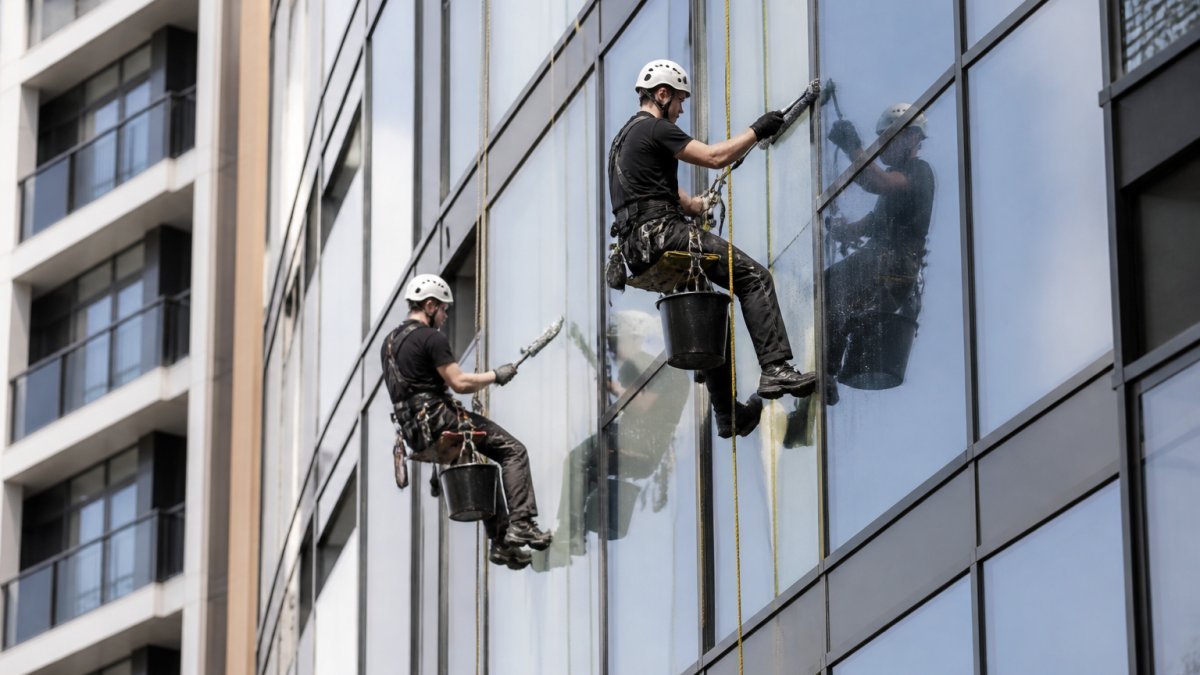
Before any descent, the team inspects the anchor points, checks the ropes and hardware, and confirms the work area below is clear. Cleaning itself uses purified water fed through a pole, traditional squeegee and scraper work, or a combination of both depending on the surface. Glass, powder-coated frames, aluminium composite panels and cladding each need a different approach, and getting that wrong can leave streaks or damage the finish.
The rope access method step by step
- Site survey and anchor assessment. The team identifies safe anchor points on the roof or plant area and checks the structure can take the load.
- Equipment inspection. Ropes, harnesses, descenders and back-up devices are checked before use.
- Exclusion zone setup. The area below the work is cordoned off so nobody walks underneath.
- Descent and cleaning. The technician works down the facade in controlled drops, cleaning glass, frames and cladding.
- Safety attendant cover. A second trained technician stays at roof level throughout the descent.
- Debrief and handover. The team reports any defects spotted on the facade, such as cracked seals or loose fixings.
That last step matters more than most people realise. A technician hanging inches from the glass sees things a ground-level inspection never will.
IRATA Trained Window Cleaners: What the Certification Means
IRATA trained window cleaners hold certification from the Industrial Rope Access Trade Association, the recognised industry body for rope access work. IRATA certification is graded in levels, and each level defines what a technician is qualified to do. A Level 1 technician can work under supervision, a Level 2 can supervise and perform more complex rigging, and a Level 3 is qualified to plan, manage and supervise rope access operations.
Certification is not a one-off. IRATA technicians must log their working hours and re-certify on a fixed cycle, which means their skills are assessed regularly rather than assumed. For a property manager, that gives you something concrete to ask about: not just "are your team trained?" but "what IRATA level are the technicians on site, and who is supervising?"
Ask for the IRATA level of the supervising technician, not just the team. A Level 3 supervisor on site is the difference between a job that is properly planned and one that is being improvised at height.
Lion Cleaning Group's team is IRATA-trained, and staff undergo rigorous training with certifications kept current. That is the baseline you should expect from any provider working on your building.
Working at Height Regulations UK: What Property Managers Need to Know
UK working at height regulations place duties on both the contractor and the client. The Work at Height Regulations 2005 require that all work at height is properly planned, supervised and carried out by competent people, and that risks are assessed and controlled (The law). For property managers, this means you have a responsibility to satisfy yourself that anyone working on your building is competent and that the method is appropriate. You can read the full detail in the Health and Safety Executive guidance on work at height.
The regulations follow a clear hierarchy. Avoid work at height where you can. Prevent falls where you cannot avoid it. Minimise the consequences of a fall where prevention is not possible. Rope access sits in the prevention category when it is properly rigged, because the technician is supported by two independent lines rather than relying on a single point of failure.
What should you actually check before a team goes up?
- Evidence of current IRATA certification for every technician on site
- Proof of insurance covering work at height
- A clear plan for the exclusion zone below the work
- A named supervisor responsible for the operation
If a provider cannot produce these on request, that is your answer.
High-Rise Window Cleaning in Cheadle: Local Service Coverage
High-rise window cleaning in Cheadle covers apartment blocks, office buildings and managed developments across the town and the surrounding Greater Manchester area. Cheadle sits within easy reach of Stockport, Didsbury, Sale and the wider south Manchester corridor, which means a local rope access team can be on site quickly and return for scheduled visits without long travel times eating into the working day.
Local knowledge counts for more than it sounds. Buildings in this area range from older brick-fronted blocks to newer glass-heavy developments, and each needs a different cleaning approach. Hard water spotting is a common issue on south-facing glass, and the North West's rainfall means facades pick up grime faster than in drier parts of the country. A team that works in Cheadle regularly understands those patterns and can recommend a sensible cleaning frequency rather than guessing.
Scheduling and Service Options for Managed Buildings
Scheduling for managed buildings works best when it is built around the building's own rhythm, not the contractor's. Residential blocks often prefer early morning visits before residents are moving about, while office buildings may need work outside core hours or at weekends. A flexible provider will plan around events, deliveries and access restrictions rather than locking you into a fixed slot that suits nobody.
Most managed buildings settle into one of a few patterns:
| Service pattern | Typical frequency | Best for |
|---|---|---|
| Full facade clean | Two to four times a year | Apartment blocks and offices with lots of glass |
| Glass-only clean | Monthly or quarterly | Buildings where frames and cladding stay cleaner |
| Reactive clean | As needed | Sites near roads or construction with fast build-up |
| Combined package | Scheduled with other exterior work | Portfolios wanting one provider and one schedule |
Combining window cleaning with cladding cleaning and general exterior maintenance usually makes sense. One team, one visit, one point of contact.
Booking a rope access team without confirming access to the roof or anchor points is one of the most common causes of a wasted visit. Confirm roof access, key holders and any permit requirements before the date is agreed.
What to Look For in an Abseil Window Cleaning Provider
Choosing a provider comes down to evidence, not sales talk. The right questions are straightforward, and any serious contractor will answer them without hesitation.
- Certification: Are the technicians IRATA-trained, and what level is the supervisor?
- Insurance: Is there cover specifically for work at height, and can you see the certificate?
- Paperwork: Will you receive safety documentation written for your building?
- References: Can they put you in touch with other property and facility managers running similar sites?
- Coverage: If you manage multiple sites, can one provider handle them all without quality slipping?
- Products: Are the cleaning products environmentally friendly, and how do they perform on the surfaces your building actually has?
On the question of switching providers, the honest answer is that a good incumbent is worth keeping. But if you are chasing missed spots, rebooking cancelled visits or waiting on paperwork, the cost of staying is higher than it looks. The right provider should make your week easier, not add to it.
Conclusion
Keeping a high-rise facade clean is a specialist job, and the difference between a provider that manages it properly and one that does not shows up in the paperwork long before it shows up on the glass. Lion Cleaning Group works at height across the UK, with IRATA-trained staff, environmentally friendly cleaning products and flexible scheduling built around how your building actually runs. We cover apartment blocks, offices and managed property portfolios, including Cheadle and the wider Greater Manchester area. Book a clean with Lion Cleaning Group and get a team that turns up, does the job properly and keeps your compliance in order.
Frequently Asked Questions
Is abseil window cleaning safe for high-rise buildings in Cheadle?
Yes, when carried out by trained and certified teams. Abseil window cleaning follows the Work at Height Regulations 2005, which require a safe system of work, trained operatives and equipment checks before every job. Lion Cleaning Group's team is IRATA-trained and works to these standards on every building, whether it is a residential block in Cheadle or a commercial tower elsewhere in Greater Manchester.
What training do abseil window cleaners require in the UK?
Rope access technicians in the UK typically hold an IRATA certification, which covers rope manoeuvres, rescue procedures and equipment inspection across three levels. This training is widely recognised as the industry standard for working at height. Lion Cleaning Group's operatives are IRATA-trained, meaning they can safely access facades, clean windows and handle emergencies without needing scaffolding or cradles.
How does rope access window cleaning differ from cradle systems?
Cradle systems are permanent installations built into some buildings, while rope access uses temporary rigging set up by the cleaning team. Rope access offers more flexibility because it can reach awkward angles, recessed windows and rooftops that cradles cannot. It also avoids the maintenance costs and planning constraints that come with cradle equipment, making it a practical choice for many apartment blocks and office buildings.
How often should high-rise windows be cleaned in Greater Manchester?
Most managed buildings in Greater Manchester schedule high-rise window cleaning every four to eight weeks, depending on the building's location, nearby trees or construction, and how visible the glass is to residents or tenants. Buildings near busy roads may need more frequent cleans. Lion Cleaning Group offers flexible scheduling so property managers can match the schedule to the building's needs.