 how-to
Commercial Window Cleaning for High-Rise Buildings
Table of Contents
- Why Commercial Window Cleaning for High-Rise Buildings Matters
- High-Rise Window Maintenance Checklist for Property Managers
- Work at Height Regulations 2005 Compliance for Window Cleaning
- Access Methods for High-Rise Window Cleaning
- Frequency of Commercial Window Cleaning for High-Rise Properties
- Safety Compliance and Equipment Requirements
- Choosing a Professional High-Rise Window Cleaning Provider
- Frequently Asked Questions
Last Updated: September 23, 2026
Why Commercial Window Cleaning for High-Rise Buildings Matters
Commercial window cleaning for high-rise buildings isn't a luxury, it's essential maintenance that directly affects your property's value, safety, and tenant satisfaction. When windows on a 20-storey office block go uncleaned for months, the building's professional image deteriorates rapidly. More importantly, dirty windows obscure structural issues and create genuine safety hazards that inspectors flag during compliance audits.
The challenge is finding a provider with the technical expertise, certifications, and equipment for high-rise work. Most standard cleaning companies lack these capabilities, leading property managers to face incomplete work, safety violations, or scheduling conflicts.
High-rise window maintenance requires specialized access methods, rigorous risk assessment, and certified technicians. The Work at Height Regulations 2005 governs every aspect of this work, from the initial site survey through final documentation. Understanding these requirements isn't optional, it's a legal obligation for building owners and facility managers.
High-Rise Window Maintenance Checklist for Property Managers
A structured maintenance checklist prevents deterioration, ensures compliance documentation, and avoids reactive problem-solving.
Pre-cleaning assessment
Before work begins, walk the building exterior and document window condition, water damage, sealant failures, and architectural features (setbacks, balconies, ledges) that affect access method selection and pricing.
Identify obstacles (satellite dishes, HVAC units, signage), windows requiring exclusion (recently painted, loose frames), and environmental factors (wind direction, nearby construction, seasonal patterns) affecting scheduling.
Verify BMU or cradle systems are certified and operational. Confirm building structure accommodates planned access methods. Document total window area and special requirements (tinted glass, heritage glazing, sensitive spaces).
During-cleaning inspection points
Monitor water quality (deionized water leaves no residue; hard water leaves streaks) and verify technicians use fall protection equipment continuously, brief lapses represent unacceptable risk.
Verify cleaning method matches glazing type (low-emissivity glass requires gentler techniques) and that technicians clean entire frames, not just glass panes.
Monitor progress against schedule and document damage discovered (loose caulking, failed seals, frame deterioration) requiring repair before the next cycle.
Post-cleaning documentation
Request a detailed report with before-and-after photographs, completion date/time, weather conditions, issues identified, and areas requiring special attention. This documentation provides legal protection and baseline for future cycles.
Record access method used, technician count, and hours spent to track budgets and efficiency. Document any safety incidents, near-misses, or environmental concerns for your health and safety file.
Record cleaning products used, especially for buildings with environmental or health sensitivity requirements, for sustainability reporting and tenant communications.
Work at Height Regulations 2005 Compliance for Window Cleaning
The Work at Height Regulations 2005 is statutory law enforced by the HSE. Non-compliance exposes your business to enforcement action, fines, and personal director liability.
Risk assessment requirements
Every project requires a formal risk assessment identifying building-specific hazards (wind exposure, traffic proximity, pedestrian areas, weather patterns, structural features) and evaluating team competence, equipment suitability, and emergency procedures.
The assessment must address fall distances, weather exposure (high-rise buildings experience stronger winds), and how these factors are managed.
The assessment must document control measures: access method, fall protection equipment, rescue procedures, and communication systems. This becomes your legal evidence of reasonable precautions.
Method statements and site-specific planning
Every project requires a site-specific method statement detailing access method, equipment, personnel qualifications, work sequence, and contingency procedures for your building.
The method statement must address environmental factors (wind speeds halting work, suspension conditions), communication protocols, rescue procedures, and nearest emergency facility.
A proper method statement is building-specific, not a generic template. Request it in advance; inability to produce one indicates non-compliance with the Work at Height Regulations 2005.
Access Methods for High-Rise Window Cleaning
Different high-rise buildings require different access approaches. The method you choose affects cost, scheduling, safety risk profile, and the frequency at which cleaning can realistically occur. Understanding these methods helps you make informed decisions about your building's maintenance strategy.
Rope access and abseiling
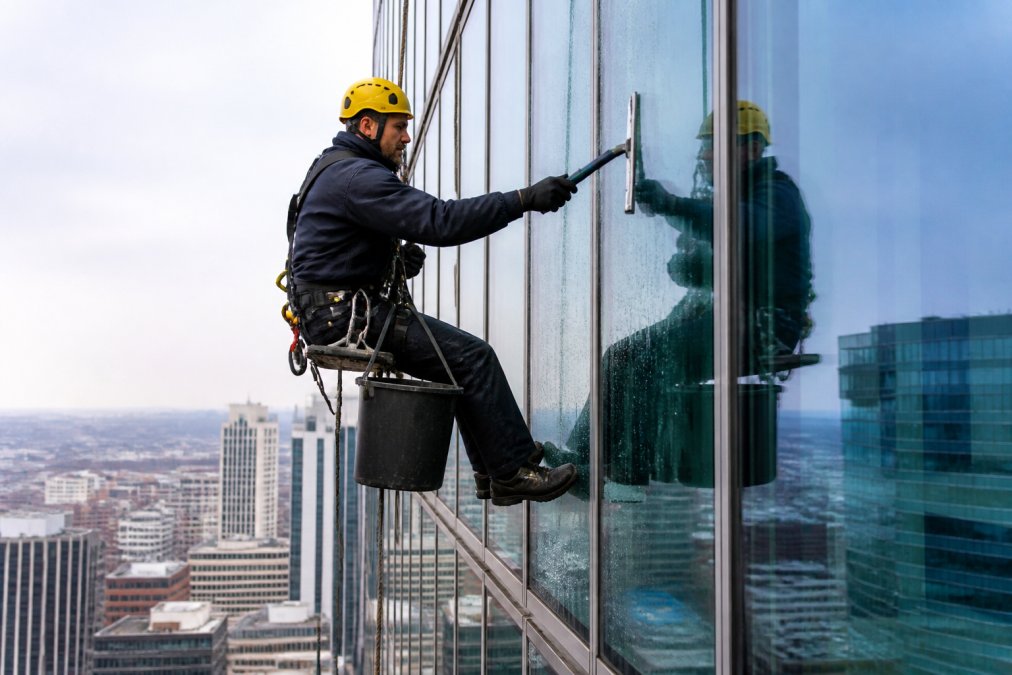
Rope access (abseiling) is the most flexible method for high-rise window cleaning. Technicians rappel from roof anchor points while secured with harnesses, working on virtually any building shape including irregular façades and setbacks.
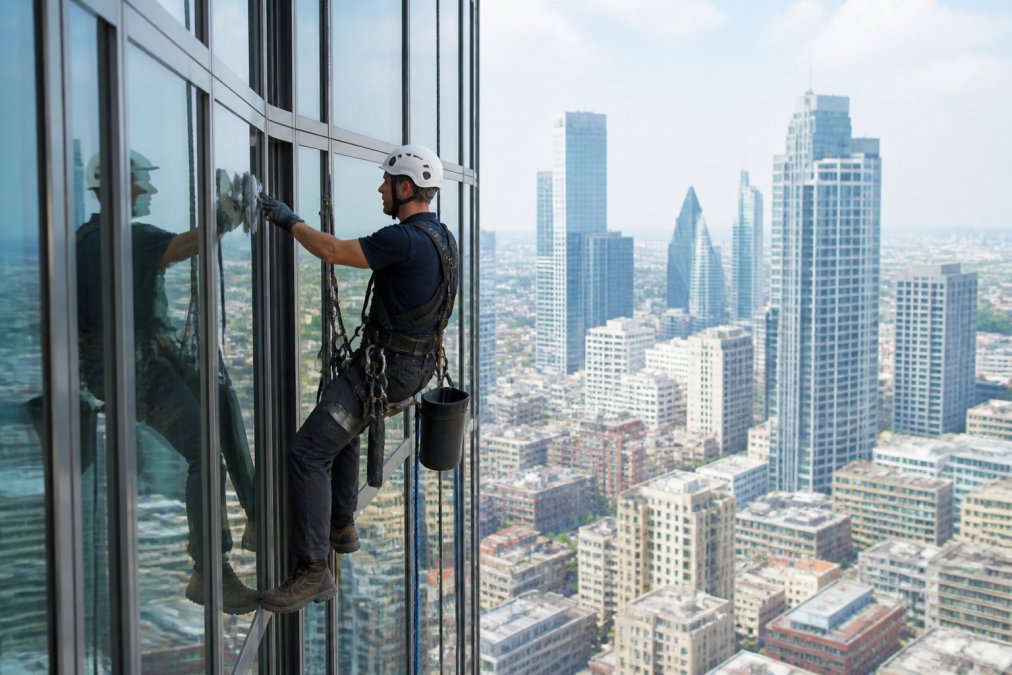
Rope access requires IRATA (Industrial Rope Access Trade Association) certification, representing genuine competence in rope systems, rescue procedures, and working-at-height safety.
Rope access requires no building modifications or permanent equipment, works in most weather except extreme winds, and is often the only option for buildings without BMUs or MEWP access.
Rope access is labour-intensive; each technician covers limited area daily, making it expensive for large buildings or frequent cleaning cycles.
Building Maintenance Units (BMU)
A BMU is a permanent roof-mounted mechanical system with a powered cradle that lowers technicians along the façade, controlled by an operator from the roof.
BMU systems allow multiple simultaneous technicians and faster progress than rope access, delivering best cost-per-clean for buildings requiring frequent maintenance.
BMU installation requires structural engineering and roof modifications. Systems are practical only for buildings over 15 storeys requiring quarterly or more frequent maintenance.
Mobile Elevating Work Platforms (MEWP)
Mobile Elevating Work Platforms (MEWPs) are self-propelled platforms with extending booms (scissor or boom lifts) suitable for mid-rise buildings (4-10 storeys) with ground-level access space.
MEWPs offer speed and simplicity with straightforward setup and widely available hire equipment. For buildings with adequate ground clearance and moderate height, they're often most cost-effective.
MEWPs require clear ground space and become unstable in strong winds, limiting use in dense urban areas and during windy conditions.
Water-fed pole systems
Water-fed poles are telescoping poles (10-20 metres) with brush heads delivering deionized water that leaves no mineral residue, operated from ground level.
Water-fed poles are ideal for low to mid-rise buildings (up to 6 storeys) and most cost-effective, requiring no installation, harnesses, or extensive training.
Water-fed poles are impractical beyond 6 storeys and depend on weather conditions. For large window areas, they're labour-intensive.
Frequency of Commercial Window Cleaning for High-Rise Properties
Optimal cleaning frequency depends on building type, location, environmental exposure, and business objectives. Most commercial properties follow quarterly schedules.
Quarterly maintenance schedules
Quarterly cleaning maintains professional appearance, prevents environmental deposit accumulation, and identifies emerging problems (failed seals, frame deterioration) before costly repairs.
Quarterly frequency suits office buildings where window condition affects lease value, retail/hospitality venues requiring professional appearance, and residential complexes preventing tenant complaints.
Quarterly maintenance provides predictable annual costs, enabling single-provider contracts with negotiated pricing and consistent building appearance year-round.
Environmental and weather factors
Environmental exposure affects frequency: motorway-adjacent buildings accumulate diesel particulates; coastal buildings experience salt spray requiring quarterly cleaning plus additional winter cycles.
Safety Compliance and Equipment Requirements
Safety is foundational in high-rise window cleaning. Cutting corners creates liability exposure, HSE enforcement risk, and genuine injury/death risk.
Fall protection and PPE standards
Every technician must wear harness, safety line, and PPE (mandatory under Work at Height Regulations 2005). Harnesses distribute fall forces; safety lines prevent free fall.
Certified technician qualifications
Technicians must hold IRATA Level 1, 2, or 3 certification (depending on complexity), requiring formal training, practical assessment, and annual refresher training.
Public liability insurance and HSE compliance
Your cleaning provider must carry public liability insurance covering damage to your building, injury to your staff or tenants, or damage to neighbouring properties. Minimum coverage should be £10 million for high-rise work. Request a copy of their insurance certificate before work begins and verify it covers the specific work being performed.
Choosing a Professional High-Rise Window Cleaning Provider
Selecting the right provider is critical. The wrong choice creates safety risks, schedule disruptions, and quality issues that consume your time managing problems instead of focusing on your business.
Verifying credentials and experience
Ask potential providers for references from other property managers managing similar buildings. Call those references and ask specific questions: Did the provider complete work on schedule? Was quality consistent across all building sections? How did they handle unexpected issues? Did they respond quickly to concerns?
Evaluating flexibility and nationwide coverage
Can the provider accommodate your scheduling needs? If you need cleaning on specific dates to avoid tenant disruption, can they guarantee availability? Do they have backup crews if their primary team is delayed? For multi-site portfolios, can they coordinate work across multiple locations efficiently?
Frequently Asked Questions
What are the legal requirements for high-rise window cleaning in the UK?
High-rise window cleaning must comply with the Work at Height Regulations 2005, which requires a formal risk assessment before work begins. A site-specific method statement must be prepared, detailing the access method, fall protection systems, and emergency procedures. All work must be carried out by certified technicians trained in working at height. Public liability insurance is mandatory, and the Health and Safety Executive (HSE) standards for façade maintenance must be followed throughout the project.
How often should commercial windows on high-rise buildings be professionally cleaned?
Quarterly maintenance schedules are standard for most high-rise commercial properties, though frequency depends on environmental exposure, location, and building type. Properties near coastal areas or industrial zones may require cleaning every 6-8 weeks due to salt spray and pollution. Urban office buildings typically benefit from quarterly cleaning to maintain glazing integrity and professional appearance. Weather conditions and seasonal accumulation of dirt should inform your cleaning frequency decision.
What access methods are safest for high-rise window cleaning?
The safest method depends on building design and access points. Rope access (abseiling) suits buildings without existing access equipment and offers flexibility for complex façades. Building Maintenance Units (BMUs) provide permanent solutions for regular cleaning on large commercial properties. Mobile Elevating Work Platforms (MEWPs) work well for moderate heights with safe ground-level positioning. Water-fed pole systems can clean lower floors safely from ground level. Professional providers assess your building's specific requirements and select the most appropriate method.
How do I know if a window cleaning contractor is properly qualified for high-rise work?
Verify that technicians hold current certifications in rope access (IRATA certification), MEWP operation, or BMU training as relevant to your project. Confirm they carry adequate public liability insurance (typically £10 million minimum for high-rise work) and hold HSE-compliant method statements for your building type. Ask for references from other property managers managing similar multi-site portfolios or apartment complexes. Ensure they conduct a formal risk assessment and provide documentation before work begins.