 blog
blog
Cleaning Services for Apartment Building Property Managers
Table of Contents
- Why Apartment Building Cleaning Is a Contract, Not a Chore
- Communal Area Cleaning Standards That Hold Up to Inspection
- Deep Cleaning Schedules for Apartment Buildings: Daily, Weekly and Periodic
- Building an Apartment Block Cleaning Contract Template
- Health and Safety Compliance, Staff Vetting and Working at Height
- What Professional Cleaning Actually Costs and Where the Money Goes
- Green Cleaning, Reporting Technology and Emergency Response
- Choosing Cleaning Services for Apartment Building Property Managers
- Frequently Asked Questions
Last Updated: September 19, 2026
Why Apartment Building Cleaning Is a Contract, Not a Chore
Cleaning services for apartment building property managers are a contracted, compliance-driven operation, not an ad-hoc tidy-up. A residential block is a shared asset watched by residents, visitors and insurers.
Communal Area Cleaning Standards That Hold Up to Inspection
Communal area cleaning standards are the written benchmarks a block manager measures a contractor against, covering every shared space from the entry door to the bin store. Without them, quality drifts within weeks.
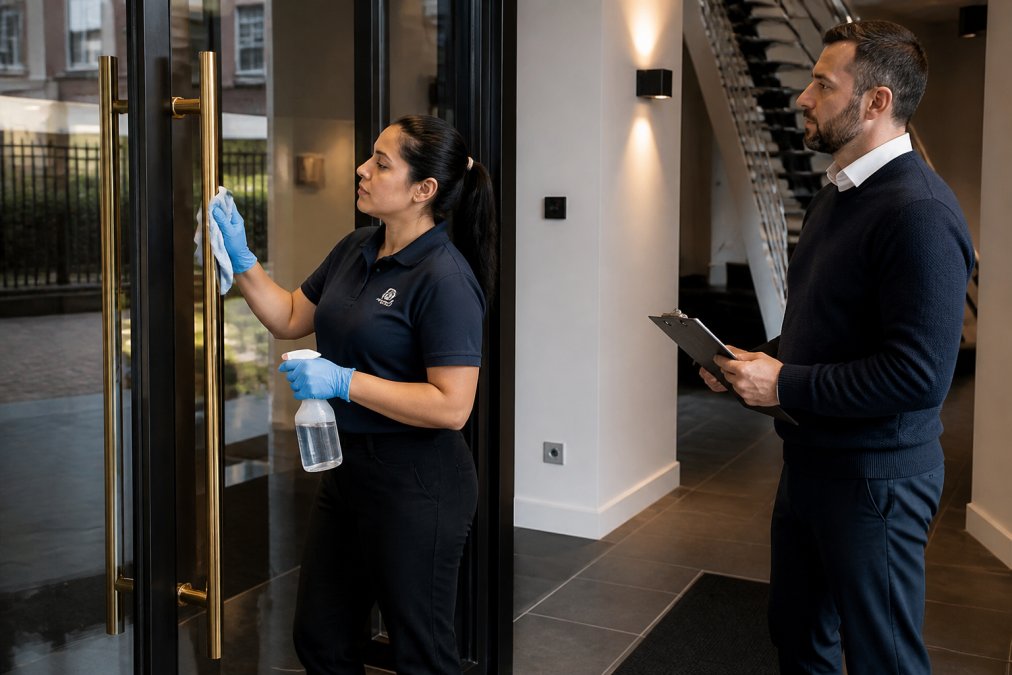
A workable standard covers:
- Entry and lobby: door glass and push plates sanitised, floors mopped, mats vacuumed, fingerprints removed from lift doors and call panels
- Stairs and corridors: handrails wiped, edges and corners vacuumed, litter picked, scuff marks treated
- Lifts: interior polished, tracks cleared of debris, mirrors and panels streak-free
- Bin stores and waste management: bins wiped, floors washed, odour treated, external litter picked
- External areas: paths swept, entrances cleared, windows and glazing cleaned on an agreed cycle
What a Quality Assurance Visit Should Check
A quality assurance visit is a scheduled inspection where the block manager and contractor score the building against the agreed standard. It should happen monthly for most residential blocks and produce a written report, not a verbal nod.
Deep Cleaning Schedules for Apartment Buildings: Daily, Weekly and Periodic
Deep cleaning schedules for apartment buildings split work into three tiers: daily, weekly and periodic deep cleans. Treating everything as "weekly" leaves grimy lift tracks and stained stair carpets.
| Frequency | Typical Tasks | Who Notices If Missed |
|---|---|---|
| Daily | Lobby mopping, litter pick, entry door sanitisation, lift polishing | Residents, visitors |
| Weekly | Stairwell vacuuming, handrail wiping, bin store wash-down | Block manager |
| Periodic (monthly/quarterly) | Carpet deep clean, window cleaning, floor maintenance, high-level dusting | Insurers, auditors |
Planning Around Lease Transitions and Vacant Units
Lease transitions and vacant units are when a block's presentation is judged hardest. A move-out leaves marks, abandoned items and worn carpets a routine visit will not fix.
Building an Apartment Block Cleaning Contract Template
An apartment block cleaning contract template converts a verbal agreement into a measurable service, short enough to read in one sitting, specific enough to settle disputes without a phone call.
A workable template includes:
- Scope of work by area, with the standard for each
- Frequency per task (daily, weekly, periodic)
- Service level agreement with response times for complaints
- Site inspection schedule and scoring method
- Reporting format and delivery (see technology-driven reporting below)
- Insurance, vetting and health and safety compliance evidence
- Transparent pricing breakdown by area and frequency
- Termination and remedy clauses
Clauses That Protect the Block, Not Just the Cleaner
The clauses most often missing protect the client. Insist on a remedy clause: if inspection scores fall below the agreed threshold for two consecutive visits, the contractor must present a corrective plan within a set number of working days.
Health and Safety Compliance, Staff Vetting and Working at Height
Health and safety compliance is the non-negotiable layer under any cleaning contract, and it is where cheap providers cut corners. Under the Health and Safety Executive's guidance on working at height, employers must avoid work at height where reasonably practicable, prevent falls where it cannot be avoided, and minimise the consequences of a fall.
What Professional Cleaning Actually Costs and Where the Money Goes
Pricing for block cleaning depends on communal area size, visit frequency, access requirements and whether working at height is involved. Any quote ignoring these factors is a guess.
A transparent quote breaks the price into:
- Labour: hours on site, adjusted for frequency and building size
- Equipment and access: lifts, harnesses, water-fed poles for high-rise windows
- Consumables: products, cloths, bin liners, odour treatments
- Management: site inspections, reporting, supervision
- Compliance: training, insurance, vetting
Building a Cleaning Budget Line by Line
Most block managers inherit a single annual cleaning figure and never interrogate it. A defensible budget is built from four inputs, each visible in the quote:
- Measurable area, the square metres of communal floor, stair, lift and external paving. Ask the contractor to state the area they priced; if they cannot, the price is a guess.
- Visit frequency, daily, three times weekly, weekly or fortnightly. Frequency drives labour cost more than any other variable.
- Access complexity, secure entry, fob systems, plant room access, roof access and any working-at-height requirement.
- Periodic works, carpet deep cleans, window cleaning cycles and floor maintenance, which should be budgeted separately from routine visits so they are not quietly dropped.
Contracted Cleaning Versus In-House: A Like-for-Like Comparison
In-house cleaning looks cheaper on a wage comparison and rarely is once the full cost base is counted. Put both on the same footing:
| Cost line | In-house | Contracted |
|---|---|---|
| Wages and on-costs | Employer National Insurance, pension contributions, holiday and sick cover | Included in contract rate |
| Equipment and consumables | Purchased and stored by the block | Supplied by contractor |
| Training and compliance | Block's responsibility | Contractor's responsibility |
| Cover for absence | Block must arrange | Contractor must arrange |
| Insurance and vetting | Block's liability | Contractor's liability |
| Management and inspection | Block manager's time | Built into contract |
What to Ask Before Signing a Quote
- Which areas, in square metres, does this price cover?
- Which tasks are routine and which are periodic, and is each priced separately?
- What is the notice period and cost for additional deep cleans?
- Are consumables included, and are they specified by brand or type?
- What is the uplift for out-of-hours or emergency callouts?
Green Cleaning, Reporting Technology and Emergency Response
Green cleaning, reporting technology and emergency response are where a modern block cleaning contract earns its keep.
Green Cleaning: What to Specify, Not Just What to Claim
"Eco-friendly" is a marketing word until pinned to a standard. When a contractor claims green cleaning, ask what they can evidence:
- Product certification, cleaning chemicals carrying recognised ecolabel certification, which restricts the surfactants, solvents and phosphates permitted in the formulation.
- Dilution control, closed-loop or pre-dosed systems that prevent over-concentration, the single biggest cause of unnecessary chemical load in enclosed communal areas.
- Packaging and waste, concentrated refills rather than ready-to-use bottles, and a stated position on plastic waste from cloths, mop heads and liners.
- Microfibre systems, microfibre cloths and mops reduce both water and chemical use compared with traditional methods, and are a practical, verifiable choice rather than a slogan.
Reporting Technology: Digital Proof of Service
Visits can now be proven rather than asserted. A contractor using digital reporting typically provides:
- Timestamped checklists, each task signed off on a handheld device at the point of completion, with the time and operative recorded.
- Photo evidence, before-and-after images for periodic works such as carpet deep cleans or bin store wash-downs.
- Automated site reports, a monthly PDF or dashboard summarising visits completed, tasks signed off, and any issues logged.
- Issue logging, a route for operatives to report damage, graffiti, blocked drains or antisocial behaviour back to the block manager, turning the cleaning team into an extra set of eyes on the building.
Emergency Response: Define the Protocol Before You Need It
Emergency response is the piece most contracts forget, and the piece residents remember longest. Spills, floods, vandalism, broken glass and post-event clean-ups cannot wait for the next scheduled visit.
A workable emergency protocol specifies four things:
- What counts as an emergency, for example, a biohazard spill, flooding, broken glass in a communal area, or graffiti containing offensive material.
- Response time, a defined window for attendance, split between in-hours and out-of-hours. A common pattern is same-day attendance for in-hours callouts and a set number of hours for out-of-hours.
- Who authorises the callout, name the roles (block manager, managing agent, out-of-hours director) who can trigger the response, and the spend limit above which further approval is needed.
- How it is charged, a pre-agreed callout rate and hourly rate, so an emergency does not become a pricing negotiation at the worst possible moment.
Waste Duty of Care
Green cleaning and emergency clean-ups both generate waste, and waste from a block is regulated. According to the Environment Agency's guidance on waste duty of care, businesses must ensure waste is stored, transferred and disposed of safely and only by authorised carriers. Confirm your contractor can evidence this for every waste collection from your site, including a written description of the waste and a transfer note.
Choosing Cleaning Services for Apartment Building Property Managers
Choosing cleaning services for apartment building property managers comes down to evidence: documented standards, vetted staff, transparent pricing and a contract that protects the block. Everything else is marketing.
- Site-specific risk assessments for high-level and window work
- Vetted, CRB checked operatives with named site assignments
- A written quality assurance process with scoring and reporting
- Transparent pricing broken down by area and frequency
- A remedy clause that makes the service level agreement enforceable
NHS guidance on cleaning to reduce infection risk
Frequently Asked Questions
What services are included in apartment building cleaning contracts?
Most contracts cover communal area cleaning: entrance halls, stairwells, corridors, lifts, bin stores and external litter picks. Many also include window cleaning, floor maintenance and waste management. Bespoke cleaning packages can add end of tenancy deep cleans, vacant unit preparation and emergency call-outs. Ask for a written service level agreement that names every task, its frequency and the standard expected, so there is no dispute later about what was included.
How often should common areas in apartment buildings be cleaned?
Frequency depends on footfall. A low-rise block may need two or three visits a week, while a busy high-rise with heavy traffic usually needs daily attendance. High-traffic areas such as lifts, entry doors and bin stores need the most attention. Set deep cleaning schedules for apartment buildings alongside routine visits, so carpets, hard floors and upholstery get periodic treatment rather than just a daily wipe-down.
What are the health and safety requirements for cleaning residential blocks?
Cleaning providers must carry out risk assessments and follow safe systems of work under the Management of Health and Safety at Work Regulations 1999. Staff working at height must be trained and use suitable equipment. Where hazardous substances are used, COSHH assessments are required. Property managers should ask for method statements, insurance certificates and evidence of staff training before signing an apartment block cleaning contract.
How do you vet a commercial cleaning company for apartment management?
Check references from other property managers running similar blocks, and ask to visit a site they already service. Confirm staff are CRB checked, trained and directly employed rather than subcontracted at short notice. Request public liability insurance, health and safety documentation and a named account manager. A trial period with agreed quality assurance inspections is the fairest way to judge whether a provider meets communal area cleaning standards before committing to a long contract.
Managing a block means balancing residents' expectations, compliance obligations and a budget that never stretches far enough. Lion Cleaning Group handles that balance with flexible scheduling, working at height specialists, environmentally friendly products and a compliance-first approach backed by rigorous staff training. Get started with Lion Cleaning Group and keep every communal area inspection-ready, from the entry door to the bin store.