 ultimate-guide
Rope Access Window Cleaning: What Property Managers Need
Table of Contents
- Rope Access Window Cleaning: What It Solves for Managed Buildings
- IRATA Rope Access Standards: Why Certification Matters
- High-Level Window Cleaning in Greater Manchester
- Commercial Window Cleaning in Cheadle for Offices and Blocks
- How a Rope Access Window Cleaning Visit Actually Runs
- Choosing a Rope Access Window Cleaning Provider
- Frequently Asked Questions
Last Updated: October 4, 2026
Rope Access Window Cleaning: What It Solves for Managed Buildings
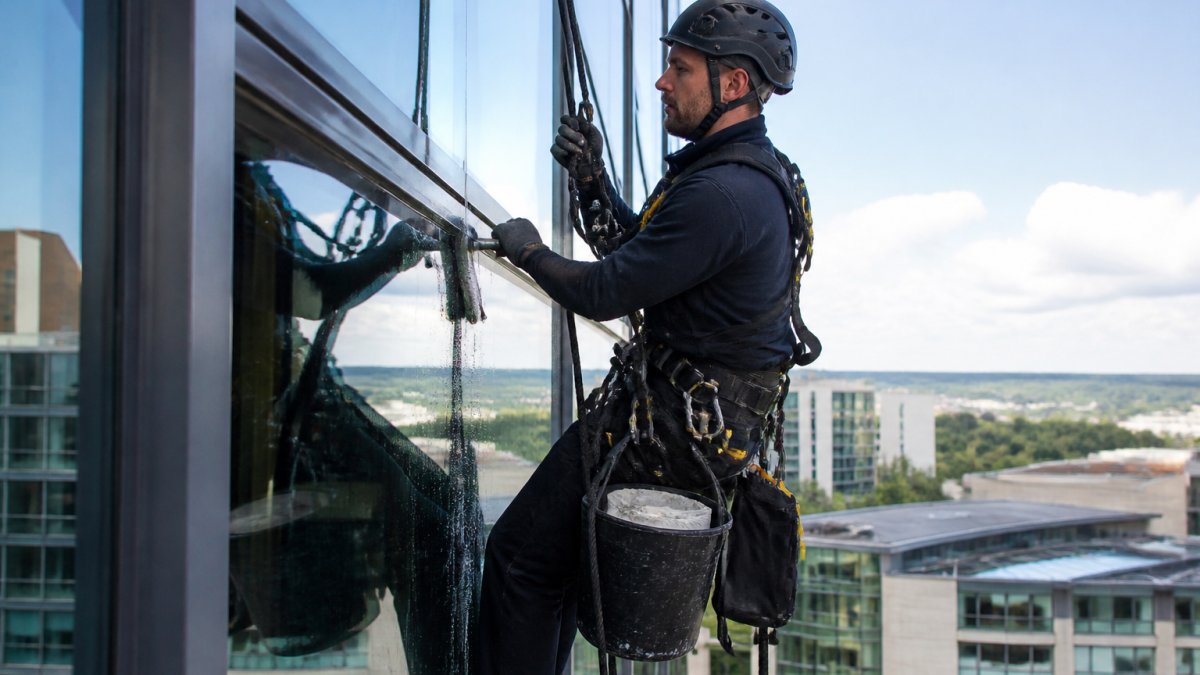
Rope access window cleaning is a method of cleaning exterior glass and facades using technicians suspended on ropes from the roof, rather than from scaffolding, cradles or mobile elevating work platforms. For property managers running apartment blocks and office buildings, it solves the access problem that makes upper-floor windows the first thing to be neglected and the last thing to be cleaned. At Lion Cleaning Group, we work at height across the UK, and this guide explains what the method involves, why IRATA certification matters, and how to choose a provider you can rely on.
Most managed buildings have the same recurring problem. Ground-floor glass gets wiped every week. Anything above the second or third storey gets postponed, because booking a cherry picker or erecting scaffolding for a few hours of window cleaning is disproportionate to the job. The result is visible from the street: smeared upper panes, water-marked glass and a building that looks tired even when the lobby is spotless.
Rope access closes that gap. Two trained technicians can rig from the roof, work down the elevation, and be gone within a few hours, with no ground-level obstruction and no permit for a crane or platform.
IRATA Rope Access Standards: Why Certification Matters
IRATA certification is the industry benchmark for rope access work, and it is the single most important thing to verify in a provider. IRATA, the Industrial Rope Access Trade Association, sets the training and assessment standards that UK rope access technicians are graded against. A certified technician holds a current IRATA logbook showing their level and their recorded hours at height.
Why does this matter to a property manager? Because rope access is a safety-critical activity, and the competence of the crew is what keeps the job compliant and the building's residents safe. An IRATA-trained team works to a recognised method, uses inspected equipment, and can evidence training records if you ask. A crew without that certification is a liability you carry, not a service you buy.
Our own team is IRATA-trained, and we keep those records current. When you request a quote, ask any provider three questions: what IRATA level are the technicians, when was their last assessment, and can you see the logbooks? A provider who hesitates on any of them is not one to book.
IRATA International training and certification standards
High-Level Window Cleaning in Greater Manchester
High-level window cleaning brings its own practical considerations. The region's weather does much of the work for you in one direction and against you in the other: regular rainfall keeps glass wet, and the mix of urban air and road grime means that when it dries, it leaves marks. Upper elevations on taller blocks accumulate a film that lower windows do not, simply because rain cannot rinse them as effectively.
That is why frequency matters more than intensity. A building cleaned on a sensible cycle needs less aggressive treatment each visit than one cleaned twice a year. For most managed blocks, a scheduled programme with a set interval works better than ad hoc bookings, because the crew knows the building, the rigging points and the access constraints before they arrive.
If you are searching for rope access window cleaning, the practical test is not who can get there fastest, it is who can show you a method for your specific elevation. Every building rigs differently.
Commercial Window Cleaning in Cheadle for Offices and Blocks
Commercial window cleaning covers many building types, from low-rise office units to multi-storey apartment blocks, and the access method has to suit the structure. A four-storey office with a flat roof and clear parapet is straightforward to rig. A building with a pitched roof, fragile roof lights or a glass balustrade at the edge needs a different approach, and sometimes a different method entirely.
This is where a provider's experience shows. The right questions at survey stage are about anchor points, roof access, and whether any part of the elevation is better reached by another means. A crew that turns up and improvises on the day is telling you something.
For offices, the timing question is usually the harder one. Staff arriving, deliveries, and client visits all shape when a crew can work. A flexible provider will schedule around your building's rhythm rather than insisting on a fixed weekly slot. For blocks, the consideration shifts to residents: early starts, parking bays and the noise of rigging all affect people living on site.
| Building type | Typical access challenge | What a good provider does |
|---|---|---|
| Low-rise office | Roof access and anchor points | Surveys the parapet before quoting |
| Multi-storey apartment block | Resident access and parking | Schedules around building activity |
| Mixed-use development | Different elevations, different needs | Splits the job by method |
| Building with fragile roof | Safe rigging without loading the roof | Uses appropriate anchor systems |
How a Rope Access Window Cleaning Visit Actually Runs
A rope access window cleaning visit follows a set sequence: survey, rigging, descent and clean, then de-rig and inspection. The crew arrives, confirms the anchor points and access route, sets the ropes, and works down the elevation in sections. Most visits to a typical managed block are completed within a single working day, though larger elevations take longer.
The detail that matters to you is the pre-visit survey. Before any ropes go over the edge, someone should have walked the roof, identified the anchor points, and confirmed there is a safe route to them. This is not paperwork for its own sake; it is what stops a job being abandoned halfway through because the rigging does not work.
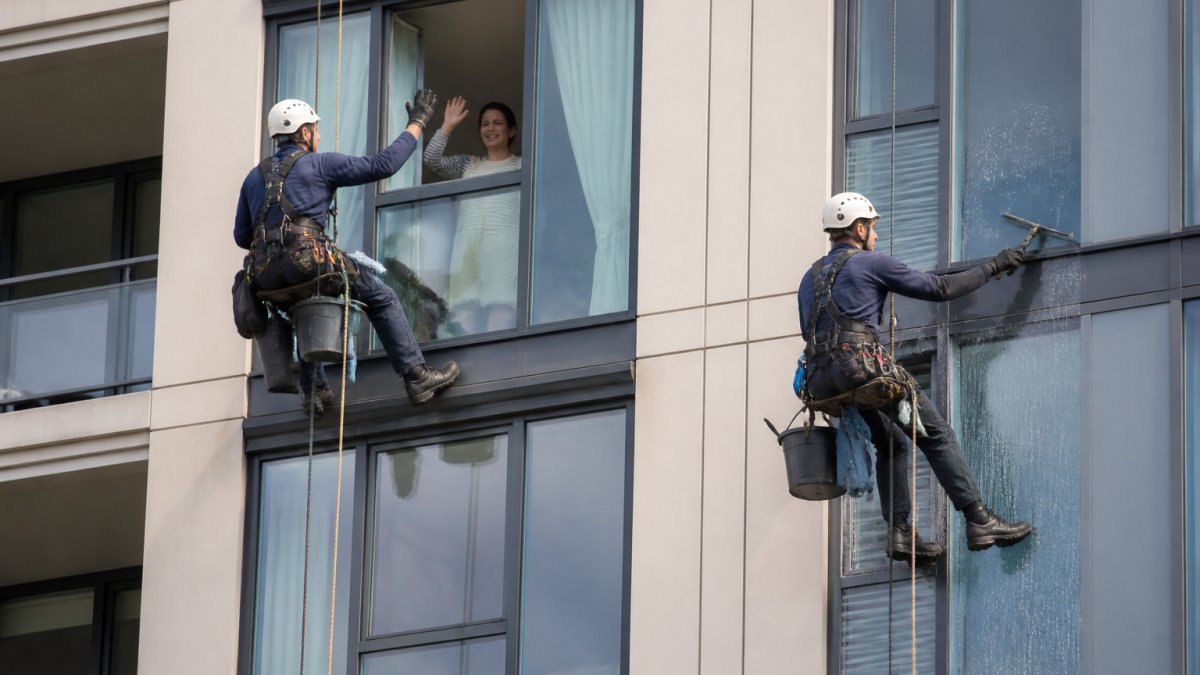
On the day, expect the crew to work in pairs. One descends while the other manages the rig from above, and they rotate. Glass is cleaned with a pole-fed water system or by hand depending on the elevation and the finish, and the descent is planned so that each section is finished before the next begins. At the end, the ropes come up, the roof is checked, and you should get a walk-round or a photographic record of the completed elevation.
Choosing a Rope Access Window Cleaning Provider
Choosing a rope access window cleaning provider comes down to four checks: certification, method, scheduling flexibility and evidence. Certification we have covered. Method means a survey before the quote, not a price given over the phone. Scheduling means the crew can fit your building's constraints. Evidence means references from other property managers running similar sites.
The pricing question deserves a straight answer. Rope access often costs more per visit than ground-level cleaning, because you are paying for trained technicians, equipment and the time it takes to rig safely. What that buys is access to glass that would otherwise go uncleaned, and a building that presents properly from every angle. If a quote looks unusually cheap for high-level work, ask what method is being used and who is going over the edge.
Ask for references. A provider working regularly with block managers and managing agents will have them ready. Our own clients include property and asset managers across residential and commercial portfolios, and we are happy for prospective clients to hear from them directly.
- Confirm IRATA certification and current logbooks
- Ask for a survey before the quote, not a phone estimate
- Check scheduling flexibility against your building's activity
- Request references from similar buildings
- Agree how the finished work will be evidenced
Health and Safety Executive guidance on working at height
Upper-floor windows are the part of a managed building that quietly lets the whole property down, and access is almost always the reason. Lion Cleaning Group works at height on apartment blocks, offices and managed portfolios across the UK, with IRATA-trained teams, environmentally friendly cleaning products and scheduling built around how your building actually runs. If your upper elevations have been on the list for months, book a clean with Lion Cleaning Group and get a survey and quote for your site.
Frequently Asked Questions
What are the safety regulations for rope access window cleaning in the UK?
Rope access work in the UK sits under the Work at Height Regulations 2005, with the Health and Safety Executive as the regulator. The industry standard is IRATA certification: technicians train through levels 1 to 3 and revalidate every three years. Employers must also hold insurance, keep equipment inspection records, and plan each job so work is done safely. Lion Cleaning Group's team is IRATA-trained, which gives property and facility managers a clear benchmark when checking any rope access window cleaning provider.
Why choose rope access instead of a cherry picker for high-rise windows?
Rope access usually needs no ground space, so it suits apartment blocks where a cherry picker would block entrances, parking or residents' paths. It also reaches recessed windows, internal courtyards and stepped facades that a boom lift cannot get to. On many buildings it is quicker to set up, and there is less movement of heavy machinery on site. For high-level window cleaning, rope access is often the only practical route on tight city-centre plots.
How do I know the team won't cut corners on the job?
Ask for named references from similar buildings and speak to those managers directly. A provider that works regularly with block managers and build-to-rent operators will have them. During the visit, expect the team to follow an agreed schedule of elevations and windows, and to report anything they could not reach. Lion Cleaning Group's clients, including block and asset managers, describe the team as professional, polite and consistent, which is the pattern to look for when comparing providers.
Can you work around our building's schedule and multiple sites?
Flexible scheduling matters for occupied buildings. Ask for visits outside peak hours, before events, or split across elevations so entrances stay usable. For portfolios, confirm the provider can cover several sites on one contract without quality dropping, and ask how they allocate teams across regions. Commercial window cleaning across the UK can be arranged on daily, weekly or periodic plans, so the schedule fits the building rather than the other way round.