Author: Ryan Marriott

  • Commercial Window Cleaning Manchester: A 2026 Guide

    Commercial Window Cleaning Manchester: A 2026 Guide

    Table of Contents

    Last Updated: 18 October 2026

    Commercial Window Cleaning Manchester: What the Job Actually Involves

    Commercial window cleaning in Manchester is the scheduled cleaning of glass, frames and adjoining facade on commercial and managed residential buildings, carried out by trained teams using water-fed poles, cradles or rope access depending on height and access. At Lion Cleaning Group, we run these programmes across Greater Manchester from our base in Cheadle. A ten-storey office block, a build-to-rent tower and a low-rise retail parade each need a different method, a different access plan and a different visit frequency.

    Below, we'll show you exactly what a commercial window cleaning programme includes, how teams reach upper floors safely, and how to choose a provider. The detail that matters most is access: get that wrong and the glass stays dirty no matter how good the cleaner is.

    Choosing a Commercial Window Cleaning Company

    Choosing a commercial window cleaning company comes down to three things: verified training, the right insurance, and a method that suits your building rather than the provider's van stock. Price matters, but a cheap quote that can't reach the eleventh floor is no quote at all. We've seen property managers switch providers three times in a year because nobody asked how the upper windows would actually be cleaned.

    Start with a site visit. Any provider worth considering will want to see the building, note the access points, and check what's below the glass before quoting.

    Watch Out
    The most common mistake is accepting a quote given over the phone without a site visit. If a provider prices a high-rise job blind, they've either guessed or planned to skip the difficult elevations, and you'll be the one chasing missed panes.

    Training, Certification and Insurance to Ask About

    Ask directly what qualifications the team holds. For work at height, look for IRATA certification, which is the industry standard for rope access technicians and requires logged hours and re-assessment (Technicians). Our team is IRATA-trained, and we'd expect any serious provider to say the same without hesitation.

    Then ask for insurance certificates, specifically public liability cover and employer's liability. Check the cover is current and matches the scale of your building. A provider working at height on a managed block should be able to produce these documents the same day you ask.

    Questions Worth Asking Before You Switch Providers

    If your current provider knows the building inside out, switching carries real risk. Ask any new company these questions before you commit:

    • Which access method will you use on each elevation, and why?
    • Who supervises the team on site, and will it be the same crew each visit?
    • How do you report missed panes or damaged seals?
    • What's your process if weather stops work on a scheduled day?
    • Can you provide references from similar buildings?

    A provider that answers these plainly is usually a reliable one.

    High-Rise Window Cleaning Manchester: How Teams Reach Upper Floors

    High-rise window cleaning in Manchester uses three main methods: water-fed poles from the ground for lower and mid-level glass, suspended cradles or building maintenance units for towers with permanent access, and rope access for everything in between. The right choice depends on the building's height, its facade design and what's directly below the glass.

    Water-fed poles reach several storeys from ground level using purified water and telescopic poles, which keeps operatives off the building entirely. Above that, cradles suit buildings designed with them, but many Manchester apartment blocks and office buildings weren't built with cradle systems. That's where rope access comes in. It reaches awkward elevations, internal corners and setback terraces that no pole or cradle can touch.

    Rope Access Window Cleaning Manchester: When Abseil Work Is the Right Call

    Rope access window cleaning in Manchester is the abseil method: technicians descend the facade on certified ropes and harnesses, cleaning glass and cladding as they go. It suits tall buildings without cradle access, complex facades, and jobs where scaffolding would be impractical or too costly to erect.
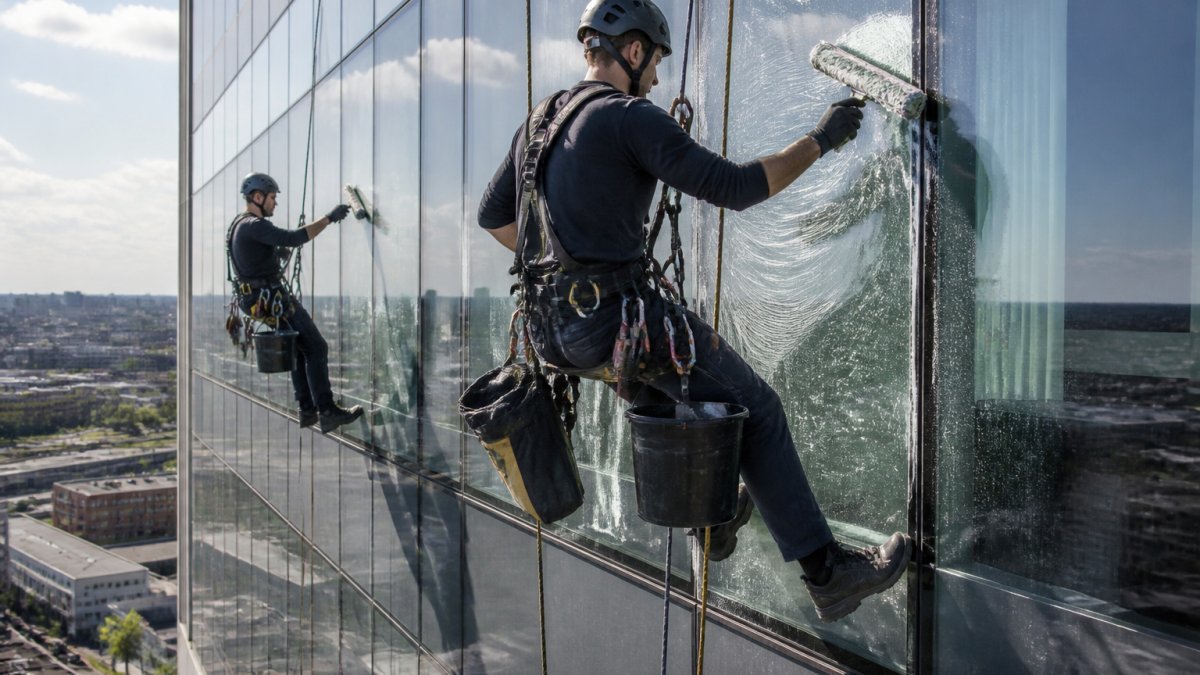
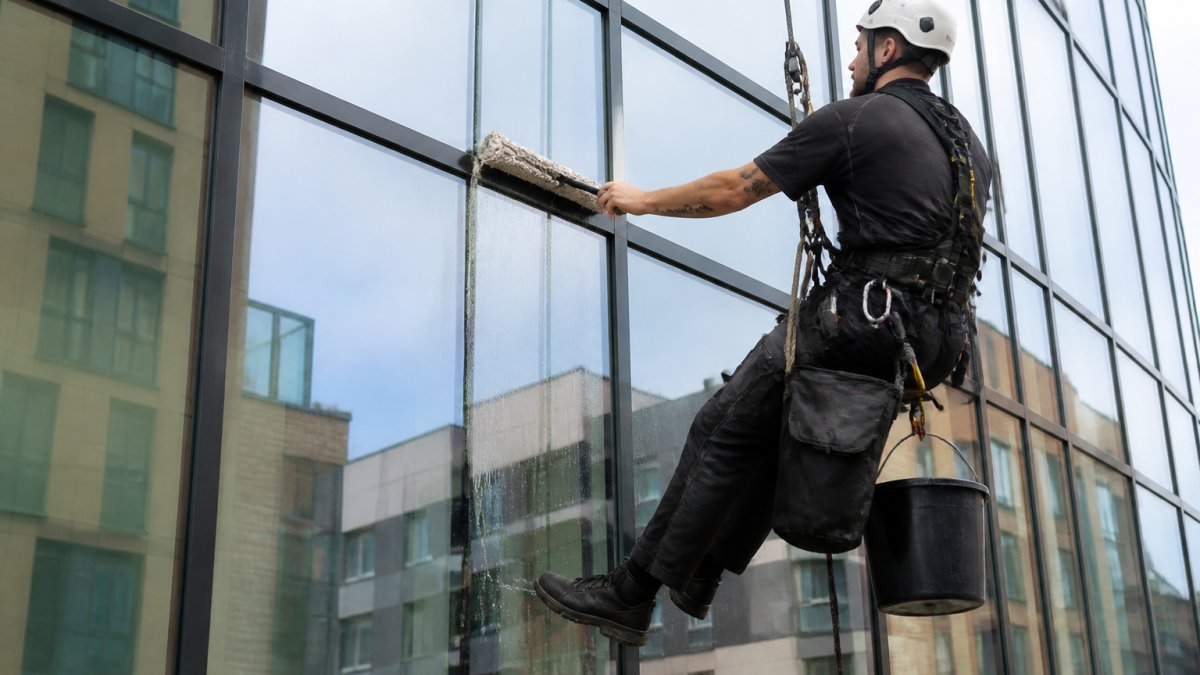
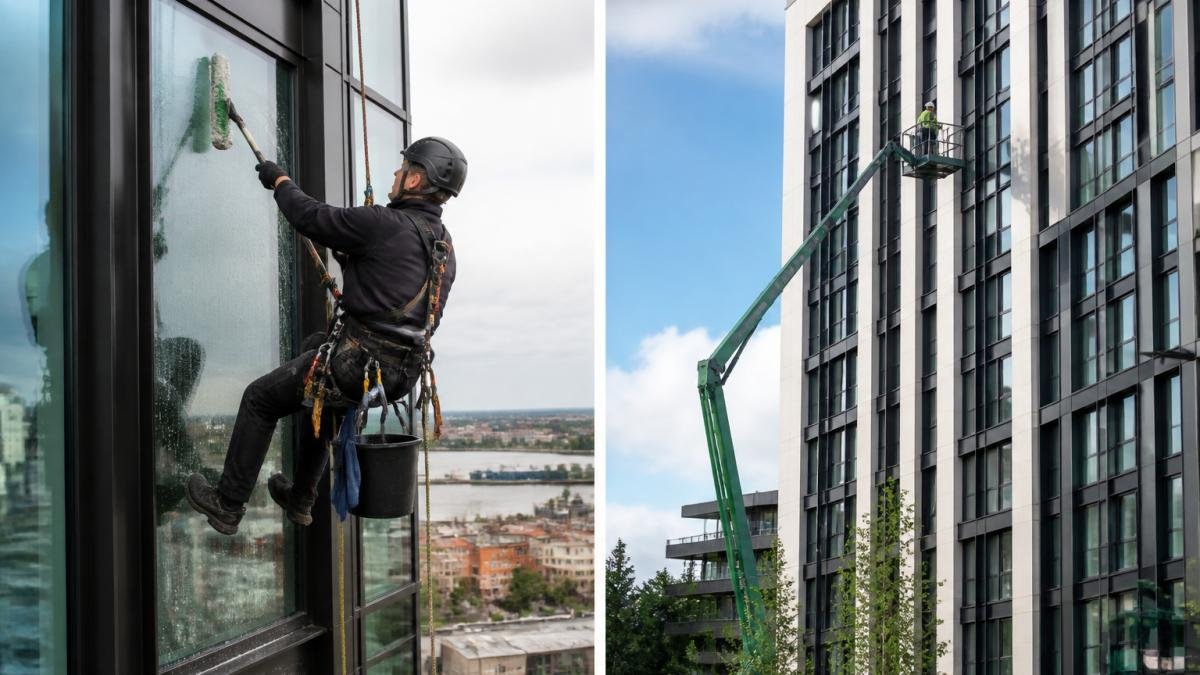
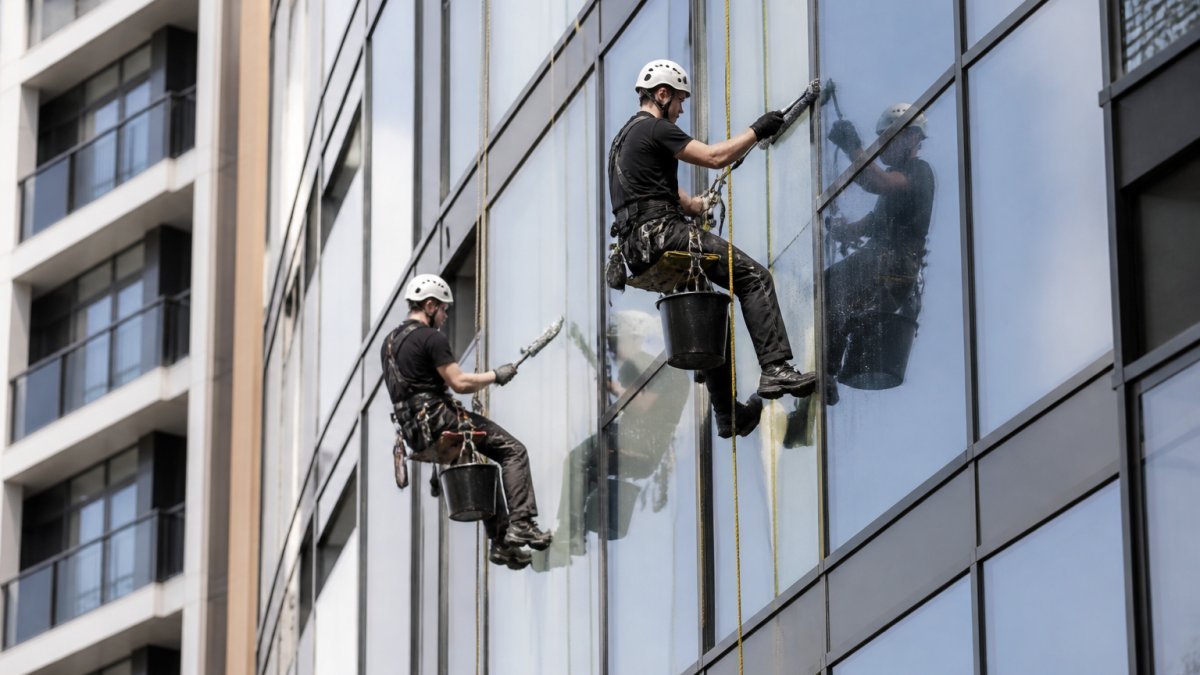
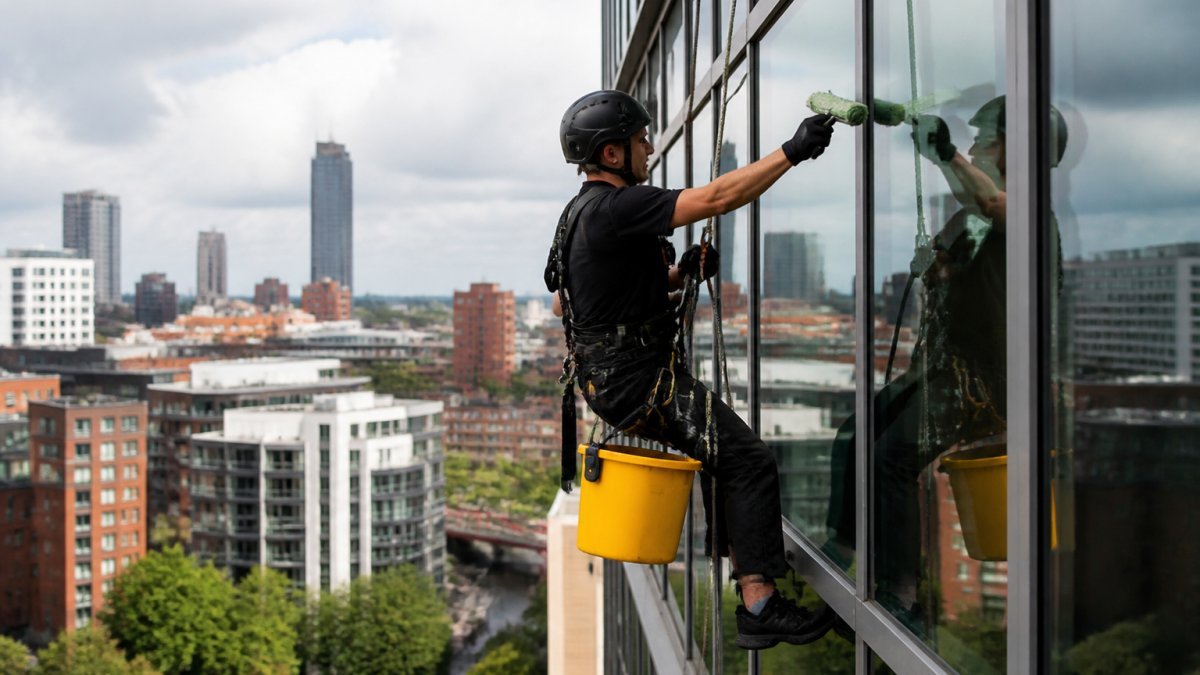
    Two rope access technicians in helmets and harnesses abseiling down the glass facade of a modern apartment block, cleaning windows with squeegees, city skyline visible behind them
    Two rope access technicians in helmets and harnesses abseiling down the glass facade of a modern apartment block, cleaning windows with squeegees, city skyline visible behind them

    Where Rope Access Beats Other Methods

    Rope access wins in specific situations. It reaches elevations that poles can't and buildings that were never fitted with cradles. It sets up quickly compared with scaffolding, which can take days to erect and needs planning permission on some sites. It also handles awkward geometry: angled glass, recessed balconies, atriums and cladding seams.

    Rope access needs trained technicians. That's why the certification question above matters so much. A provider offering abseil work without IRATA-trained staff is a risk.

    Commercial Window Cleaning Frequency: How Often Should Windows Be Cleaned?

    Commercial window cleaning frequency depends on the building's location, exposure and how much the glass is seen. Most Manchester commercial buildings sit somewhere between monthly and quarterly cleans, with high-street retail and customer-facing entrances cleaned more often than back-office elevations.

    Get a Quote →

    City-centre buildings pick up more grime from traffic and construction dust, so they tend to need more frequent visits than suburban sites. Buildings near main roads, tram lines or ongoing development work need the most attention. A provider should recommend a frequency after seeing the site, not before.

    A Simple Frequency Guide by Building Type

    Building Type Typical Frequency Main Reason
    Customer-facing retail and entrances Weekly to fortnightly Presentation and footfall
    City-centre offices Monthly Traffic and construction grime
    Suburban offices Quarterly Lower exposure
    Apartment blocks and BTR Monthly to quarterly Resident expectations
    Cladding and facade panels Twice yearly Material care and inspection

    Treat this as a starting point. Your building's exposure and the finish you want will shift the schedule, and a good provider will adjust it after the first few visits.

    Property Types We Clean Across Greater Manchester

    We clean across Greater Manchester, from Cheadle and the surrounding suburbs through to the city centre and out to the wider region. The buildings we work on fall into a few clear groups:

    • Managed apartment blocks and residential management sites, where block managers need a reliable schedule and a team that's courteous to residents.
    • Build-to-rent developments, often multi-site portfolios needing consistent standards across locations.
    • Corporate offices, including high-level facade and cladding work at height.
    • Retail and mixed-use buildings, where the ground-floor glass is the shop window.

    Each type brings its own access challenges and its own expectations. A BTR tower and a suburban office park need different methods, different frequencies and different reporting.

    Planning, Access and Working Around Your Building's Schedule

    Planning starts with the site visit and the access method. From there, we agree a schedule that fits your building's rhythm: early starts before staff arrive, avoiding event days, or split visits across elevations. We can work around your schedule if your building has events on a Tuesday morning.

    Weather plays a part. High winds stop rope access and cradle work, so a sensible programme builds in flexibility rather than cancelling outright. We'll tell you when conditions rule out a visit and when we'll return.

    Pro Tip
    Ask for a named site supervisor and a direct contact. The single biggest complaint about window cleaning providers is not being able to reach anyone when something's missed. A named contact can help address this.

    Getting a Quote and Booking Your Clean

    A proper quote follows a site visit and sets out the access method, frequency and what's covered on each elevation. Pricing depends on building height, access method, frequency and the number of elevations, so we quote per site rather than publishing a rate card. You can request a quote through Lion Cleaning Group and we'll arrange a visit.

    If you're comparing providers, hold them to the same standard: site visit first, certification and insurance on request, and references from similar buildings. This approach can help you find a suitable provider.

    Frequently Asked Questions

    How often should commercial windows be cleaned in Manchester?

    Most commercial buildings in Manchester sit on a four- to eight-week cycle. Office blocks on busy roads often need monthly cleaning because of traffic film and rain spotting, while quieter sites can stretch to every six to eight weeks. Buildings near construction work or with heavy footfall may need fortnightly visits. The right commercial window cleaning frequency depends on how quickly glass picks up dirt, so a provider should assess your site and agree a schedule rather than apply one fixed interval to every building.

    How do window cleaners work safely at height?

    Teams use rope access, mobile elevating work platforms or water-fed poles from the ground, depending on the building. Rope access technicians are IRATA trained, work in pairs, and rig anchor points that are checked before anyone goes over the edge. Ground areas are cordoned off and the public kept clear. Ask any provider what certification their operatives hold and how they plan access for your specific building before work starts.

    What should I check when choosing a commercial window cleaning company in Manchester?

    Check that operatives hold recognised working-at-height certification, that the company carries public liability insurance, and that they can show references from similar buildings. Ask how they handle scheduling around events and residents, what method they will use on your facade, and whether they use water-fed poles, rope access or platforms. A provider who visits the site before quoting and explains the access plan is usually a safer bet than one who prices blind over the phone.

    What information should I provide when requesting a commercial window cleaning quote?

    Give the building address and height, the number of floors and approximate window count, the facade material, and any access restrictions such as parking, loading bays or shared entrances. Mention whether there are balconies, atriums or glazed stairwells, and any times when work cannot happen. Photos of the elevations help. With that detail a provider can recommend a method and a commercial window cleaning frequency, then give you a realistic quote rather than a rough guess.


    Managing a building where the upper windows have gone too long without attention? Lion Cleaning Group works at height across Greater Manchester with IRATA-trained teams, environmentally friendly products and flexible scheduling that fits around your building. Get in touch for a site visit and a tailored quote, and we'll show you exactly how we'd reach every pane.
  • Commercial Window Cleaning in Salford: A Manager’s Guide

    Commercial Window Cleaning in Salford: A Manager’s Guide

    Table of Contents

    Last Updated: October 17, 2026

    Why Commercial Window Cleaning Matters for Your Property

    Clean windows aren't just about appearance. For apartment blocks, office buildings, and managed properties across Greater Manchester, they're a practical necessity that affects how residents and staff perceive the space.

    Dirty windows reduce natural light, collect debris that damages frames, and signal poor maintenance to anyone entering the building. Property managers we work with at Lion Cleaning Group often tell us that clean windows were one of the first things tenants and visitors noticed.

    Commercial window cleaning Salford isn't a luxury, it's part of keeping a building functional and presentable. Regular cleaning extends the life of frames and seals, prevents water ingress, and maintains the professional standard your tenants expect.

    High-Rise Window Cleaning in Salford: Safety and Equipment

    High-rise window cleaning requires trained operatives and specialist equipment. At heights above three storeys, standard ladders and platforms become impractical and unsafe. This is where rope access work becomes essential.

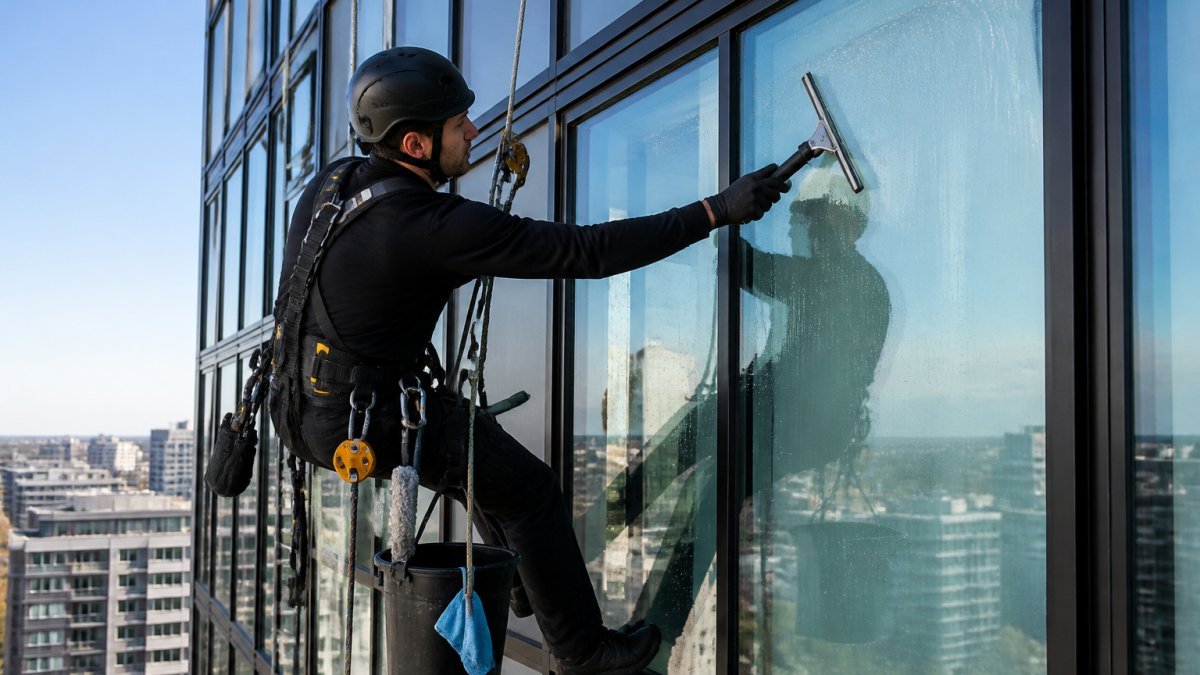
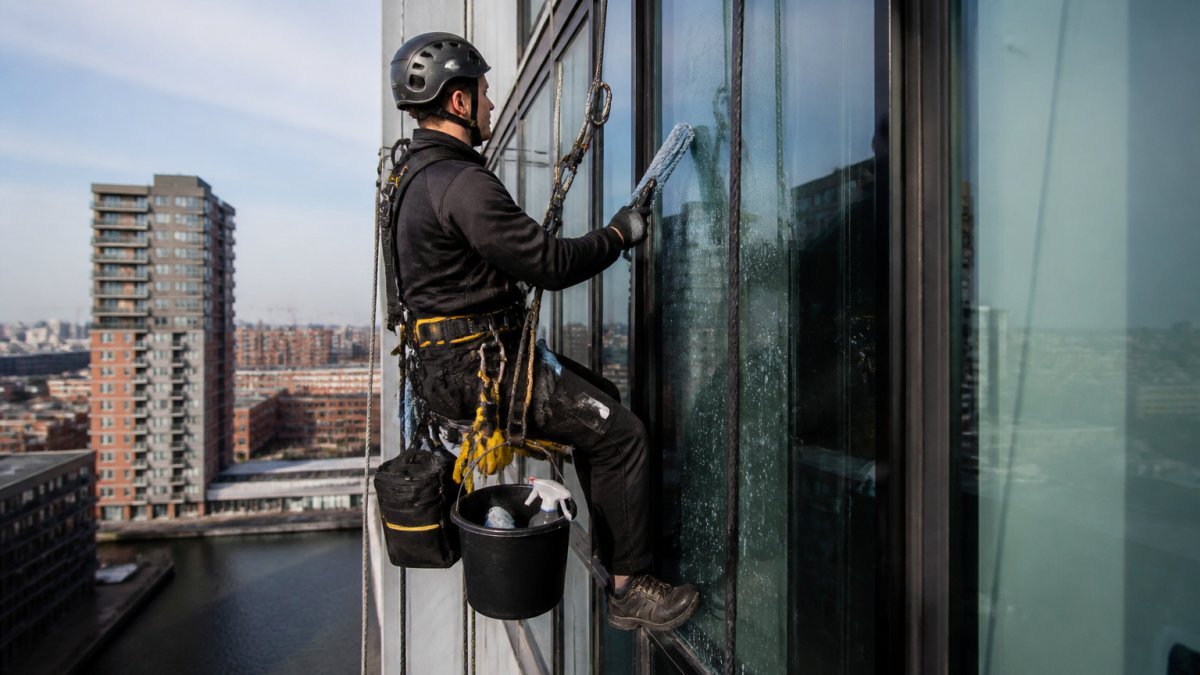
    Professional IRATA-trained rope access operative abseiling down a tall commercial building facade with safety harness, carabiners, and cleaning equipment, securing lines to roof anchor points in daylight
    Professional IRATA-trained rope access operative abseiling down a tall commercial building facade with safety harness, carabiners, and cleaning equipment, securing lines to roof anchor points in daylight

    Our team at Lion Cleaning Group holds IRATA certification, which means operatives have undergone rigorous training in rope access techniques and safety protocols. IRATA (Industrial Rope Access Trade Association) sets the standard for working at height across the UK. Certified operatives understand load calculations, anchor point assessment, and emergency procedures.

    High-rise window cleaning typically uses either single-rope technique or two-rope systems depending on building height and facade condition. The operative descends on a primary rope while a secondary safety line provides backup. All equipment is inspected before each job and replaced on schedule.

    Rope Access Window Cleaning in Salford for Difficult Facades

    Not all commercial buildings have simple, rectangular facades. Some have curved surfaces, setbacks, balconies, or architectural features that make traditional window cleaning impossible.

    Rope access window cleaning in Salford handles these difficult facades by allowing operatives to position themselves exactly where they need to be. An operative can work around obstacles, clean angled surfaces, and reach windows that would otherwise stay dirty.

    This flexibility is particularly valuable for listed buildings or properties with heritage status. Rope access avoids problems associated with scaffolding because operatives work from ropes rather than platforms.

    Cladding and facade cleaning often combines rope access with specialist techniques. Modern buildings with metal panels, glass sections, or composite materials need careful handling to avoid damage. Our operatives assess each surface type and select appropriate cleaning methods and products.

    Apartment Block Window Cleaning in Salford: Scheduling and Standards

    Apartment blocks present a different challenge from office buildings. Residents live in the building, which means cleaning schedules must work around occupancy and avoid disruption during sensitive hours.

    Apartment block window cleaning typically runs on monthly or quarterly schedules, depending on the building's location and exposure. Blocks near main roads or in areas with higher air pollution often need more frequent cleaning. Coastal or industrial areas see faster accumulation of salt spray or particulates.

    Scheduling matters because residents need notice. A professional contractor will confirm dates in advance, work during agreed hours, and coordinate with building management. This prevents complaints and ensures consistent standards.

    Our team at Lion Cleaning Group treats residential blocks with the same professionalism as corporate sites, but adapts the approach to residential needs.

    Window frames in apartment blocks also need attention. Frames collect debris, algae, and mineral deposits from rain and air pollution. Cleaning frames alongside panes ensures the whole window looks maintained, not just the glass.

    Window Cleaning for Managed Properties in Salford

    Managed properties, portfolios of multiple buildings across different locations, need consistency and reliability. A property manager running five apartment blocks or three office buildings can't afford to coordinate with five different contractors.

    Window cleaning for managed properties in Salford works best when a single contractor handles all sites. This creates consistent standards, simplified invoicing, and a single point of contact. If something goes wrong at one property, the same team fixes it quickly.

    Flexibility matters. One month a block might need extra cleaning because of renovation work nearby. Another month, bad weather might delay a scheduled clean. A contractor who adapts to these situations without constant renegotiation saves property managers time.

    Get a Quote →

    Managed properties also benefit from regular communication. Property managers want to know cleaning schedules in advance, receive photos confirming work completion, and have a direct contact for any concerns. This transparency builds confidence that the job is being done properly.

    How Often Should You Clean Commercial Windows?

    The frequency of commercial window cleaning depends on several factors: building location, exposure to weather, surrounding environment, and tenant expectations.

    Office buildings in city centres typically benefit from monthly cleaning. These buildings collect urban dust, vehicle emissions, and atmospheric pollution. Regular schedules keep them looking professional year-round.

    Apartment blocks often run on quarterly schedules, roughly every three months. This maintains appearance without excessive cost. Some blocks with high-profile entrances or premium positioning choose monthly cleaning instead.

    Buildings near industrial areas, construction sites, or main roads accumulate dirt faster and may need more frequent cleaning. Buildings in quieter residential areas might manage with less frequent cleaning.

    Weather also drives frequency. Rainy periods can leave mineral deposits and streaks. Windy seasons blow dust and debris onto windows. After heavy rain or storms, a quick clean-up might be needed outside the regular schedule.

    The best approach is to start with a baseline frequency and adjust based on how the building looks after each clean. A contractor who reviews results with you can recommend adjustments without overselling unnecessary services.

    What to Look for in a Commercial Window Cleaning Contractor

    Choosing a contractor for commercial window cleaning Salford means checking several things before signing an agreement.

    First, verify safety credentials. For high-rise work, ask whether operatives hold IRATA certification (Training Requirements). For ground-level and low-level cleaning, check that the contractor has public liability insurance and understands working-at-height regulations. A reputable contractor will provide evidence of both without hesitation.

    Second, ask about experience with your building type. A contractor experienced with apartment blocks understands resident communication. A contractor experienced with office buildings knows how to work around business hours. Experience matters because it shows the contractor has solved problems similar to yours.

    Third, request references from similar properties. Ask to speak with property managers or facility managers running comparable buildings. Questions to ask references: Did the contractor show up on schedule? Were windows cleaned thoroughly? Did the team communicate well? Were there any problems, and how were they handled?

    Fourth, discuss your specific needs. Every building is different. A contractor who listens to your requirements and proposes a tailored approach is more likely to deliver results than one offering a standard package.

    Finally, clarify what's included. Does the quote cover window panes only, or frames and sills too? Are gutters included? What happens if weather delays a scheduled clean? A clear scope of work prevents misunderstandings later.


    Commercial window cleaning in Salford keeps your building looking professional and maintains the fabric of the structure. Regular cleaning protects frames, extends window life, and shows residents and tenants that you take maintenance seriously. At Lion Cleaning Group, our IRATA-trained team handles everything from routine apartment block cleaning to specialist high-rise rope access work. If your building needs a reliable contractor who understands commercial properties across Greater Manchester, get in touch for a no-obligation assessment. Book a Clean with us today.

    Frequently Asked Questions

    How often should commercial windows be cleaned in Salford?

    Frequency depends on your building type and location. Buildings near busy roads or industrial areas may need more frequent cleaning due to dust and pollution accumulation. Your property manager should assess your specific situation, weather, foot traffic, and building exposure all play a role in determining the right schedule for commercial window cleaning.

    Can rope access window cleaning work on buildings with complex facades?

    Yes. Rope access is ideal for buildings with irregular shapes, protruding elements, or hard-to-reach sections. IRATA-trained operatives can access facades that traditional methods cannot reach safely. This includes curved surfaces, recessed areas, and multi-level architectural features. Rope access window cleaning in Salford allows teams to clean every section thoroughly without the need for scaffolding or expensive equipment, making it both practical and cost-effective for complex commercial properties.

    What makes a reliable commercial window cleaning contractor?

    Look for teams with formal training certifications, proven experience with building types similar to yours, and clear communication about scheduling and expectations. Ask for references from other property managers and facility managers, they'll tell you whether the contractor delivers consistent quality and respects site access requirements. A trustworthy contractor will also discuss safety protocols, equipment standards, and how they handle feedback or missed spots.

    Are environmentally friendly cleaning products effective for commercial buildings?

    Modern eco-friendly products are highly effective for routine window cleaning and are equally capable of removing dirt, algae, and mineral deposits as conventional chemicals. They're particularly valuable in buildings where staff health is a concern or where runoff enters sensitive areas. For most commercial window cleaning in Salford, environmentally friendly solutions deliver excellent results without the harsh fumes or environmental impact of traditional cleaners.

  • IRATA Rope Access Cleaning: How It Works at Height

    IRATA Rope Access Cleaning: How It Works at Height

    Table of Contents

    Last Updated: October 15, 2026

    IRATA Rope Access Cleaning: What the Ticket Actually Means

    IRATA rope access cleaning is window cleaning and facade work carried out by technicians who hang from ropes fixed at roof level, using a two-rope system that has a primary line and a separate back-up line. The ticket that matters is the IRATA certificate: a training and assessment record held by the individual technician, graded from Level 1 to Level 3.

    Here at Lion Cleaning Group, we run IRATA-trained teams out of Cheadle, Greater Manchester, covering apartment blocks, offices and managed property portfolios across the UK.

    The system is simple once you see it. One rope takes the weight. The other is there in case the first one fails. The technician wears a harness that connects to both, and the back-up line runs through a device that grips automatically if the main line goes slack.

    That single design choice is why rope access sits comfortably alongside other methods for work at height. It is not a shortcut. It is a controlled, inspected, documented way of getting a person to a pane of glass that no platform or pole can reach.

    The word "ticket" trips people up, though. It is not a licence issued by a government body. It is a certification scheme run by IRATA International, the Industrial Rope Access Trade Association, and it is renewed through reassessment. A Level 1 technician works under supervision. A Level 3 technician can plan the job, set up the rigging and supervise the team. Most cleaning crews run with one Level 3 and a small number of Level 1s and 2s.

    When a property manager asks whether a contractor is "IRATA certified", this is what they are really asking: are the people on the ropes trained to a recognised standard, and can the company prove it?

    Key Takeaway
    IRATA certification belongs to the individual technician, not the company. Always ask to see the certificates and check the expiry dates, not just the logo on the van.

    Rope Access Window Cleaning: How a Descent Works

    Rope access window cleaning follows a fixed sequence on every drop: anchor, rig, descend, clean, ascend, inspect. The technician never free-climbs and never works from a single line.

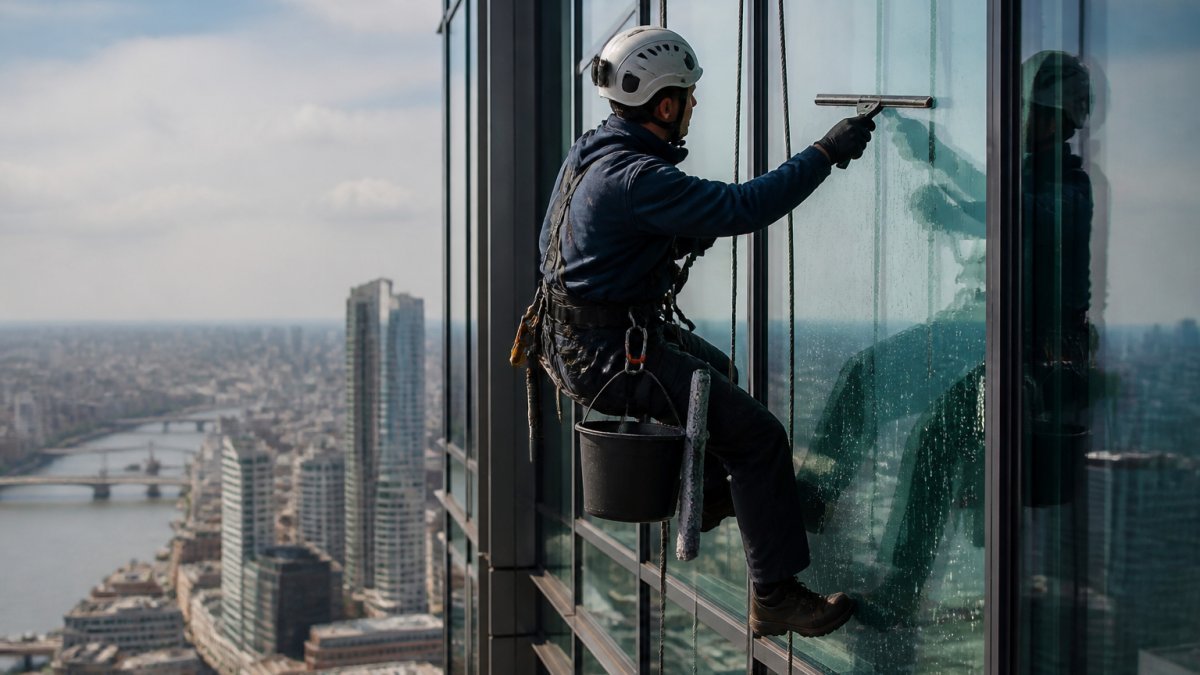
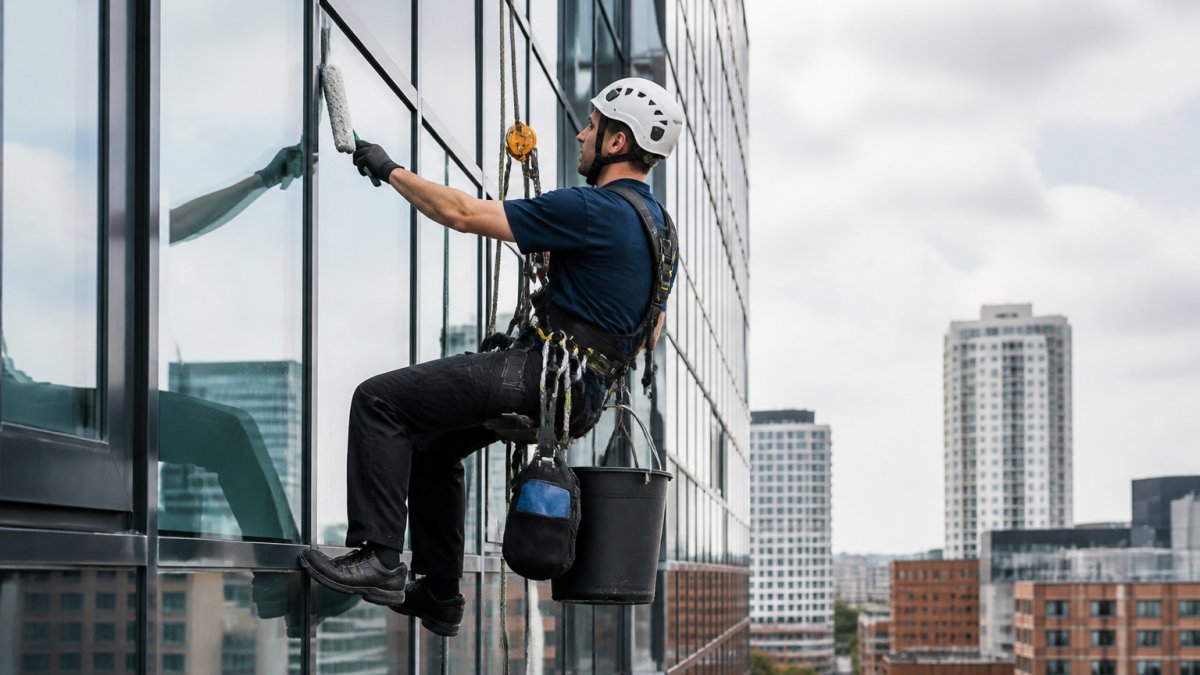
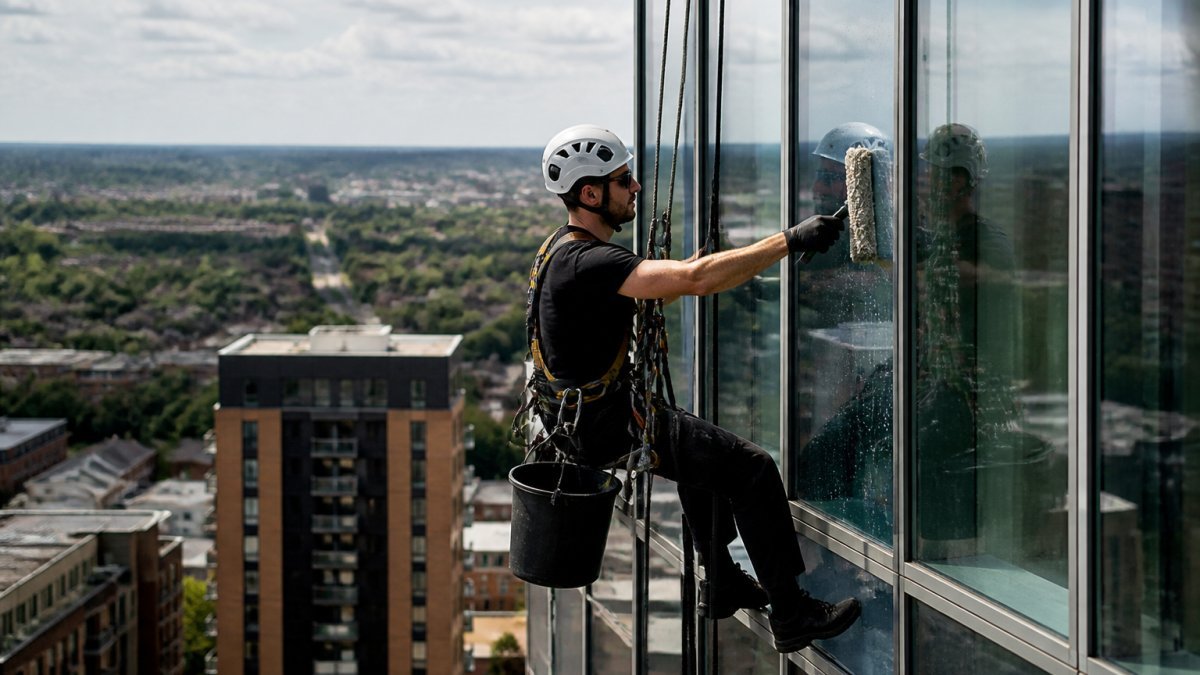
    An IRATA-trained rope access technician in full harness and helmet descending a high-rise apartment facade on two ropes, squeegee in hand, cleaning a glass panel mid-descent on a clear day
    An IRATA-trained rope access technician in full harness and helmet descending a high-rise apartment facade on two ropes, squeegee in hand, cleaning a glass panel mid-descent on a clear day

    The setup starts on the roof. The team identifies anchor points that are structurally sound, then rigs the main line and the back-up line. Both run over edge protection so the rope is not rubbing on a sharp corner. The technician clips in, checks the rig, and lowers over the edge.

    From there the work is methodical. The technician cleans a vertical strip, then moves across, then drops down a section and repeats. Water is fed down in a hose or carried in a bucket on the harness, depending on the building and the height.

    Cleaning a full elevation of a mid-rise block usually takes a day or two with a small team. A single awkward elevation on a taller building can take longer than the whole of a straightforward one, because access, wind and window spacing all slow the descent.

    The ascent is the part people forget. Going up takes longer than going down, and the technician is working against gravity the whole way. Good crews plan the drop so the hardest cleaning happens early, while arms are fresh.

    The Kit: What a Rope Access Team Brings On Site

    A rope access team's kit splits into three groups: the rope system, the personal protective equipment, and the cleaning tools. Every item is inspected before use and logged.

    The rope system carries the load:

    • Main line, usually 11mm semi-static rope
    • Back-up line, matched to the main line
    • Descender device for controlled lowering
    • Back-up device that grips the second line automatically
    • Edge protection pads at the roof lip
    • Anchor slings and connectors rated for the load
    • Rope bags to keep lines clean and tangle-free

    The technician wears a full-body harness, a helmet with a chin strap, and gloves. A small tool bag hangs from the harness so both hands stay free.

    Cleaning tools are chosen for the job:

    • Squeegees with different blade widths for large panes and narrow frames
    • Water-fed poles for reach where a full descent is not needed
    • Scrapers for paint spots and builders' residue
    • Microfibre cloths for frames, sills and detailing
    • A pure-water system for streak-free glass on tall elevations

    What most guides miss is that the cleaning kit is the cheap part. The rope system and PPE get replaced on a schedule whether or not they look worn. That cost sits in the job, and it is why a proper rope access quote is not the same as a ground-level window clean.

    Watch Out
    Rope and hardware have fixed service lives. A contractor who cannot show inspection records is a contractor you should not put on your building.

    Rope Access Cleaning Safety: The Checks Before Anyone Leaves the Roof

    Rope access cleaning safety rests on three checks: the anchor, the rig and the technician. All three are verified before anyone goes over the edge, and the same checks repeat at the end of the drop.

    The anchor check confirms the fixing point is sound and rated. On modern apartment blocks this is often a designed anchor or a certified structural point. On older buildings it may need a sling around a suitable column or beam.

    The rig check covers the rope path. Are both lines over edge protection? Is the descender threaded correctly? Is the back-up device positioned above the descender, where it can actually catch a fall?

    The technician check is the human one. Harness buckles, helmet, connectors, and a final look at the tool bag so nothing heavy is loose.

    Then there is the plan for the day. Wind speed matters more than most people realise. Glass cleaning on a tall elevation in a strong gust is miserable work and unsafe work, so crews stop when conditions turn. Rain is less of a problem than wind, but it still affects the finish.

    Get a Quote →

    A competent team also runs a rescue plan. If a technician cannot get themselves back to the roof, someone needs to reach them. That plan is written before the first descent, not improvised after an incident.

    High-Rise Window Cleaning: When Rope Access Beats a MEWP

    High-rise window cleaning usually comes down to a choice between rope access and a mobile elevating work platform, or MEWP. Rope access wins on tall, awkward or tightly packed buildings. A MEWP wins on low, open elevations with room to set up.

    Here is how the two compare in practice:

    Situation Rope Access MEWP
    Height above 20 metres Practical and fast to set up Reach limits apply
    Tight or landscaped ground No ground footprint needed Needs level standing space
    Glass atria and recessed facades Reaches any pane Often cannot reach
    Low single-storey elevations Slower to rig Quicker and cheaper
    Busy public pavement below Ropes only Needs cordon and permits

    The ground footprint is the big one. A MEWP needs a level, stable base, and on a residential site that often means closing a car park, a path or a loading bay. Rope access needs nothing at ground level except a safe zone under the work area.

    Where a building has a mix of heights, most crews use both. A MEWP for the low frontage, ropes for the tower behind it. That is a planning decision, not a loyalty to one method.

    Apartment Block Window Cleaning in Cheadle and Across Greater Manchester

    Apartment block window cleaning is really a people problem as much as a technical one. Residents live behind the glass you are cleaning, and they notice everything.

    The practical issues are predictable:

    • Balconies with furniture, plants and washing that block access
    • Windows left open, especially in warm weather
    • Pets and children in rooms where a technician appears at the glass
    • Residents who want advance notice before anyone is outside their window

    Good crews post notice in the communal areas a few days ahead. We find a short note in the lobby and a message through the managing agent covers most buildings. On larger schemes, working a floor at a time in a set order keeps things calm.

    Scheduling matters too. Many blocks want the front elevation done in a quieter window, or the whole job moved around a resident event. Flexible scheduling is normal for us, not a favour.

    For blocks in Cheadle and the wider Greater Manchester area, weather adds its own rhythm. Damp, grey spells mean more spotting on glass.

    If you are searching for rope access window cleaning near you, the questions to ask are the same wherever the building sits: who is on the ropes, what is their level, and how do they handle residents?

    Choosing an IRATA Rope Access Cleaning Team

    Choosing an IRATA rope access cleaning team comes down to proof, not promises. Certificates, insurance, method and references. Ask for all four.

    Work through this before you appoint anyone:

    • Ask for each technician's IRATA certificate and check the level and expiry date
    • Confirm the company holds current public liability and employers' liability insurance
    • Ask how anchors are selected and who signs off the rigging plan
    • Request the rescue plan for your specific building
    • Ask what happens if wind stops the job partway through
    • Get two references from buildings similar to yours
    • Confirm who supervises on site and at what level
    • Check how residents will be notified and when

    The references matter more than the paperwork. A block manager will tell you whether a crew turned up when they said they would, whether residents complained, and whether the glass was actually clean at the end.

    At Lion Cleaning Group, our teams are IRATA-trained, we work to a documented safety standard, and we use environmentally friendly cleaning products. We cover apartment blocks, offices and managed portfolios nationwide, with flexible daily and weekly schedules. Block managers we work with, including Emma Riley at CPM, tell us the courtesy shown to residents is what keeps us on site.

    Frequently Asked Questions

    What is IRATA rope access cleaning?

    It is window and facade cleaning carried out by technicians suspended on ropes rather than from a cradle, boom or scaffold. IRATA is the industry body that sets the training and certification standard, so an IRATA-trained operative has passed assessed modules in rope manoeuvres, rigging and rescue. For buildings where a MEWP cannot reach, or where putting one on site is impractical, rope access cleaning gives a safe route to every pane and panel.

    What qualifications should rope access cleaners have?

    Ask for current IRATA certification, a valid medical certificate and evidence of regular refresher training, since IRATA tickets need renewing. Beyond the rope ticket, the team should be able to show public liability insurance and a working-at-height approach that follows the Work at Height Regulations 2005. Lion Cleaning Group's team is IRATA-trained, and staff hold the certifications that go with it.

    Is IRATA rope access suitable for apartment blocks?

    It often suits apartment blocks better than a MEWP or scaffold, because there is no large machine to park, no road closure and no equipment blocking entrances for weeks. Apartment block window cleaning by rope can be phased, and the team can move between elevations as access allows. Where balconies, planters or fragile roof edges get in the way, the rigging plan is adjusted before the visit.

    When is rope access preferable to a MEWP for window cleaning?

    Rope access tends to win on tall or awkward buildings: narrow courtyards, stepped facades, glazed atria and elevations a boom lift cannot safely reach. A MEWP needs firm level ground, a clear footprint and often a permit or traffic management, which adds time and cost. Rope access needs only a safe anchor point and roof access, so high-rise window cleaning can be completed in a fraction of the setup time on the right building.


    A high-rise facade does not clean itself, and the wrong crew on your building is a problem you will feel for months. Lion Cleaning Group brings IRATA-trained rope access teams, nationwide coverage and flexible scheduling to apartment blocks, offices and managed property portfolios, with environmentally friendly products and a safety standard we can evidence. Get started with Lion Cleaning Group and put your building in the hands of a team that works at height every week.

  • Benefits of Regular Skyscraper Window Maintenance

    Benefits of Regular Skyscraper Window Maintenance

    Table of Contents

    Last Updated: 13 October 2026

    Why Skyscraper Window Maintenance Pays for Itself

    Skyscraper window maintenance is the scheduled cleaning and inspection of glass on tall buildings, carried out by trained operatives working at height. The benefits of regular skyscraper window maintenance go well beyond appearance: dirt holds moisture against seals, and small defects caught early stay small. Lion Cleaning Group works on apartment blocks, offices and managed portfolios across the UK.

    Glass on a tall building never gets a quiet week. It faces rain, traffic film, pollen and airborne grit from every direction, and the higher the floor, the harder the wind drives that mix into frame joints and sealant lines. Left alone, that layer stops being cosmetic. It starts working against the building itself. Below, we explain what actually builds up, how often to clean, and what proper high-level work involves.

    The five sections that follow cover the build-up itself, cleaning frequency, methods, safety, and where windows sit within wider facade care.

    What Actually Builds Up on High-Rise Glass

    The film on high-rise glass is rarely just dust. It is a mix of atmospheric pollution, traffic-related particulates, pollen, bird droppings and the minerals left behind when rainwater evaporates. Each one behaves differently.

    Traffic film and pollution particles bond to glass and need proper cleaning agents to shift. Pollen is seasonal and sticky. Bird droppings are acidic and will etch glass if left. Mineral deposits from rain build in thin layers that cloud the view long before anyone notices from the pavement.

    The real damage happens at the edges. Dirt sitting in the frame and sealant line holds moisture there, and moisture is what breaks down seals over time. Clean the glass and you clear the seal edges at the same time.

    Watch Out
    Bird droppings left on glass will etch the surface permanently. No amount of cleaning brings back glass that has already been marked this way, so it becomes a replacement job rather than a cleaning job.

    The Early Warning Effect: Damage Spotted From the Cradle

    A cleaning visit is also an inspection, whether or not anyone calls it one. The operative is inches from the glass, running a squeegee across every panel and looking at every seal, frame and fixing along the way.

    That position is the best vantage point a building ever gets. Cracked sealant, failed gaskets, water tracking behind a frame, a hairline crack in a pane, a loose fixing: these show up during a clean long before they show up as a leak, a draught or a damp patch inside. We flag what we find and report it, so the building's maintenance team can act on a small repair instead of a large one.

    The economics are straightforward. A sealant repair is routine work. Water getting behind cladding, saturating insulation and reaching the internal structure is not.

    High-Rise Window Cleaning Frequency: How Often Is Often Enough?

    Most tall buildings sit comfortably on a quarterly clean, with some on a six-monthly cycle and others needing monthly attention. There is no single correct number, because the right frequency depends on the building, not on a generic rule.

    A quarterly schedule suits most apartment blocks and office buildings in typical urban conditions. Buildings in heavy pollution, close to major roads or under flight paths usually need more. Coastal buildings face salt and wind-driven spray, which pushes them up the schedule too. Buildings surrounded by trees deal with pollen and sap in season.

    What Pushes a Building Up or Down the Schedule

    Five factors decide where a building lands:

    • Location and exposure: busy roads, industrial neighbours and open, windy sites all accelerate build-up
    • Surroundings: trees mean pollen and sap; nearby construction means dust
    • Facade type and angle: glass that faces the prevailing weather takes more of a beating
    • Building use and visibility: a flagship office or a building with a public face will want a tighter cycle
    • Access method: some buildings can be worked more often simply because access is quicker

    The honest answer is that frequency should be set per building after a first visit. Anyone quoting a fixed cycle before seeing the elevation is guessing.

    Building Situation Typical Frequency Main Driver
    Standard urban apartment block Quarterly Routine build-up
    Busy road or industrial setting Monthly to quarterly Traffic film and particulates
    Coastal or exposed site Monthly to quarterly Salt and wind-driven spray
    Tree-lined residential setting Quarterly, plus seasonal Pollen and sap
    Low-visibility or rear elevation Six-monthly Slower build-up

    Skyscraper Window Cleaning Methods: Cradles, Abseil and Water-Fed Poles

    Three methods cover most high-rise window cleaning: cradles, abseil and water-fed poles. The right one depends on the building's height, shape, facade and the access equipment it already has.

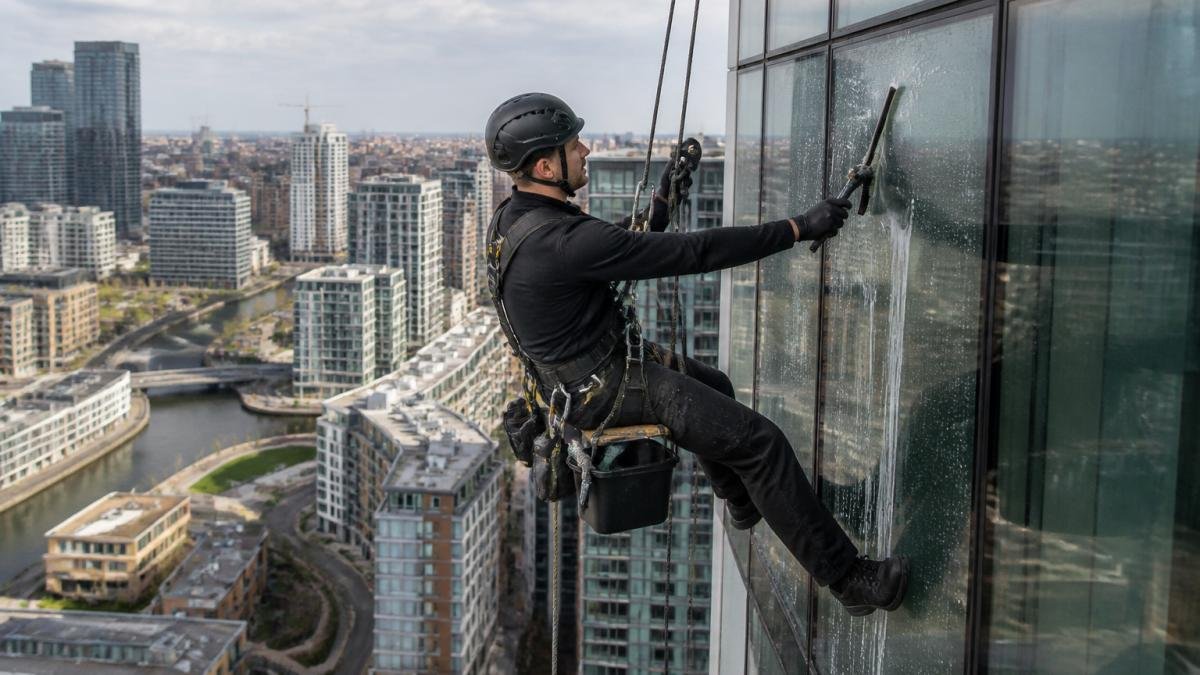
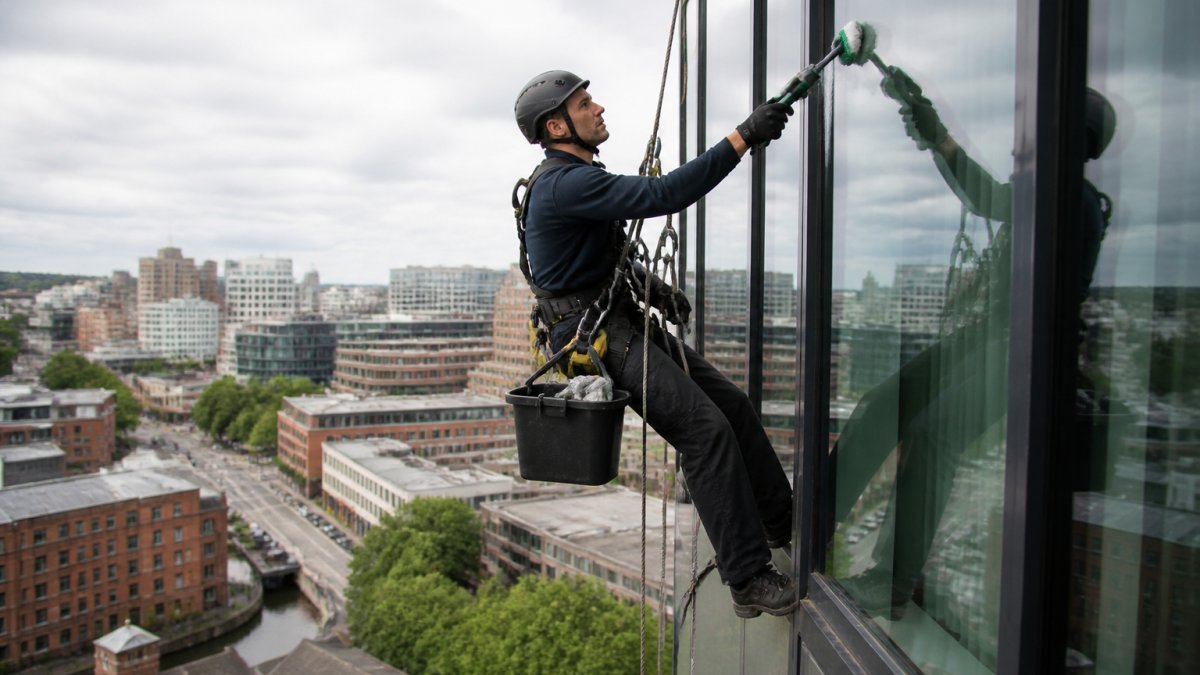
    A rope access technician in full harness and helmet abseiling down the glass facade of a tall residential apartment block, cleaning a window with a squeegee, city skyline visible behind
    A rope access technician in full harness and helmet abseiling down the glass facade of a tall residential apartment block, cleaning a window with a squeegee, city skyline visible behind

    Cradles are suspended platforms that run on tracks or davits fixed to the roof. They suit buildings designed with them, cover large flat elevations efficiently, and allow two operatives to work side by side. The limitation is coverage: a cradle only reaches where its track runs.

    Abseil, or rope access, uses a two-rope system with the operative suspended in a harness. It reaches shapes and elevations that cradles cannot, including recessed sections, atria and irregular facades. It is also quick to set up where roof access is tight. Our team is IRATA-trained, which is the recognised standard for this work.

    Water-fed poles carry purified water to a brush head from ground level or a roof position, reaching several storeys without suspending anyone. They work well on lower-rise sections and where the glass is not heavily soiled. On tall towers, poles usually support abseil or cradle work rather than replace it.

    Get a Quote →

    Pro Tip
    Ask how the team plans to reach the awkward elevations, not just the main face. The recessed sections, returns and internal atria are where cheap quotes quietly exclude work, and where the finished job looks patchy from the ground.

    High-Rise Window Cleaning Safety: The Non-Negotiables

    Safety on high-rise window cleaning is not a paperwork exercise. It is the difference between a job that gets finished and an incident that stops the building's operations and puts people at risk.

    Work at height in the UK is governed by the Work at Height Regulations, which place duties on both the contractor and the building's duty holder (The law). The hierarchy is clear: avoid work at height where possible, prevent falls where it cannot be avoided, and minimise the consequences of a fall where prevention is not enough. You can read the detail in the HSE guidance on work at height.

    In practice, on a rope access job, that means trained and competent operatives, inspected and logged equipment, a safe rigging plan for each elevation, exclusion zones at ground level, and a rescue plan that does not depend on calling the fire service. Weather is a live factor: wind speed at 20 storeys is not the wind speed at street level, and work stops when conditions move outside safe limits.

    For building managers, the questions worth asking are simple. Who is trained, to what standard, and how is that evidenced? What happens if something goes wrong mid-descent? A team that answers those without hesitation is a team you can put on a tower.

    Facade Maintenance for Tall Buildings: Where Windows Fit In

    Facade maintenance for tall buildings works best as one coordinated programme rather than a series of separate jobs. Windows, cladding, sealant lines and rainwater goods all sit on the same elevation and all degrade from the same exposure.

    Treating them separately is how buildings end up paying for access twice. If a rope access team is already on the elevation cleaning glass, that same access can carry out a cladding inspection, clear a blocked outlet or note a failed seal.

    This is the practical case for a planned cycle. A building on a regular schedule builds up a record of its elevations over time, and problems get caught in sequence rather than in a crisis.

    Choosing a High-Rise Window Cleaning Team in Greater Manchester

    Choosing a high-rise window cleaning team in Cheadle or anywhere across Greater Manchester comes down to three things: training, access capability and reliability. Height is not the place to find out that a contractor was overselling.

    Ask for evidence rather than assurances. IRATA certification for the operatives who will actually be on the ropes, not just the company. Insurance that covers work at height. A clear method for each elevation. References from other property managers running similar buildings, because a team that performs on an apartment block performs on yours.

    Coverage matters if you manage more than one site. A provider that can service a single building in Cheadle but not the rest of your portfolio creates a second set of contractors, standards and invoices. We work across the UK on managed portfolios, apartment blocks and offices, which keeps one team and one standard across every site.

    If you are searching for high-rise window cleaning near me and comparing providers, ask each one the same set of questions and compare the answers side by side. The differences show up quickly.


    Dirt left on glass etches it, moisture trapped at seal edges breaks seals down, and small defects found late become structural problems found later still. Lion Cleaning Group provides working at height specialists, environmentally friendly cleaning products and flexible scheduling, with IRATA-trained staff who report what they find on every elevation. Get started with Lion Cleaning Group and put your building on a cleaning cycle that protects the glass, the seals and the facade behind them.

    Frequently Asked Questions

    What are the benefits of regular high-rise window cleaning?

    Regular skyscraper window maintenance keeps glass clear for residents and tenants, and it lets the cleaning team spot problems early: cracked panes, failed seals, corroded fixings and damaged cladding. On a rope access descent, a technician sees every floor close up, so small faults are reported before they become water ingress or repair bills. It also protects the building's appearance, which matters for lettings and valuations.

    How often should skyscraper windows be cleaned?

    Most UK high-rise buildings sit on a two to four cleans per year cycle, with city-centre towers near busy roads often on a monthly or six-weekly schedule. The right high-rise window cleaning frequency depends on how much dirt the glass collects, so a building beside a main road or railway will need more visits than one set back in a park. Your provider should walk the facade and set the schedule around what it actually sees.

    What safety measures are used for window cleaning at height?

    High-rise window cleaning safety rests on trained, IRATA-trained technicians, inspected harnesses and ropes, secure anchor points, exclusion zones below the work area, and a rescue plan that does not rely on calling the fire service. Equipment is checked before every descent, and work stops in high winds or heavy rain. Ask any provider to show certification and insurance before they set foot on your roof.

    Can rope access be used to clean skyscraper windows?

    Yes. Abseil or rope access is a way to reach high-rise glass, especially where a building management unit cannot be moved or a cradle is slow to rig. It also lets technicians reach awkward sections, atrium glass and cladding that cradles miss. Lion Cleaning Group's team is IRATA-trained and uses rope access across apartment blocks, offices and managed portfolios.

  • Hiring Professional Window Cleaners: Commercial Property Guide

    Hiring Professional Window Cleaners: Commercial Property Guide

    Table of Contents

    Last Updated: October 12, 2026

    Why Professional Window Cleaners Matter for Commercial Properties

    Clean windows matter more than most property managers realise. They're not just about appearance, they affect how your building feels to staff, visitors, and clients the moment they walk through the door. When windows are neglected, dirt builds up fast, especially on high-rise buildings where weather and pollution take their toll.

    Professional commercial window cleaning isn't a luxury. It's maintenance. Buildings with dirty windows look neglected, even if everything else is spotless. That first impression sticks. More importantly, regular cleaning protects your glass from permanent damage caused by mineral deposits, algae, and environmental contamination that accumulate over time.

    At Lion Cleaning Group, we work with property managers across the UK who manage everything from city-centre apartment blocks to sprawling office complexes. The difference between handling this in-house and bringing in specialists becomes clear quickly. Professional teams have the right equipment, the right training, and crucially, they understand working at height safely. That's not something to cut corners on.

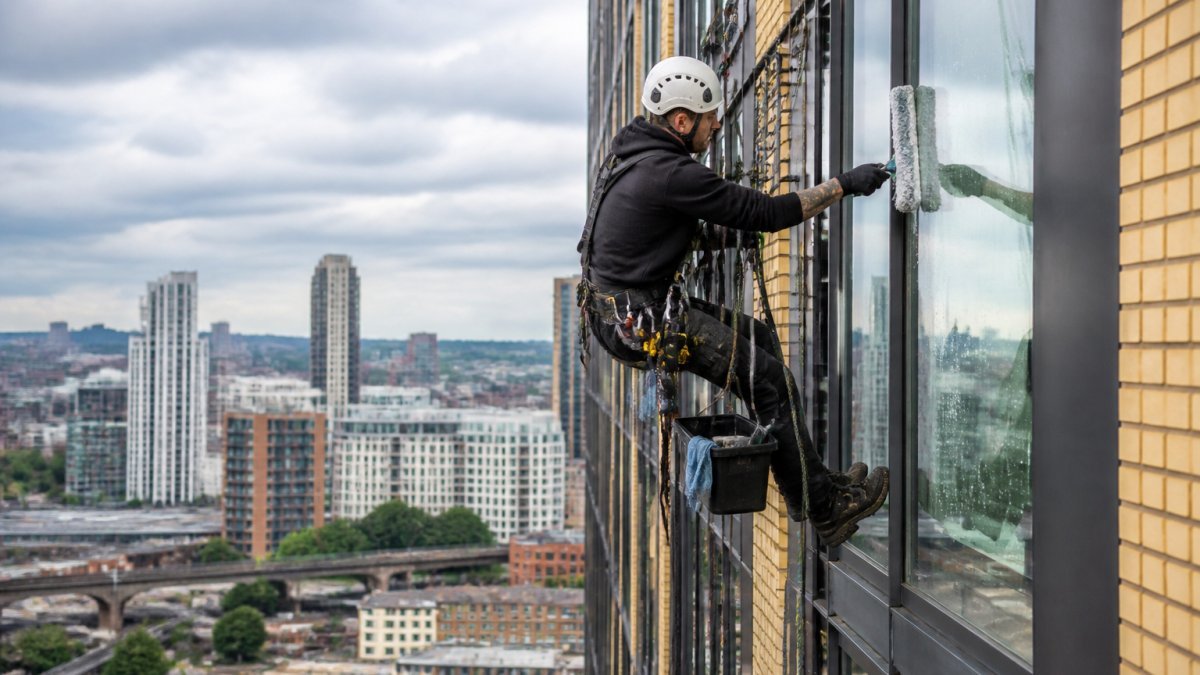
    Professional abseiler in safety harness descending on rope alongside tall office building facade, performing high-rise window cleaning with equipment visible
    Professional abseiler in safety harness descending on rope alongside tall office building facade, performing high-rise window cleaning with equipment visible

    Safety Qualifications and Working-at-Height Credentials

    Any team working above ground level needs proper credentials. This isn't optional, it's a legal requirement under the Work at Height Regulations 2005. Your cleaners must be trained, competent, and properly equipped. If they're not, you're liable.

    The standard qualification in the UK for rope access work is IRATA certification. IRATA stands for Industrial Rope Access Trade Association, and it's the benchmark for working at height safely. Our team at Lion Cleaning Group holds IRATA qualifications, which means they've undergone rigorous training in rope techniques, safety systems, and emergency procedures. This isn't a box-ticking exercise, it's intensive, hands-on training that covers everything from rigging to rescue.

    When you're evaluating professional window cleaners for commercial property, ask directly about their certifications. A legitimate provider will have no hesitation showing you their credentials. They should be able to name their IRATA level (Level 1, 2, or 3) and explain what that means for your specific job. If they're vague about qualifications, that's a red flag.

    Beyond IRATA, look for teams with insurance that covers working at height. Employers' liability insurance and public liability insurance are non-negotiable. The provider should carry public liability cover. Ask to see their certificates of insurance before any work starts.

    High-Rise Window Cleaning: Equipment and Access Methods

    High-rise window cleaning requires specific equipment and methods. There's no one-size-fits-all approach, what works for a four-storey apartment block in Cheadle won't necessarily work for a twenty-storey office tower in Manchester city centre.

    The most common methods are rope access, water-fed poles, and cradles. Each has its place depending on building height, architecture, and access points.

    Rope access is the most versatile for truly high buildings. Trained abseilers descend on ropes, secured to anchor points on the roof or upper structure. This method works on buildings with difficult geometry, protruding features, or where traditional equipment can't reach. It's precise, controlled, and allows cleaners to work on individual panes without rushing.

    Water-fed poles use lightweight poles with purified water systems. Cleaners stand on the ground and extend poles upward, typically up to around six storeys, sometimes higher with specialist equipment. This is efficient for regular maintenance on mid-rise buildings and keeps teams working at ground level where it's safer and faster.

    Cradles and platforms are permanent or temporary suspended platforms. These suit buildings with regular facade maintenance needs and are common on office buildings where windows need cleaning frequently. They're more expensive to install but allow teams to work methodically across large areas.

    For commercial property in Greater Manchester and across the UK, rope access is often the practical choice for anything above five storeys. It's flexible, safe when done properly, and works on nearly any building shape. The key is having a team trained to the right standard, which brings us back to those IRATA qualifications.

    Rope Access Window Cleaning for Apartment Blocks and Offices

    Rope access window cleaning is the standard for apartment blocks and tall office buildings. When you've got residents or staff inside, you need a method that's controlled, safe, and doesn't disrupt the building.

    Abseilers work from the roof down, cleaning one section at a time. They're secured on multiple ropes with backup systems, if one fails, they're still safe. This redundancy is built into every job. The team will plan access points, identify anchor locations, and set up systems before anyone goes over the edge. That planning phase is where safety gets done, not during the work itself.

    For apartment blocks, rope access means residents stay comfortable inside. There's no scaffolding blocking windows, no temporary platforms cluttering the facade, no noise or disruption. Cleaners work methodically from top to bottom, and the job gets done in a fraction of the time traditional methods would take. Our team has handled blocks across Liverpool, Manchester, and beyond, they understand the logistics of working around occupied buildings.

    Office buildings benefit from the same approach. High-rise commercial properties often have glass facades that are expensive to damage and critical to the building's appearance. Rope access lets trained professionals clean every pane carefully without the risk that comes with other methods. Scheduling is straightforward, you pick dates that suit your building, and the team executes efficiently.

    The cost of rope access is proportional to the complexity of the job, the height, and the area to be cleaned. Rather than guessing at pricing, get a specialist to assess your building first. They'll measure access points, evaluate the facade, and give you an accurate quote based on what's actually needed.

    Commercial Window Cleaning Frequency: What Your Property Needs

    How often should you clean your windows? The answer depends on your building type, location, and environmental factors.

    For most office buildings in urban areas, quarterly cleaning (four times per year) is standard. This keeps windows consistently clean and prevents the heavy build-up that becomes harder to remove later. If your building is near major roads or industrial areas, you might need more frequent cleaning, six-weekly or monthly depending on pollution levels.

    Apartment blocks typically follow a similar schedule, though it depends on ground-level exposure. Ground-floor windows get dirtier faster than upper floors. Some property managers clean ground and lower floors more frequently, monthly or six-weekly, while upper floors go on a quarterly schedule.

    Coastal properties need different thinking. Salt spray accelerates corrosion and mineral build-up. Buildings near the coast should be on a more frequent schedule, at least every six weeks, sometimes monthly. The same applies to buildings near agricultural areas where dust and pollen are heavier.

    Your location matters. Buildings in Cheadle and across Greater Manchester deal with typical UK weather, regular rain, occasional industrial fallout, and seasonal pollen. If your building has particular exposure, facing a busy road, surrounded by construction, or in an area with heavy pollution, increase frequency accordingly.

    The practical approach is to assess your building's condition after the first professional clean, then establish a schedule based on how quickly dirt returns. A good provider will advise you on this rather than pushing you toward unnecessary frequency. You want clean windows, not over-servicing.

    Creating a Commercial Window Cleaning Quote Checklist

    Before you commit to professional window cleaners commercial services, get a detailed quote. A proper quote tells you exactly what you're paying for and removes surprises later.

    Here's what your quote should include:

    Building details: Height, number of storeys, total window area, building materials, and access points. The provider should have visited or at least reviewed plans. A quote based on guesswork is worthless.

    Get a Quote →

    Access method: Which technique will they use, rope access, water-fed poles, cradles, or a combination? This directly affects cost and timeline.

    Scope of work: What exactly gets cleaned? Interior only, exterior only, or both? Frame cleaning? Sills? Gutters? Be specific. Vague scopes lead to disputes later.

    Frequency: How often, and what does each visit include?

    Timeline: How long does the job take? When will it happen? Are there any building access restrictions they need to plan around?

    Insurance and credentials: Certificate of insurance, IRATA level, and any other relevant certifications. This should be included without asking.

    Cleaning products: What will they use? If your building has environmental requirements or resident sensitivities, this matters. Professional providers should be happy to discuss their products.

    Safety measures: How will they protect the building, residents, and staff? What happens if weather stops work mid-job?

    Terms: Payment terms, cancellation policy, what happens if work isn't satisfactory.

    A detailed quote takes time to prepare because it requires a proper site assessment. If a provider gives you a quote over the phone without visiting, that's a warning. They don't know your building well enough to price it accurately.

    Questions to Ask Before Committing to a New Provider

    Once you have quotes, you need to evaluate the providers themselves. The cheapest option isn't always the best, you're hiring a team to work at height on your building. Competence and reliability matter more.

    Ask these questions:

    How long have you been operating? Experience matters. A team that's been doing this for ten years has handled edge cases and learned from mistakes. New operators might be competent, but established providers have proven track records.

    Can you provide references? Ask for contact details from other property managers they work with, ideally managing similar buildings. Call them. Ask whether the team showed up on time, did thorough work, and handled any issues professionally.

    What's your process if weather stops work? Bad weather can halt jobs. How do they reschedule? Do they charge extra? Is there a contingency plan?

    What insurance do you carry, and what does it cover? Get specifics. Employers' liability, public liability, and tools insurance are standard. Ask about cover limits and whether they have specific cover for your building type.

    How do you handle complaints or issues? If a window isn't cleaned properly or something gets damaged, how do you resolve it? A provider who takes responsibility and fixes problems without argument is worth keeping.

    Are you IRATA-trained, and can you show your certification? For any work at height, this is essential. Ask to see current certificates. IRATA training requires renewal, so check that credentials are current.

    Do you work with other properties like mine? If they manage apartment blocks, office buildings, or mixed-use properties similar to yours, they understand your specific challenges.

    What's included in your quote, and what costs extra? Clarify whether the quote is fixed or if additional charges might apply. Ask about extras like frame cleaning, internal windows, or post-job inspections.

    A provider who answers these questions clearly and confidently is worth considering. If they're evasive or dismissive, keep looking.


    Hiring professional window cleaners for commercial property is an investment in your building's appearance, safety, and long-term condition. The right team, properly trained, properly insured, and experienced with buildings like yours, makes the difference between adequate maintenance and genuinely professional care.

    At Lion Cleaning Group, we've built our reputation on exactly this: IRATA-trained teams, rigorous safety standards, and the kind of reliability that keeps property managers coming back.

    Frequently Asked Questions

    What qualifications should professional window cleaners have for high-rise work?

    For work at height, window cleaners must hold IRATA (Industrial Rope Access Trade Association) certification, demonstrating competence in rope access techniques and safety protocols. They should also carry public liability insurance and evidence of working-at-height training. Always ask for credentials before hiring, especially for high-rise properties or rope access work on apartment blocks and offices.

    How often should a commercial property have its windows cleaned?

    Frequency depends on your property type, location, and weather exposure. Most commercial office buildings benefit from regular cleaning, whilst apartment complexes often need consistent services. Ground-level windows in dusty areas may require more frequent attention. A professional window cleaning provider can assess your specific needs and recommend a schedule that maintains appearance and protects your investment.

    What should I include in a commercial window cleaning quote checklist?

    Request details on: number of windows and building height, access methods and equipment needed, cleaning frequency and scheduling flexibility, insurance and safety certifications, environmentally friendly products used, team size and training background, and references from similar properties. Clarify what's included (frames, sills, gutters) and any additional services. Compare quotes on scope and quality, not price alone.

    Can rope access cleaning handle windows on tall residential and office buildings?

    Yes. Rope access window cleaning is ideal for high-rise residential apartments, office towers, and buildings where traditional scaffolding is impractical or costly. IRATA-trained abseilers use safety harnesses and ropes to access and clean exterior windows at any height. This method is particularly effective for listed buildings, complex facades, and multi-storey developments where standard equipment cannot reach.

  • Apartment Block Window Cleaning Manchester: A Guide

    Apartment Block Window Cleaning Manchester: A Guide

    Table of Contents

    Last Updated: October 12, 2026

    What Makes Apartment Block Window Cleaning Different

    Apartment block window cleaning isn't the same as cleaning a single house or a small commercial unit. When you're managing a residential complex, you're dealing with multiple storeys, dozens or hundreds of windows, and the practical challenge of coordinating access across occupied units.

    The scale changes everything. A terraced house takes a few hours. An apartment block with 60 units across six storeys takes planning, coordination with residents, and safety protocols that go beyond what ground-level work requires. You need teams that understand how to work around people's schedules, manage access to communal areas, and handle the technical side of working at height.

    At Lion Cleaning Group, we've managed apartment blocks across Greater Manchester and beyond. The difference between a routine clean and a professional job comes down to whether the team has experience with residential complexes specifically. They need to know how to minimise disruption to residents, work safely when windows overlook busy streets or shared courtyards, and deliver consistent results across multiple visits.

    Most apartment blocks need regular maintenance. Windows collect dirt faster in urban areas, and the more units you have, the more visible any neglect becomes. A single dirty window on the fifth floor is noticed. Multiply that across the building, and it affects how residents and visitors perceive the entire complex.

    High-Rise Window Cleaning Manchester: Safety and Equipment

    High-rise window cleaning requires equipment and training that standard window cleaning doesn't. You can't use a ladder on the side of a six-storey building. You need rope access teams, harnesses, and people trained to work safely at height.

    This is where IRATA certification matters. Our team at Lion Cleaning Group holds IRATA qualifications, which means they've completed rigorous training in rope access techniques and safety protocols. IRATA (Industrial Rope Access Trade Association) sets the standard for working at height across the UK. Teams with this qualification understand fall protection, equipment inspection, and how to manage risk on high-rise work.

    The equipment itself is substantial. Rope access requires ropes rated for the load, harnesses that distribute weight correctly, and backup systems in case the primary rope fails. The team needs to inspect all equipment before every job. A frayed rope or a worn harness isn't acceptable.

    Weather matters more on high-rise work too. Wind at ground level is manageable. Wind at the fifth or sixth floor changes how a team works. Rain makes surfaces slippery. Teams need to know when conditions are safe and when to reschedule. Rushing a high-rise clean because the weather window is closing is how accidents happen.

    For apartment blocks in Cheadle or across Manchester, high-rise window cleaning also means working around residents. You can't close off a residential building the way you might close a commercial site. Teams need to plan access carefully, communicate with building management, and work in a way that doesn't create safety hazards for people moving around the building.

    IRATA-trained rope access technician abseiling down the facade of a tall apartment block with safety harness and equipment, cleaning windows at height with Greater Manchester cityscape visible below
    IRATA-trained rope access technician abseiling down the facade of a tall apartment block with safety harness and equipment, cleaning windows at height with Greater Manchester cityscape visible below

    Rope Access Window Cleaning Manchester for Hard-to-Reach Facades

    Some apartment blocks have features that make them difficult to clean. Protruding balconies, recessed areas, or architectural details mean certain windows can't be reached from a standard ladder or platform. This is where rope access becomes essential, not optional.

    Rope access lets teams reach windows that would otherwise stay dirty. A window recessed behind a balcony overhang, or one on a corner where wind makes ladder work unsafe, becomes accessible when you have trained abseil technicians. They can position themselves precisely where they need to be and work safely in positions that would be impossible from the ground.

    The technique also works for facades with cladding or unusual materials. Apartment blocks built in the last 20 years often have composite cladding, metal panels, or other finishes that need different cleaning approaches than traditional brickwork. Rope access teams can work close to these surfaces and clean them properly without damaging the material.

    For buildings in Greater Manchester with complex architecture, rope access is often the only practical solution. Trying to force a standard cleaning method onto a building that needs specialist access usually results in missed windows or rushed work. A team that understands rope access planning can assess the building and propose the right approach before work starts.

    Communication with building management is important here too. If you're planning rope access work on an apartment block, residents need to know what's happening and when. A team abseiling down the outside of the building is visible and can cause concern if people aren't prepared for it. Professional teams coordinate with management to brief residents and ensure the work runs smoothly.

    How Often to Clean Apartment Block Windows

    The right cleaning frequency depends on the building's location, the type of windows, and how quickly dirt accumulates. There's no universal answer, but several factors determine what works.

    Buildings in urban areas like Manchester city centre collect dirt faster than those in quieter suburbs. Traffic pollution, industrial dust, and general atmospheric grime build up on windows exposed to busy streets. A block near a main road might need cleaning every four to six weeks. One in a quieter area might be fine on a quarterly schedule.

    The building's orientation matters too. Windows facing a busy road collect more dirt than those facing a park or open space. South-facing windows in sunlight show marks more clearly, so they might need more frequent cleaning even if the actual dirt level is similar. North-facing windows stay cleaner-looking longer.

    Resident expectations also play a role. Some apartment blocks maintain very high standards and expect windows cleaned monthly. Others operate on a twice-yearly schedule. The building's market positioning and the type of residents influence this decision. A premium development will clean more frequently than a standard residential block.

    Weather in the North West affects how quickly windows need cleaning. Rain helps rinse dust away, but it also leaves water marks. Dry spells mean dust accumulates faster. Over time, you learn what schedule works for your specific building based on how it looks between cleans.

    Most apartment blocks find that a quarterly clean keeps windows in good condition. Some move to six-weekly cycles during spring and summer when there's more activity and pollen in the air. A professional cleaning contractor can assess your building and recommend a schedule that works for your situation.

    Choosing the Right Apartment Block Window Cleaning Contractor

    Not all window cleaning contractors have experience with apartment blocks. Some specialise in domestic properties or small commercial units. When you're managing a residential complex, you need a team that understands the specific challenges of multi-unit buildings.

    Get a Quote →

    Experience with your building type matters. A contractor who's cleaned dozens of apartment blocks in Manchester knows the common issues: how to coordinate with residents, how to manage access, how to schedule work around building events. They've solved problems you haven't encountered yet.

    Safety credentials are non-negotiable. If the work involves any height, the team should have IRATA certification or equivalent qualifications. Ask to see their certifications and insurance. A contractor who's vague about their safety training or won't provide references is a risk you don't need to take.

    References from other building managers are valuable. If a contractor has cleaned similar blocks in the area, they can point you to clients you can contact. Ask specifically about reliability, attention to detail, and how they handle problems. A reference from someone running a comparable building is worth more than any marketing claim.

    Communication is often overlooked but essential. The best contractor is one who keeps you informed, responds to queries, and lets residents know what to expect. If a team arrives without warning or leaves windows unfinished, that's a sign of poor organisation. Professional contractors plan ahead and communicate clearly.

    Pricing matters, but it shouldn't be the only factor. The cheapest quote often means corners are cut. A contractor who understands apartment block work will price fairly for the complexity involved. They factor in safety protocols, equipment costs, and the coordination required. If a quote seems too low, it probably is.

    Why Scheduling Matters for Residential Complexes

    Scheduling window cleaning in a residential building is more complex than scheduling it for a commercial site. Residents live in the building, and their routines need to be considered. A team that shows up at 7am on a Tuesday morning might catch residents leaving for work or children getting ready for school.

    The best contractors work around residents' schedules, not against them. That might mean starting later in the morning, avoiding school hours, or scheduling work on quieter days. It requires flexibility and communication with building management to understand when the building is least busy.

    Some apartment blocks have restrictions on when external work can happen. A building with a strict no-noise policy before 8am, or one where weekends are off-limits, needs a contractor who respects those boundaries. Professional teams ask about these restrictions upfront and build them into their planning.

    Coordination with other maintenance also matters. If the building is having roof work done or the communal areas are being refurbished, window cleaning might need to fit around those projects. A contractor experienced with apartment blocks knows how to slot their work into the building's maintenance calendar without creating conflicts.

    Seasonal scheduling is worth considering too. Spring and autumn are busy times for window cleaning across Manchester. If you book early, you get better availability and can ensure the work happens when you want it. Waiting until the last minute often means accepting whatever slots are available.

    Regular scheduling, whether weekly, monthly, or quarterly, creates routine and reliability. Residents get used to the team being there on a particular day, and the contractor can plan their workload efficiently. This consistency usually leads to better results than sporadic, ad-hoc cleaning.

    Conclusion

    Apartment block window cleaning in Manchester requires more than basic window cleaning skills. It demands safety expertise, experience with multi-unit buildings, and the ability to coordinate across dozens of residents and their schedules. The team needs IRATA certification for any high-rise work, professional equipment, and a clear understanding of how to manage the logistical side of residential complexes.

    Lion Cleaning Group brings all of this to apartment blocks across Cheadle and Greater Manchester. Our IRATA-trained team understands rope access work, handles high-rise facades safely, and coordinates with building management to minimise disruption. We work around resident schedules, manage access to communal areas, and deliver consistent results across multiple visits.

    If your apartment block needs professional window cleaning, whether it's regular maintenance or a one-off deep clean of hard-to-reach windows, get in touch. We'll assess your building, recommend a cleaning schedule that works for your residents, and handle the work to the standard your complex deserves.

    IRATA Industrial Rope Access Trade Association standards

    Frequently Asked Questions

    How often should apartment block windows be cleaned?

    Most apartment blocks benefit from cleaning every 6 to 12 weeks, depending on location, weather, and pollution levels. Blocks in urban areas or near busy roads may need more frequent cleaning due to dust and exhaust buildup. A professional contractor can assess your building and recommend a schedule that keeps windows clear and maintains the building's appearance year-round.

    What is rope access window cleaning and when is it needed?

    Rope access window cleaning uses IRATA-trained technicians who abseil down the building facade using safety harnesses and ropes to clean windows and facades that cannot be reached from the ground or with standard equipment. It is essential for high-rise apartment blocks, buildings with complex architecture, or those without suitable access points. This method allows thorough cleaning of every window safely and efficiently.

    How do I choose an apartment block window cleaning contractor?

    Look for contractors with IRATA certification, public liability insurance, and experience working on similar-sized buildings. Ask for references from other property managers or building owners. Check that the team has the right equipment for your building's height and layout, and confirm they can work around your residents' schedules. Reliable contractors will provide a detailed quote and clear communication about timings and access requirements.

    Can window cleaning teams work around resident events and schedules?

    Yes, professional contractors offer flexible scheduling to work around tenant activities, building events, and access restrictions. Rather than fixed weekly slots, they can arrange cleaning on specific dates that suit your building's calendar. Discuss your scheduling constraints upfront so the team can plan access points and timings that minimise disruption to residents and staff.


    Book a Clean with Lion Cleaning Group. Our team will assess your apartment block, create a tailored cleaning plan, and deliver professional window cleaning that keeps your building looking its best. Contact us for a quote and find out how we can help maintain your residential complex across Greater Manchester.

  • High Level Window Cleaning Cost: What to Budget

    High Level Window Cleaning Cost: What to Budget

    Table of Contents

    Last Updated: 11 October 2026

    What Determines High Level Window Cleaning Cost

    Understanding what determines high level window cleaning cost requires knowing several practical factors that directly affect how your team approaches the job. Building height, window quantity, glass condition, and access method all play a role in determining what you'll need to budget.

    Property managers often underestimate the complexity involved in high-level work. A ten-storey apartment block isn't simply twice the cost of a five-storey building. The equipment required, the number of trained staff needed, and the safety protocols involved scale differently at each height tier.

    Understanding these variables upfront helps you get accurate quotes and plan your maintenance schedule effectively. The difference between a straightforward job and a complex one can be substantial, so knowing what questions to ask your cleaning provider matters.

    High-Rise Window Cleaning Cost: Key Variables

    Several specific factors directly influence pricing for high-rise window cleaning. Building height is the most obvious, work at 15 metres requires different equipment and certification than work at 50 metres. The taller the building, the more specialist training and equipment your cleaning team needs.

    Window accessibility affects cost significantly. A modern office tower with regularly spaced windows and clear access points is simpler to clean than a heritage building with ornate stonework, recessed windows, or architectural features that complicate positioning. Cladding type matters too. Some buildings have aluminium frames that clean quickly; others have stone or brick facades requiring more careful handling.

    Weather exposure is another consideration. Buildings in exposed locations that face prevailing winds or weather patterns may need more frequent cleaning or require extra safety measures during certain seasons. Organic growth like algae or lichen accumulation on north-facing walls takes longer to remove than surface dust.

    The frequency of your cleaning schedule affects unit costs. Buildings cleaned monthly typically cost less per visit than those cleaned quarterly, because the team can work more efficiently when buildup is minimal. One-off deep cleans after years of neglect are more labour-intensive and costly than regular maintenance.

    Access equipment available on site changes the equation. Some buildings have permanent anchor points, davit systems, or roof access that speeds up setup. Others require mobile elevated work platforms or temporary rigging, adding time and complexity to each job.

    Rope Access Window Cleaning vs Other Methods

    Rope access window cleaning using abseiling techniques is one of several methods available for high-rise work. Understanding the differences helps you choose the right approach for your building.

    Professional IRATA-trained rope access technician abseiling down a high-rise building facade, secured with harness and ropes, cleaning windows at height with squeegee and water-fed pole
    Professional IRATA-trained rope access technician abseiling down a high-rise building facade, secured with harness and ropes, cleaning windows at height with squeegee and water-fed pole

    Rope access is particularly effective for buildings where other methods aren't practical. Modern office blocks with regular window patterns often suit mobile elevated work platforms. Heritage buildings, those with unusual shapes, or structures with limited roof access frequently rely on rope access teams instead. The method is precise, flexible, and allows technicians to work safely on complex facades.

    Water-fed poles operated from ground level work well for lower buildings, typically up to four or five storeys, but become impractical for higher structures. The poles become unwieldy, water pressure drops over distance, and achieving proper cleaning quality becomes difficult. For anything beyond mid-rise, rope access or powered platforms become necessary.

    Mobile elevated work platforms (MEWPs) suit buildings with clear, open facades and sufficient ground space for vehicle positioning. They're efficient for regular office cleaning but aren't suitable for all locations. Buildings in city centres with limited parking, narrow streets, or pedestrian areas often can't accommodate the vehicles. Rope access teams need only a safe anchor point and trained staff, making them more adaptable to constrained urban sites like those in Cheadle and central Manchester.

    The team at Lion Cleaning Group uses IRATA-trained technicians for rope access work, ensuring compliance with industry standards and safety requirements. This specialist training and certification directly affects pricing compared to standard methods.

    Window Cleaning Frequency for Apartment Blocks

    How often your apartment block needs cleaning depends on its location, exposure, and the standards you want to maintain. Most residential blocks in the UK benefit from quarterly or half-yearly cleaning schedules for high-level windows.

    Blocks in exposed locations or those facing prevailing winds may accumulate dirt and organic growth more quickly, justifying more frequent visits. A building facing north might need cleaning more often than a south-facing block in a sheltered location. Pollution levels in urban areas also affect frequency, city-centre apartments typically need more frequent attention than suburban properties.

    Monthly cleaning is rarely necessary for residential blocks unless the building faces specific environmental challenges or you're maintaining exceptionally high standards. Most property managers find that quarterly visits keep windows looking presentable whilst balancing cost against appearance. Some blocks operate on a twice-yearly schedule and accept that windows will look less pristine between visits.

    The condition of your windows between cleans depends partly on your cleaning provider's technique and product quality. Professional deep cleaning that removes all organic growth and mineral deposits lasts longer than surface cleaning. This is another reason discussing your maintenance goals with your provider upfront matters, they can recommend a schedule that matches both your budget and your standards.

    Get a Quote →

    Getting a High-Level Window Cleaning Quote

    Requesting a quote for high-level window cleaning requires providing specific information so your provider can give you an accurate figure. Start by documenting your building's basic details: height in metres, number of windows or total window area, building type (residential, office, mixed-use), and current condition of the windows.

    Describe any access challenges. Are there permanent anchor points on the roof? Is there clear access to the building perimeter? Are there obstacles like plant boxes, air conditioning units, or architectural features that complicate positioning? Does the building have listed status or conservation requirements that affect working methods?

    Specify what you want cleaned. High-level windows only, or do you also need frames and sills cleaned? Should the team clean internal glass as well, or external only? Are there skylights, glass balconies, or other glass areas beyond standard windows? The scope of work directly affects the quote.

    Ask your provider how they'll access the building. Will they use rope access, mobile platforms, or another method? What safety certifications does their team hold? How long do they estimate the job will take? A reputable provider will explain their approach and answer questions about their team's training and experience.

    Request a detailed quote that breaks down labour costs, equipment costs, and any additional charges. Ask whether the quote includes travel time to your location, setup time, and any contingencies if weather delays the work. Understanding what's included prevents surprises later.

    Discuss scheduling. When can the team visit? Do they work around your building's events and resident activities? Can they accommodate specific time windows? Flexibility in scheduling often justifies a higher cost because it reduces disruption to your operations.

    Safety Certifications and Staff Training Impact Pricing

    The qualifications your cleaning team holds directly affect the cost of high-level window cleaning. IRATA certification for rope access technicians, for example, requires substantial training and regular renewal. Teams with certified staff cost more than untrained alternatives, but they deliver safer, more reliable work.

    IRATA (International Rope Access Trade Association) training ensures technicians understand fall arrest systems, rescue procedures, and safe working practices at height. This certification is industry-standard for professional rope access work in the UK. Teams without this qualification shouldn't be working on high-rise buildings, they're operating outside safe practice.

    Other relevant certifications include working-at-height training, rescue qualifications, and equipment inspection certifications. Your cleaning provider should be able to show evidence of current certifications for all staff members working on your building.

    Insurance requirements also factor into pricing. Professional indemnity insurance, public liability insurance, and employers' liability insurance are essential for any team working at height. These costs are built into service pricing, and they exist to protect both the cleaning company and the building owner if something goes wrong.

    The investment in staff training and certification isn't just a cost factor, it's a safety requirement. When you pay more for a qualified team, you're paying for reduced risk, professional standards, and compliance with working-at-height regulations. This is why comparing quotes purely on price can be risky. A cheaper quote from an unqualified team isn't a saving; it's a liability.


    Getting your building's high-level windows cleaned professionally requires understanding what affects cost and choosing a provider with the right expertise. Buildings across Cheadle and Greater Manchester benefit from regular professional cleaning by teams trained to work safely at height. Lion Cleaning Group operates nationwide with IRATA-trained technicians who handle complex facade cleaning on apartment blocks and office buildings. To discuss your building's specific needs and get an accurate quote, book a clean with the team today.

    Frequently Asked Questions

    How much does high-level window cleaning cost in the UK?

    High level window cleaning cost varies significantly based on building height, window quantity, access difficulty, and how often you need the service. A small apartment block cleaned quarterly will cost less than a large office tower on a monthly schedule. Contact Lion Cleaning Group for a tailored quote based on your specific building and requirements.

    What affects the cost of high-rise window cleaning?

    Several factors influence pricing: building height and complexity, number of windows, frequency of cleaning, accessibility (some buildings require rope access; others can use platforms), weather conditions, and whether additional services like cladding or solar panel cleaning are needed. Buildings with difficult access or extreme heights typically cost more because they require specialist equipment and IRATA-trained staff.

    How often should high-rise windows be cleaned?

    Apartment blocks typically benefit from quarterly or bi-annual cleaning to maintain appearance and prevent dirt buildup. Office buildings in city centres may need monthly or bi-monthly schedules depending on pollution levels and tenant expectations. Frequency affects your total annual cost, so finding the right balance between maintenance standards and budget is important. Lion Cleaning Group can recommend a schedule based on your building's exposure and usage.

    What should be included in a high-level window cleaning quote?

    A proper quote should specify: number of windows and square meterage, access method (rope access, platform, or other), frequency and duration of service, any additional services (frames, cladding, solar panels), staff qualifications and insurance details, and total cost. Ensure the quote covers all safety measures and compliance requirements. Ask Lion Cleaning Group to break down costs so you understand what you're paying for.

  • Avoiding Missed Tasks in Commercial Cleaning: 2026 Guide

    Avoiding Missed Tasks in Commercial Cleaning: 2026 Guide

    Table of Contents

    Last Updated: October 9, 2026

    Why Missed Tasks Happen on Commercial Sites

    Missed tasks in commercial cleaning rarely happen because a cleaner is lazy. They happen because the job was never written down properly in the first place. At Lion Cleaning Group, we see the same pattern across apartment blocks, offices and managed portfolios: a verbal handover, a vague schedule, and no way to prove what was done.

    That gap costs property managers real time. You end up chasing a team about a bin store that was never touched, or a stairwell that looks tired two days after a visit. The fix is not more supervision. It is a better system.

    Below, we'll show you exactly how to build one, step by step, so nothing slips.

    Here is what most guides get wrong: they jump straight to software. Software tracks tasks. It does not decide what the tasks are, how often they happen, or who covers them when someone calls in sick. Get the paperwork right first, and the tracking becomes easy.

    Key Takeaway
    A missed task is almost always a planning failure, not a cleaning failure. Fix the checklist and the schedule before you blame the team.

    What You'll Need Before You Start

    You need four things before you write a single task. Skipping this stage is the fastest route to a schedule nobody follows.

    • A full site walk. Note every room, corridor, entrance, bin store and external area.
    • Your contract or service agreement. This sets the standard you are being held to.
    • A named contact per site. Someone who signs off on quality.
    • Access details. Keys, fobs, alarm codes, and any areas with restricted hours.

    For working-at-height tasks, such as high-level window cleaning on a tower block, you also need to confirm who is trained and insured for that work. Our own team is IRATA-trained, which matters when a job involves rope access rather than a pole from the ground.

    Once you have these, you can build a checklist that reflects the actual building, not a generic template.

    Step 1: Build a Commercial Cleaning Checklist That Works

    A commercial cleaning checklist is a written list of every task, the area it belongs to, and how often it must be done. It is the backbone of the whole system. Without it, "clean the building" means something different to every person who reads it.

    Write tasks as actions, not feelings. "Vacuum the reception carpet" beats "keep reception tidy." A cleaner can tick off the first. They cannot tick off the second.

    Zone-by-Zone Checklist Structure

    Split the building into zones, then list tasks under each one. A typical apartment block might use:

    • Entrances and lobbies. Glass doors, floor mopping, mat cleaning, letterbox area.
    • Corridors and stairwells. Vacuuming, skirting boards, handrails, light fittings.
    • Bin stores. Sweeping, disinfecting, odour control, bin lid cleaning.
    • External areas. Paths, car parks, bin compounds.
    • High-level and windows. Rope access window cleaning, cladding, fascias.

    This structure makes it obvious when a zone has been skipped. It also makes handovers easier when a new cleaner covers a shift.

    Frequency Codes: Daily, Weekly, Monthly, Quarterly

    Tag every task with a frequency code so nobody has to guess. Use short letters and keep them consistent.

    Code Frequency Example Task
    D Daily Mop lobby floor, empty bins
    W Weekly Vacuum corridors, clean handrails
    M Monthly Wipe light fittings, deep clean bin store
    Q Quarterly Sweep paths, high-level window cleaning
    A Annual Cladding clean, gutter check

    Print the code beside each task. When a cleaner sees "W" next to a job, they know it is not due today.

    Pro Tip
    Add a "last completed" date column to your paper checklist. It takes seconds to fill in and instantly shows which weekly or monthly jobs have been quietly forgotten.

    Step 2: Turn the Checklist Into a Commercial Cleaning Schedule Template

    A commercial cleaning schedule template turns your checklist into a calendar. It answers one question: who does what, where, and when. The checklist tells you the tasks. The schedule tells you the timing.

    Build it in a simple grid. Rows are zones. Columns are days of the week. Cells hold the frequency code and the assigned cleaner. Anything with a "D" code appears in every column. Weekly and monthly jobs slot into fixed days so they are never left to chance.

    Coordinating Multiple Sites and Buildings

    Multiple sites break most schedules. A cleaner finishes one building, travels to the next, and the timing drifts. Two things fix this.

    First, group sites by location. A cleaner covering three buildings in one area loses less time travelling than one covering three spread across a city.

    Second, give each site its own template. Do not force one schedule to fit every building. A student accommodation block has different needs from a corporate office.

    Site Type Peak Demand Best Visit Window
    Apartment block Mornings, evenings Mid-morning
    Corporate office 9am-5pm Early morning or evening
    Student accommodation Term time Between lectures
    Build-to-rent Evenings, weekends Late morning

    If you manage a portfolio across Greater Manchester, keeping a single master sheet with one tab per site stops tasks falling between buildings.

    Get a Quote →

    Step 3: Use Cleaning Task Management Software to Track Completion

    Cleaning task management software records what was done, when, and by whom. Instead of trusting a paper tick, you get a timestamp and often a photo. For multi-site managers, this is the difference between guessing and knowing.

    You do not need anything complex. Look for four features:

    • Digital checklists that match your zones and frequency codes.
    • Photo proof for high-value or hard-to-verify tasks.
    • Time stamps so you can see when a job was completed.
    • Reporting that flags overdue or skipped tasks automatically.

    The software does not clean anything. It simply removes the "I thought someone else did it" excuse. When a task is missed, you see it the same day, not three weeks later.

    Watch Out
    Do not roll out software before your checklist is solid. Tracking a badly written task list just produces a tidy record of confusion.

    Step 4: Set Up Commercial Cleaning Quality Control

    Commercial cleaning quality control is the process of checking completed work against the agreed standard. It is how you catch problems before a client or resident does. A schedule proves a task was attempted. Quality control proves it was done well.

    A cleaning supervisor in a high-visibility vest inspecting a corridor of a modern apartment building with a tablet in hand, checking completed work against a digital checklist
    A cleaning supervisor in a high-visibility vest inspecting a corridor of a modern apartment building with a tablet in hand, checking completed work against a digital checklist

    Run checks on a set pattern:

    • Daily spot checks on high-traffic zones like lobbies and bin stores.
    • Weekly reviews against the full checklist for one zone at a time.
    • Monthly walkthroughs with the site contact to sign off.
    • Quarterly deep audits covering every zone, including high-level work.

    Keep a simple scoring sheet. Score each zone from one to five. Anything below three gets a note and a re-clean date.

    What to Do When a Task Is Missed

    When a task is missed, log it, fix it, and find the cause. Do not just re-clean and move on.

    1. Log it. Note the task, the zone, the date and who was assigned.
    2. Fix it. Get it done within the same week.
    3. Find the cause. Was it unclear, unassigned, or genuinely forgotten?
    4. Update the system. Add a code, a reminder, or a second pair of eyes.

    Most missed tasks trace back to one of three causes: an unclear task, an unassigned task, or an unrealistic schedule. Fix the cause, and the same miss stops repeating.

    Step 5: Cover Absences and Last-Minute Changes

    Absences are the biggest single cause of missed tasks. One person calls in sick, and their whole zone goes untouched. Plan for this before it happens.

    • Cross-train staff so at least two people can cover each zone.
    • Keep a floating cleaner on the rota for short-notice cover.
    • List priority tasks so a stand-in knows what matters most.
    • Share access details so a cover cleaner is never locked out.

    If you use an external provider, ask how they handle cover. A good provider builds it into the contract. A weak one leaves you chasing. For sites near Cheadle and across Greater Manchester, we plan cover in advance so a single absence never leaves a zone untouched.

    Flexible scheduling also helps. If your building has an event on a Tuesday morning, a rigid weekly slot will not work. A provider that can shift the visit window keeps the schedule intact.

    Pro Tip
    Mark your top five "never skip" tasks per site. If cover is short, those get done first and everything else is rescheduled, not dropped.

    Common Mistakes That Cause Missed Tasks

    Most missed tasks come from a short list of repeat mistakes. Fix these and your completion rate climbs fast.

    Mistake Why It Causes Misses The Fix
    Vague tasks Nobody knows what "clean" means Write tasks as clear actions
    No frequency codes Jobs get forgotten Tag every task D, W, M, Q or A
    One schedule for all sites It fits none of them Build a template per building
    No cover plan One absence breaks the rota Cross-train and keep a floater
    No quality checks Misses go unnoticed for weeks Run daily and weekly checks
    Paper-only records No proof, no timestamps Use task management software

    A common mistake is treating the checklist as a one-off. Buildings change. A new bin store, a refit, a change of use. Review the checklist every quarter so it still matches the site.

    What most guides miss is that the schedule and the checklist must live together. Keep them apart and you get tasks that are written down but never timed, or timed but never defined. Keep them together and missed tasks become rare.


    Missed tasks are a planning problem, and planning is something you can fix this week. If you would rather hand the whole system to a team that already runs it, Lion Cleaning Group can help. We offer nationwide coverage, flexible daily and weekly scheduling, working-at-height specialisms, and rigorous staff training, so your checklist, schedule and quality checks stay in step. Our clients include property and asset managers who need consistency across multiple buildings. Book a clean with Lion Cleaning Group and get a team that turns up, follows the plan, and proves the work is done.

    Frequently Asked Questions

    How can commercial cleaners avoid missing tasks?

    The most reliable way to avoid missed tasks is to remove memory from the process. Every job should sit on a written checklist, assigned to a named person on a dated schedule. Supervisors then spot-check a sample of tasks each week rather than trusting a verbal 'done'. When a task is missed, log it, find out whether the cause was the checklist, the schedule or the person, and fix that cause. Teams that review missed tasks monthly typically close the gaps within two or three cycles.

    What should a commercial cleaning checklist include?

    A working commercial cleaning checklist lists each area (entrance, lifts, washrooms, stairwells, bin stores, external windows), the specific task for that area, the frequency, and a sign-off column. Add a priority marker so high-traffic or compliance-critical jobs are obvious. Keep it to one or two pages per site; if it runs longer, split it by zone. Review the checklist quarterly, because buildings change and tasks get added without anyone removing the old ones.

    How can cleaning teams track completed tasks across multiple sites?

    Cleaning task management software solves the multi-site problem because every job is timestamped and photographed on a phone or tablet. A supervisor in one location can see whether a team at another site completed the washrooms before 9am. If software is not in the budget yet, a shared spreadsheet updated at the end of each shift works, provided someone checks it daily. The key is a single record that all sites feed into, not separate paper sheets per building.

    What should a cleaning supervisor do when a task is missed?

    Re-clean the task first, then investigate. Ask whether the person was trained on it, whether it was on their schedule, and whether they had the time and equipment to do it. Most missed tasks trace back to one of those three, not to laziness. Log the miss in your quality control record, adjust the schedule or checklist if needed, and check that same task on the next visit. Repeated misses on the same task usually mean the frequency is wrong for the building.

  • Abseil Window Cleaning: High-Rise Experts in Cheadle

    Abseil Window Cleaning: High-Rise Experts in Cheadle

    Table of Contents

    Last Updated: October 7, 2026

    Abseil Window Cleaning for High-Rise Buildings in Cheadle

    Abseil window cleaning is a rope access method in which trained technicians descend a building's facade on suspended ropes to clean glass, cladding and frames that cannot be reached safely from the ground or from a cradle. For property managers in Cheadle and across Greater Manchester, it is often the only practical way to keep upper floors of apartment blocks and office buildings presentable. This guide from Lion Cleaning Group explains how the method works, what IRATA certification means, what UK working at height rules require, and how to choose a provider you can rely on.

    High-rise buildings present a problem that ground-level cleaning simply cannot solve. Reach-and-wash poles top out well below the upper floors of a typical apartment block, and mobile elevating work platforms need space, firm ground and road closures that many managed sites cannot provide. Abseil window cleaning removes those constraints. A two-person rope access team can be on the facade within minutes of arriving, work around balconies, recessed windows and awkward corners, and be gone again without blocking access for residents or tenants.

    That flexibility is why rope access has become standard practice for managed buildings. The work is regulated, the technicians are trained to a recognised standard, and the results are visible from the moment the ropes come down.

    Key Takeaway
    Abseil window cleaning is not a shortcut or a budget alternative. It is a specialist access method governed by the same health and safety framework as any other work at height, and it should only ever be carried out by trained, certified technicians.

    How Abseil Window Cleaning Works

    The rope access method works by suspending a trained technician from two independently anchored lines: a working rope and a back-up safety rope. The technician sits in a harness, controls their descent with a descender, and cleans the facade in vertical drops, moving horizontally along the building as needed. A second technician remains at roof level as the safety attendant, managing the ropes and responding if anything needs attention.

    Two rope access technicians in full safety gear abseiling down the glass facade of a modern high-rise apartment building, cleaning windows with squeegees on a bright day
    Two rope access technicians in full safety gear abseiling down the glass facade of a modern high-rise apartment building, cleaning windows with squeegees on a bright day

    Before any descent, the team inspects the anchor points, checks the ropes and hardware, and confirms the work area below is clear. Cleaning itself uses purified water fed through a pole, traditional squeegee and scraper work, or a combination of both depending on the surface. Glass, powder-coated frames, aluminium composite panels and cladding each need a different approach, and getting that wrong can leave streaks or damage the finish.

    The rope access method step by step

    1. Site survey and anchor assessment. The team identifies safe anchor points on the roof or plant area and checks the structure can take the load.
    2. Equipment inspection. Ropes, harnesses, descenders and back-up devices are checked before use.
    3. Exclusion zone setup. The area below the work is cordoned off so nobody walks underneath.
    4. Descent and cleaning. The technician works down the facade in controlled drops, cleaning glass, frames and cladding.
    5. Safety attendant cover. A second trained technician stays at roof level throughout the descent.
    6. Debrief and handover. The team reports any defects spotted on the facade, such as cracked seals or loose fixings.

    That last step matters more than most people realise. A technician hanging inches from the glass sees things a ground-level inspection never will.

    IRATA Trained Window Cleaners: What the Certification Means

    IRATA trained window cleaners hold certification from the Industrial Rope Access Trade Association, the recognised industry body for rope access work. IRATA certification is graded in levels, and each level defines what a technician is qualified to do. A Level 1 technician can work under supervision, a Level 2 can supervise and perform more complex rigging, and a Level 3 is qualified to plan, manage and supervise rope access operations.

    Certification is not a one-off. IRATA technicians must log their working hours and re-certify on a fixed cycle, which means their skills are assessed regularly rather than assumed. For a property manager, that gives you something concrete to ask about: not just "are your team trained?" but "what IRATA level are the technicians on site, and who is supervising?"

    Pro Tip
    Ask for the IRATA level of the supervising technician, not just the team. A Level 3 supervisor on site is the difference between a job that is properly planned and one that is being improvised at height.

    Lion Cleaning Group's team is IRATA-trained, and staff undergo rigorous training with certifications kept current. That is the baseline you should expect from any provider working on your building.

    Working at Height Regulations UK: What Property Managers Need to Know

    UK working at height regulations place duties on both the contractor and the client. The Work at Height Regulations 2005 require that all work at height is properly planned, supervised and carried out by competent people, and that risks are assessed and controlled (The law). For property managers, this means you have a responsibility to satisfy yourself that anyone working on your building is competent and that the method is appropriate. You can read the full detail in the Health and Safety Executive guidance on work at height.

    The regulations follow a clear hierarchy. Avoid work at height where you can. Prevent falls where you cannot avoid it. Minimise the consequences of a fall where prevention is not possible. Rope access sits in the prevention category when it is properly rigged, because the technician is supported by two independent lines rather than relying on a single point of failure.

    What should you actually check before a team goes up?

    • Evidence of current IRATA certification for every technician on site
    • Proof of insurance covering work at height
    • A clear plan for the exclusion zone below the work
    • A named supervisor responsible for the operation

    If a provider cannot produce these on request, that is your answer.

    Get a Quote →

    High-Rise Window Cleaning in Cheadle: Local Service Coverage

    High-rise window cleaning in Cheadle covers apartment blocks, office buildings and managed developments across the town and the surrounding Greater Manchester area. Cheadle sits within easy reach of Stockport, Didsbury, Sale and the wider south Manchester corridor, which means a local rope access team can be on site quickly and return for scheduled visits without long travel times eating into the working day.

    Local knowledge counts for more than it sounds. Buildings in this area range from older brick-fronted blocks to newer glass-heavy developments, and each needs a different cleaning approach. Hard water spotting is a common issue on south-facing glass, and the North West's rainfall means facades pick up grime faster than in drier parts of the country. A team that works in Cheadle regularly understands those patterns and can recommend a sensible cleaning frequency rather than guessing.

    Scheduling and Service Options for Managed Buildings

    Scheduling for managed buildings works best when it is built around the building's own rhythm, not the contractor's. Residential blocks often prefer early morning visits before residents are moving about, while office buildings may need work outside core hours or at weekends. A flexible provider will plan around events, deliveries and access restrictions rather than locking you into a fixed slot that suits nobody.

    Most managed buildings settle into one of a few patterns:

    Service pattern Typical frequency Best for
    Full facade clean Two to four times a year Apartment blocks and offices with lots of glass
    Glass-only clean Monthly or quarterly Buildings where frames and cladding stay cleaner
    Reactive clean As needed Sites near roads or construction with fast build-up
    Combined package Scheduled with other exterior work Portfolios wanting one provider and one schedule

    Combining window cleaning with cladding cleaning and general exterior maintenance usually makes sense. One team, one visit, one point of contact.

    Watch Out
    Booking a rope access team without confirming access to the roof or anchor points is one of the most common causes of a wasted visit. Confirm roof access, key holders and any permit requirements before the date is agreed.

    What to Look For in an Abseil Window Cleaning Provider

    Choosing a provider comes down to evidence, not sales talk. The right questions are straightforward, and any serious contractor will answer them without hesitation.

    • Certification: Are the technicians IRATA-trained, and what level is the supervisor?
    • Insurance: Is there cover specifically for work at height, and can you see the certificate?
    • Paperwork: Will you receive safety documentation written for your building?
    • References: Can they put you in touch with other property and facility managers running similar sites?
    • Coverage: If you manage multiple sites, can one provider handle them all without quality slipping?
    • Products: Are the cleaning products environmentally friendly, and how do they perform on the surfaces your building actually has?

    On the question of switching providers, the honest answer is that a good incumbent is worth keeping. But if you are chasing missed spots, rebooking cancelled visits or waiting on paperwork, the cost of staying is higher than it looks. The right provider should make your week easier, not add to it.

    Conclusion

    Keeping a high-rise facade clean is a specialist job, and the difference between a provider that manages it properly and one that does not shows up in the paperwork long before it shows up on the glass. Lion Cleaning Group works at height across the UK, with IRATA-trained staff, environmentally friendly cleaning products and flexible scheduling built around how your building actually runs. We cover apartment blocks, offices and managed property portfolios, including Cheadle and the wider Greater Manchester area. Book a clean with Lion Cleaning Group and get a team that turns up, does the job properly and keeps your compliance in order.

    Frequently Asked Questions

    Is abseil window cleaning safe for high-rise buildings in Cheadle?

    Yes, when carried out by trained and certified teams. Abseil window cleaning follows the Work at Height Regulations 2005, which require a safe system of work, trained operatives and equipment checks before every job. Lion Cleaning Group's team is IRATA-trained and works to these standards on every building, whether it is a residential block in Cheadle or a commercial tower elsewhere in Greater Manchester.

    What training do abseil window cleaners require in the UK?

    Rope access technicians in the UK typically hold an IRATA certification, which covers rope manoeuvres, rescue procedures and equipment inspection across three levels. This training is widely recognised as the industry standard for working at height. Lion Cleaning Group's operatives are IRATA-trained, meaning they can safely access facades, clean windows and handle emergencies without needing scaffolding or cradles.

    How does rope access window cleaning differ from cradle systems?

    Cradle systems are permanent installations built into some buildings, while rope access uses temporary rigging set up by the cleaning team. Rope access offers more flexibility because it can reach awkward angles, recessed windows and rooftops that cradles cannot. It also avoids the maintenance costs and planning constraints that come with cradle equipment, making it a practical choice for many apartment blocks and office buildings.

    How often should high-rise windows be cleaned in Greater Manchester?

    Most managed buildings in Greater Manchester schedule high-rise window cleaning every four to eight weeks, depending on the building's location, nearby trees or construction, and how visible the glass is to residents or tenants. Buildings near busy roads may need more frequent cleans. Lion Cleaning Group offers flexible scheduling so property managers can match the schedule to the building's needs.

  • How to Choose a Commercial Cleaning Company in Cheadle

    How to Choose a Commercial Cleaning Company in Cheadle

    Table of Contents

    Last Updated: 5 October 2026

    What to Look for in a Commercial Cleaning Company

    Choosing the right commercial cleaning company in Cheadle means knowing what separates a reliable partner from one that will leave you chasing missed spots and broken promises. The difference often comes down to three things: whether they can handle your building's specific needs, whether their team stays trained and accountable, and whether they have the equipment and certifications to work safely at height.

    Most facility managers we speak to have been burned before. A cleaner arrives, does the visible work, and disappears. Then you notice the corners weren't touched, the high windows are still streaky, or the schedule slipped without warning. That happens because the provider didn't invest in the right team or systems from the start.

    Working-at-height capability and safety certifications

    If your building has windows above ground level, rope access expertise isn't optional, it's essential. Many standard cleaning companies can't touch high-rise exteriors safely. You need a team trained in working at height, with the certifications to back it up.

    Look for IRATA certification. This is the industry standard for rope access work in the UK. Teams holding IRATA credentials have completed rigorous training in safety protocols, equipment handling, and rescue procedures. Lion Cleaning Group's team holds IRATA training.

    Ask any potential provider:

    • Do your teams hold IRATA certification?
    • What insurance do you carry for working at height?
    • Can you provide examples of similar buildings you've cleaned?
    • What happens if weather stops work mid-job?

    Staff training and reliability

    A cleaning company is only as good as the people doing the work. Trained staff show up on time, notice details, and follow through. Untrained staff cut corners and move on.

    Ask whether the company invests in regular staff training. Do they have a system for checking quality? Are the same people assigned to your site, or does it rotate constantly? Consistency matters. When the same team knows your building, they understand your layout, your preferences, and your schedule.

    The best providers track performance. They use checklists, photos, or inspection systems to verify work before they leave. They also have a process for handling complaints. If you flag a missed area, does it get fixed the same day, or does it take a week of emails?

    Key Questions to Ask a Commercial Cleaning Company

    Before signing a contract, you need answers to specific questions about how a commercial cleaning company will actually work with you. Generic promises mean nothing. You need to understand their experience, flexibility, and safety practices in detail.

    Property manager reviewing a detailed cleaning checklist with a uniformed team member on site at a modern commercial building in Greater Manchester, natural daylight streaming through large windows
    Property manager reviewing a detailed cleaning checklist with a uniformed team member on site at a modern commercial building in Greater Manchester, natural daylight streaming through large windows

    Understanding their experience with your building type

    Every building type has different demands. An apartment block needs different cleaning than an office building. A shopping centre has different pressure than a warehouse. A provider experienced with your building type will spot problems faster and know how to solve them.

    Ask them:

    • How long have you been cleaning buildings like ours?
    • Can you name three similar buildings you currently service?
    • What's the most common issue you find in buildings like ours, and how do you handle it?
    • Do you have experience with our specific materials (glass, cladding, stone, brick)?

    Listen to the details in their answers. If they've cleaned five apartment blocks in Cheadle, they understand the area's weather patterns, the wear and tear typical buildings face, and the rhythm of resident life. If they've only cleaned offices, they might miss what matters to your residents.

    Confirming scheduling flexibility and responsiveness

    You need a provider who fits your schedule, not the other way around. Can they work early mornings before your tenants wake up? Can they adjust if you have an event? What happens if you need an emergency clean?

    Ask:

    • What scheduling options do you offer?
    • Can you work outside standard hours if needed?
    • How do I request changes or report issues?
    • What's your typical response time if something goes wrong?
    • Do you have a single point of contact, or do I deal with whoever shows up?

    A good provider gives you a named contact. You email or call the same person every time. They know your building, your concerns, and your preferences. They also respond quickly. If you spot a problem on a Tuesday, you shouldn't have to wait until Friday for a reply.

    Verifying safety compliance and equipment

    Working at height requires specific equipment: harnesses, ropes, anchors, and rescue gear. All of it must be maintained, inspected, and replaced on schedule (Maintenance of work equipment). Ask the provider how they manage this.

    Questions to ask:

    • What equipment do you use for high-level work?
    • How often is equipment inspected and certified?
    • What's your process if equipment fails during a job?
    • Do you have liability insurance for working at height?
    • Can you provide proof of your safety certifications?

    Ask how they handle weather delays and whether they reschedule automatically or wait for you to contact them.

    How to Compare Commercial Cleaning Quotes

    Getting quotes from multiple providers is essential, but comparing them requires care. The cheapest quote often hides problems. The most expensive might include services you don't need.

    What should be included in a quote

    A proper quote spells out exactly what you're paying for. It lists:

    • Frequency (daily, weekly, fortnightly)
    • Specific areas covered (windows, entrance, common areas, etc.)
    • Type of cleaning (standard, deep clean, specialist work)
    • Equipment and materials used
    • Any extras (pressure washing, cladding cleaning, rope access work)
    • Response time for issues
    • Contract length and renewal terms

    If a quote is vague, just a single line saying "cleaning services", ask for a breakdown. You need to know what's included and what costs extra. A quote that seems cheap might exclude window cleaning or only cover ground level. A higher quote might include rope access work, specialist products, and guaranteed response times.

    Compare apples to apples. If one provider quotes for weekly cleaning and another for fortnightly, adjust the numbers to match. If one includes window cleaning and another doesn't, add that cost separately.

    Avoiding the lowest-price trap

    The provider quoting 30% less than everyone else isn't necessarily offering a better deal. They might be:

    • Using cheaper products that don't last
    • Sending fewer staff, so the job takes longer
    • Cutting corners on safety or quality checks
    • Planning to raise prices once you're locked in

    A sustainable price reflects the cost of trained staff, proper equipment, insurance, and quality control. If a quote seems too low, ask why. What corners are they cutting? What's missing from their service?

    Get a Quote →

    The best approach is to rank providers by value, not just price. Consider:

    • Their experience with your building type
    • Safety certifications and insurance
    • Quality control systems
    • Responsiveness and communication
    • Contract flexibility

    Pick the provider that offers the best combination of these factors within a reasonable price range.

    Commercial Cleaning Contract Checklist

    Before you sign, make sure your contract covers the essentials. A good contract protects both you and the provider. It sets clear expectations and gives you recourse if things go wrong.

    Essential terms and conditions

    Your contract should include:

    • Scope of work: Exactly what gets cleaned, how often, and to what standard
    • Pricing: Total cost, payment terms, and what triggers price changes
    • Schedule: Days, times, and how changes are requested
    • Safety and compliance: Insurance, certifications, and liability limits
    • Quality standards: How work is inspected and what happens if standards aren't met
    • Response time: How quickly issues are addressed
    • Termination: How either party can end the contract and notice period required
    • Insurance and liability: Who's responsible if something goes wrong

    Don't skip the fine print. If the contract says they're not responsible for damage, that's a problem. If it locks you in for two years with no exit clause, that's inflexible.

    Performance standards and accountability

    The contract should define what "clean" means for your building. Does it mean no visible dust? No streaks on windows? Floors swept and mopped? Different buildings have different standards.

    Include a process for reporting issues:

    • How do you flag a problem (email, phone, app)?
    • When should they respond?
    • When should they fix it?
    • What happens if they don't meet the standard?

    A good contract includes a clause allowing you to withhold payment or terminate if standards aren't met consistently. This gives you recourse if quality drops.

    Cleaning Schedule for Commercial Premises

    The right cleaning schedule depends on your building type, foot traffic, and standards. Getting this right keeps your building looking professional without overspending.

    Daily versus weekly cleaning plans

    Daily cleaning suits high-traffic areas: office lobbies, apartment common areas, shopping centres. Daily work keeps dust and dirt from building up and shows residents the space is well-maintained.

    Weekly cleaning works for lower-traffic areas or smaller buildings. It's more cost-effective and still keeps the space clean if traffic is moderate.

    Most buildings use a mix. Daily cleaning for high-traffic zones, weekly for storage areas or less-used spaces. A good provider will recommend a schedule based on your building's actual use.

    Seasonal and specialist cleaning needs

    Beyond routine cleaning, most buildings need specialist work seasonally:

    • Spring: Deep clean after winter grime, window cleaning, cladding wash
    • Autumn: Gutter cleaning, removal of debris, preparation for winter weather
    • Winter: Extra attention to entrances where salt and mud accumulate
    • Summer: Pressure washing, deep clean of exterior surfaces

    Ask your provider what specialist services they offer. Can they handle pressure washing, cladding cleaning, or gutter work? Do they charge extra, or is it included? Knowing this upfront prevents surprises later.

    Checking References and Track Record

    References matter. A provider with a solid track record in Cheadle and Greater Manchester has proven they can deliver consistently.

    Ask for references from property managers or facility managers running similar buildings. When you call, ask specific questions:

    • How long have you used this provider?
    • Do they show up on schedule?
    • How do they handle complaints?
    • Would you recommend them?
    • What could they improve?

    Also ask the provider for examples of buildings they've cleaned. If they've worked on apartment blocks or office buildings near you, visit if possible. Look at the quality of the work. Are windows clean? Are common areas tidy?

    Online reviews are a starting point, but personal references are more valuable. A manager who's used a provider for two years can tell you more than a five-star review from someone you don't know.


    Choosing a commercial cleaning company in Cheadle comes down to finding a partner who understands your building, invests in their team, and delivers consistently. The right provider becomes an extension of your management team.

    Lion Cleaning Group brings IRATA-trained teams, nationwide coverage across the UK, and a track record with apartment blocks and office buildings. They offer flexible scheduling to fit your needs.

    Frequently Asked Questions

    What should I look for in a commercial cleaning company in Cheadle?

    Look for a company with experience cleaning buildings similar to yours, IRATA-trained staff for working at height, flexible scheduling that fits your operations, and clear safety compliance. Request references from other property managers or facility managers running similar operations. Check whether they use environmentally friendly products and offer transparent communication about what's included in their service.

    What questions should I ask a commercial cleaning company before hiring them?

    Ask about their experience with your building type, how they handle scheduling around events or occupied spaces, what safety certifications their team holds, how they respond to complaints or missed areas, whether they're insured and guaranteed, and what happens if you need to cancel or adjust service. Confirm they can service multiple sites if you manage more than one location, and ask for references from similar clients.

    How do I compare commercial cleaning quotes fairly?

    Request quotes from at least three providers using the same scope of work so comparisons are consistent. Check what's included: frequency, areas covered, equipment provided, and any specialist services like window cleaning or pressure washing. Don't choose based on price alone, a lower quote may mean corners are cut. Compare the company's experience, staff training, response time for issues, and contract terms alongside cost.

    What should a commercial cleaning contract include?

    Your contract should specify the scope of work, cleaning frequency and schedule, areas to be cleaned, performance standards and inspection procedures, pricing and payment terms, how complaints are handled, insurance and liability coverage, notice periods for changes or termination, and what happens if the team doesn't meet agreed standards. Include details about access to your building, any restricted areas, and whether they provide their own equipment or use yours.