
Table of Contents
- Why Skyscraper Window Maintenance Pays for Itself
- High-Rise Window Cleaning Frequency: How Often Is Often Enough?
- Skyscraper Window Cleaning Methods: Cradles, Abseil and Water-Fed Poles
- High-Rise Window Cleaning Safety: The Non-Negotiables
- Facade Maintenance for Tall Buildings: Where Windows Fit In
- Choosing a High-Rise Window Cleaning Team in Greater Manchester
- Frequently Asked Questions
Last Updated: 13 October 2026
Why Skyscraper Window Maintenance Pays for Itself
Skyscraper window maintenance is the scheduled cleaning and inspection of glass on tall buildings, carried out by trained operatives working at height. The benefits of regular skyscraper window maintenance go well beyond appearance: dirt holds moisture against seals, and small defects caught early stay small. Lion Cleaning Group works on apartment blocks, offices and managed portfolios across the UK.
Glass on a tall building never gets a quiet week. It faces rain, traffic film, pollen and airborne grit from every direction, and the higher the floor, the harder the wind drives that mix into frame joints and sealant lines. Left alone, that layer stops being cosmetic. It starts working against the building itself. Below, we explain what actually builds up, how often to clean, and what proper high-level work involves.
The five sections that follow cover the build-up itself, cleaning frequency, methods, safety, and where windows sit within wider facade care.
What Actually Builds Up on High-Rise Glass
The film on high-rise glass is rarely just dust. It is a mix of atmospheric pollution, traffic-related particulates, pollen, bird droppings and the minerals left behind when rainwater evaporates. Each one behaves differently.
Traffic film and pollution particles bond to glass and need proper cleaning agents to shift. Pollen is seasonal and sticky. Bird droppings are acidic and will etch glass if left. Mineral deposits from rain build in thin layers that cloud the view long before anyone notices from the pavement.
The real damage happens at the edges. Dirt sitting in the frame and sealant line holds moisture there, and moisture is what breaks down seals over time. Clean the glass and you clear the seal edges at the same time.
Bird droppings left on glass will etch the surface permanently. No amount of cleaning brings back glass that has already been marked this way, so it becomes a replacement job rather than a cleaning job.
The Early Warning Effect: Damage Spotted From the Cradle
A cleaning visit is also an inspection, whether or not anyone calls it one. The operative is inches from the glass, running a squeegee across every panel and looking at every seal, frame and fixing along the way.
That position is the best vantage point a building ever gets. Cracked sealant, failed gaskets, water tracking behind a frame, a hairline crack in a pane, a loose fixing: these show up during a clean long before they show up as a leak, a draught or a damp patch inside. We flag what we find and report it, so the building's maintenance team can act on a small repair instead of a large one.
The economics are straightforward. A sealant repair is routine work. Water getting behind cladding, saturating insulation and reaching the internal structure is not.
High-Rise Window Cleaning Frequency: How Often Is Often Enough?
Most tall buildings sit comfortably on a quarterly clean, with some on a six-monthly cycle and others needing monthly attention. There is no single correct number, because the right frequency depends on the building, not on a generic rule.
A quarterly schedule suits most apartment blocks and office buildings in typical urban conditions. Buildings in heavy pollution, close to major roads or under flight paths usually need more. Coastal buildings face salt and wind-driven spray, which pushes them up the schedule too. Buildings surrounded by trees deal with pollen and sap in season.
What Pushes a Building Up or Down the Schedule
Five factors decide where a building lands:
- Location and exposure: busy roads, industrial neighbours and open, windy sites all accelerate build-up
- Surroundings: trees mean pollen and sap; nearby construction means dust
- Facade type and angle: glass that faces the prevailing weather takes more of a beating
- Building use and visibility: a flagship office or a building with a public face will want a tighter cycle
- Access method: some buildings can be worked more often simply because access is quicker
The honest answer is that frequency should be set per building after a first visit. Anyone quoting a fixed cycle before seeing the elevation is guessing.
| Building Situation | Typical Frequency | Main Driver |
|---|---|---|
| Standard urban apartment block | Quarterly | Routine build-up |
| Busy road or industrial setting | Monthly to quarterly | Traffic film and particulates |
| Coastal or exposed site | Monthly to quarterly | Salt and wind-driven spray |
| Tree-lined residential setting | Quarterly, plus seasonal | Pollen and sap |
| Low-visibility or rear elevation | Six-monthly | Slower build-up |
Skyscraper Window Cleaning Methods: Cradles, Abseil and Water-Fed Poles
Three methods cover most high-rise window cleaning: cradles, abseil and water-fed poles. The right one depends on the building's height, shape, facade and the access equipment it already has.
Cradles are suspended platforms that run on tracks or davits fixed to the roof. They suit buildings designed with them, cover large flat elevations efficiently, and allow two operatives to work side by side. The limitation is coverage: a cradle only reaches where its track runs.
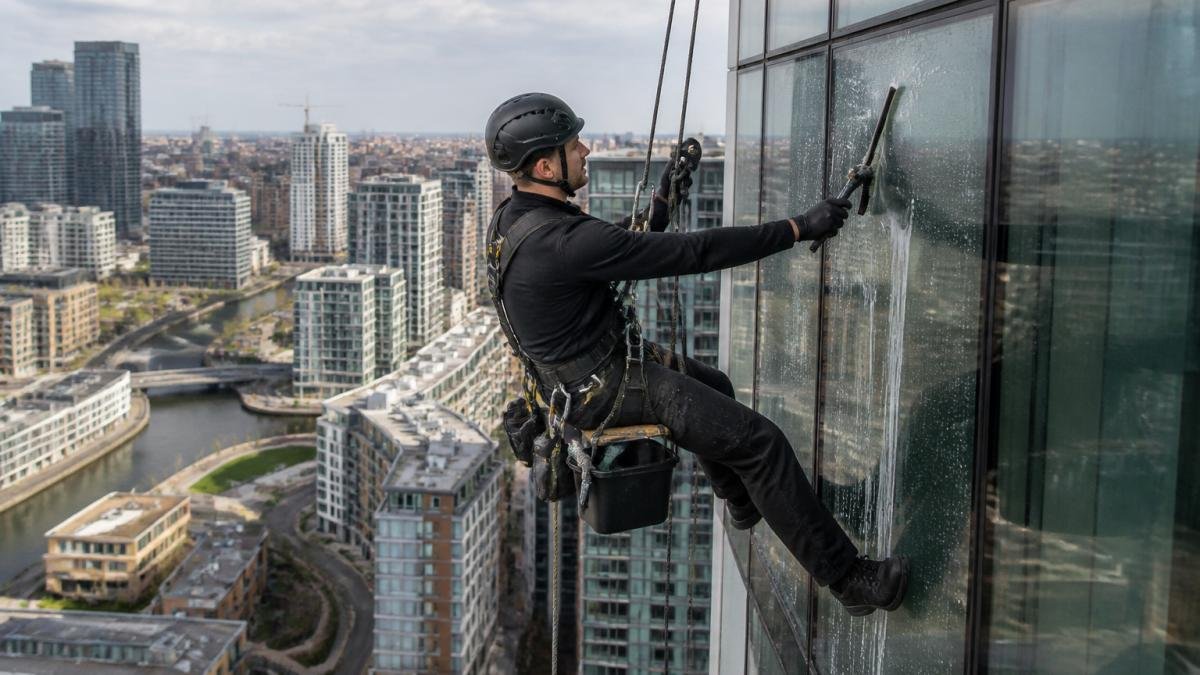
Abseil, or rope access, uses a two-rope system with the operative suspended in a harness. It reaches shapes and elevations that cradles cannot, including recessed sections, atria and irregular facades. It is also quick to set up where roof access is tight. Our team is IRATA-trained, which is the recognised standard for this work.
Water-fed poles carry purified water to a brush head from ground level or a roof position, reaching several storeys without suspending anyone. They work well on lower-rise sections and where the glass is not heavily soiled. On tall towers, poles usually support abseil or cradle work rather than replace it.
Ask how the team plans to reach the awkward elevations, not just the main face. The recessed sections, returns and internal atria are where cheap quotes quietly exclude work, and where the finished job looks patchy from the ground.
High-Rise Window Cleaning Safety: The Non-Negotiables
Safety on high-rise window cleaning is not a paperwork exercise. It is the difference between a job that gets finished and an incident that stops the building's operations and puts people at risk.
Work at height in the UK is governed by the Work at Height Regulations, which place duties on both the contractor and the building's duty holder (The law). The hierarchy is clear: avoid work at height where possible, prevent falls where it cannot be avoided, and minimise the consequences of a fall where prevention is not enough. You can read the detail in the HSE guidance on work at height.
In practice, on a rope access job, that means trained and competent operatives, inspected and logged equipment, a safe rigging plan for each elevation, exclusion zones at ground level, and a rescue plan that does not depend on calling the fire service. Weather is a live factor: wind speed at 20 storeys is not the wind speed at street level, and work stops when conditions move outside safe limits.
For building managers, the questions worth asking are simple. Who is trained, to what standard, and how is that evidenced? What happens if something goes wrong mid-descent? A team that answers those without hesitation is a team you can put on a tower.
Facade Maintenance for Tall Buildings: Where Windows Fit In
Facade maintenance for tall buildings works best as one coordinated programme rather than a series of separate jobs. Windows, cladding, sealant lines and rainwater goods all sit on the same elevation and all degrade from the same exposure.
Treating them separately is how buildings end up paying for access twice. If a rope access team is already on the elevation cleaning glass, that same access can carry out a cladding inspection, clear a blocked outlet or note a failed seal.
This is the practical case for a planned cycle. A building on a regular schedule builds up a record of its elevations over time, and problems get caught in sequence rather than in a crisis.
Choosing a High-Rise Window Cleaning Team in Greater Manchester
Choosing a high-rise window cleaning team in Cheadle or anywhere across Greater Manchester comes down to three things: training, access capability and reliability. Height is not the place to find out that a contractor was overselling.
Ask for evidence rather than assurances. IRATA certification for the operatives who will actually be on the ropes, not just the company. Insurance that covers work at height. A clear method for each elevation. References from other property managers running similar buildings, because a team that performs on an apartment block performs on yours.
Coverage matters if you manage more than one site. A provider that can service a single building in Cheadle but not the rest of your portfolio creates a second set of contractors, standards and invoices. We work across the UK on managed portfolios, apartment blocks and offices, which keeps one team and one standard across every site.
If you are searching for high-rise window cleaning near me and comparing providers, ask each one the same set of questions and compare the answers side by side. The differences show up quickly.
Dirt left on glass etches it, moisture trapped at seal edges breaks seals down, and small defects found late become structural problems found later still. Lion Cleaning Group provides working at height specialists, environmentally friendly cleaning products and flexible scheduling, with IRATA-trained staff who report what they find on every elevation. Get started with Lion Cleaning Group and put your building on a cleaning cycle that protects the glass, the seals and the facade behind them.
Frequently Asked Questions
What are the benefits of regular high-rise window cleaning?
Regular skyscraper window maintenance keeps glass clear for residents and tenants, and it lets the cleaning team spot problems early: cracked panes, failed seals, corroded fixings and damaged cladding. On a rope access descent, a technician sees every floor close up, so small faults are reported before they become water ingress or repair bills. It also protects the building's appearance, which matters for lettings and valuations.
How often should skyscraper windows be cleaned?
Most UK high-rise buildings sit on a two to four cleans per year cycle, with city-centre towers near busy roads often on a monthly or six-weekly schedule. The right high-rise window cleaning frequency depends on how much dirt the glass collects, so a building beside a main road or railway will need more visits than one set back in a park. Your provider should walk the facade and set the schedule around what it actually sees.
What safety measures are used for window cleaning at height?
High-rise window cleaning safety rests on trained, IRATA-trained technicians, inspected harnesses and ropes, secure anchor points, exclusion zones below the work area, and a rescue plan that does not rely on calling the fire service. Equipment is checked before every descent, and work stops in high winds or heavy rain. Ask any provider to show certification and insurance before they set foot on your roof.
Can rope access be used to clean skyscraper windows?
Yes. Abseil or rope access is a way to reach high-rise glass, especially where a building management unit cannot be moved or a cradle is slow to rig. It also lets technicians reach awkward sections, atrium glass and cladding that cradles miss. Lion Cleaning Group's team is IRATA-trained and uses rope access across apartment blocks, offices and managed portfolios.