Author: Ryan Marriott

  • Rope Access Window Cleaning: What Property Managers Need

    Rope Access Window Cleaning: What Property Managers Need

    Table of Contents

    Last Updated: October 4, 2026

    Rope Access Window Cleaning: What It Solves for Managed Buildings

    Rope access window cleaning is a method of cleaning exterior glass and facades using technicians suspended on ropes from the roof, rather than from scaffolding, cradles or mobile elevating work platforms. For property managers running apartment blocks and office buildings, it solves the access problem that makes upper-floor windows the first thing to be neglected and the last thing to be cleaned. At Lion Cleaning Group, we work at height across the UK, and this guide explains what the method involves, why IRATA certification matters, and how to choose a provider you can rely on.

    Most managed buildings have the same recurring problem. Ground-floor glass gets wiped every week. Anything above the second or third storey gets postponed, because booking a cherry picker or erecting scaffolding for a few hours of window cleaning is disproportionate to the job. The result is visible from the street: smeared upper panes, water-marked glass and a building that looks tired even when the lobby is spotless.

    Rope access closes that gap. Two trained technicians can rig from the roof, work down the elevation, and be gone within a few hours, with no ground-level obstruction and no permit for a crane or platform.

    Key Takeaway
    Rope access exists because the alternative access methods cost more than the cleaning itself. If your upper windows are cleaned less often than your lower ones, access, not budget, is the real reason.

    IRATA Rope Access Standards: Why Certification Matters

    IRATA certification is the industry benchmark for rope access work, and it is the single most important thing to verify in a provider. IRATA, the Industrial Rope Access Trade Association, sets the training and assessment standards that UK rope access technicians are graded against. A certified technician holds a current IRATA logbook showing their level and their recorded hours at height.

    Why does this matter to a property manager? Because rope access is a safety-critical activity, and the competence of the crew is what keeps the job compliant and the building's residents safe. An IRATA-trained team works to a recognised method, uses inspected equipment, and can evidence training records if you ask. A crew without that certification is a liability you carry, not a service you buy.

    Our own team is IRATA-trained, and we keep those records current. When you request a quote, ask any provider three questions: what IRATA level are the technicians, when was their last assessment, and can you see the logbooks? A provider who hesitates on any of them is not one to book.

    IRATA International training and certification standards

    High-Level Window Cleaning in Greater Manchester

    High-level window cleaning brings its own practical considerations. The region's weather does much of the work for you in one direction and against you in the other: regular rainfall keeps glass wet, and the mix of urban air and road grime means that when it dries, it leaves marks. Upper elevations on taller blocks accumulate a film that lower windows do not, simply because rain cannot rinse them as effectively.

    That is why frequency matters more than intensity. A building cleaned on a sensible cycle needs less aggressive treatment each visit than one cleaned twice a year. For most managed blocks, a scheduled programme with a set interval works better than ad hoc bookings, because the crew knows the building, the rigging points and the access constraints before they arrive.

    If you are searching for rope access window cleaning, the practical test is not who can get there fastest, it is who can show you a method for your specific elevation. Every building rigs differently.

    Commercial Window Cleaning in Cheadle for Offices and Blocks

    Commercial window cleaning covers many building types, from low-rise office units to multi-storey apartment blocks, and the access method has to suit the structure. A four-storey office with a flat roof and clear parapet is straightforward to rig. A building with a pitched roof, fragile roof lights or a glass balustrade at the edge needs a different approach, and sometimes a different method entirely.

    This is where a provider's experience shows. The right questions at survey stage are about anchor points, roof access, and whether any part of the elevation is better reached by another means. A crew that turns up and improvises on the day is telling you something.

    For offices, the timing question is usually the harder one. Staff arriving, deliveries, and client visits all shape when a crew can work. A flexible provider will schedule around your building's rhythm rather than insisting on a fixed weekly slot. For blocks, the consideration shifts to residents: early starts, parking bays and the noise of rigging all affect people living on site.

    Get a Quote →

    Building type Typical access challenge What a good provider does
    Low-rise office Roof access and anchor points Surveys the parapet before quoting
    Multi-storey apartment block Resident access and parking Schedules around building activity
    Mixed-use development Different elevations, different needs Splits the job by method
    Building with fragile roof Safe rigging without loading the roof Uses appropriate anchor systems

    How a Rope Access Window Cleaning Visit Actually Runs

    A rope access window cleaning visit follows a set sequence: survey, rigging, descent and clean, then de-rig and inspection. The crew arrives, confirms the anchor points and access route, sets the ropes, and works down the elevation in sections. Most visits to a typical managed block are completed within a single working day, though larger elevations take longer.

    The detail that matters to you is the pre-visit survey. Before any ropes go over the edge, someone should have walked the roof, identified the anchor points, and confirmed there is a safe route to them. This is not paperwork for its own sake; it is what stops a job being abandoned halfway through because the rigging does not work.
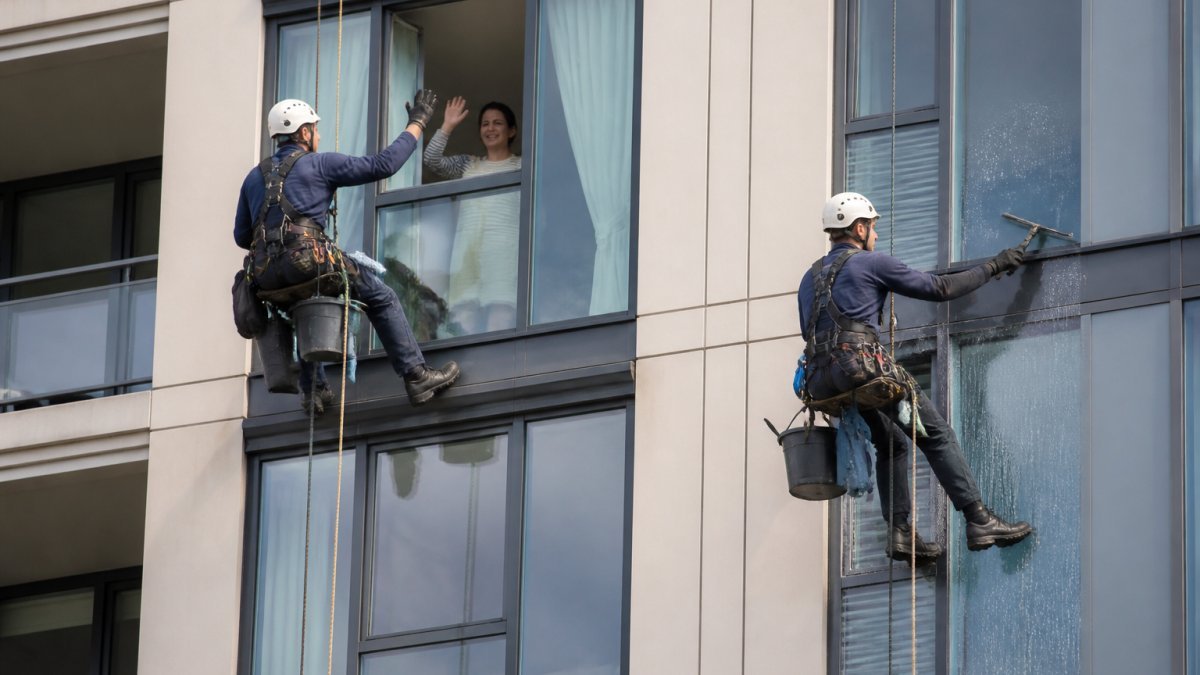
    Two rope access technicians in helmets and harnesses cleaning the glass facade of a modern apartment block, ropes rigged from the roof, one technician waving to a resident at a window
    Two rope access technicians in helmets and harnesses cleaning the glass facade of a modern apartment block, ropes rigged from the roof, one technician waving to a resident at a window

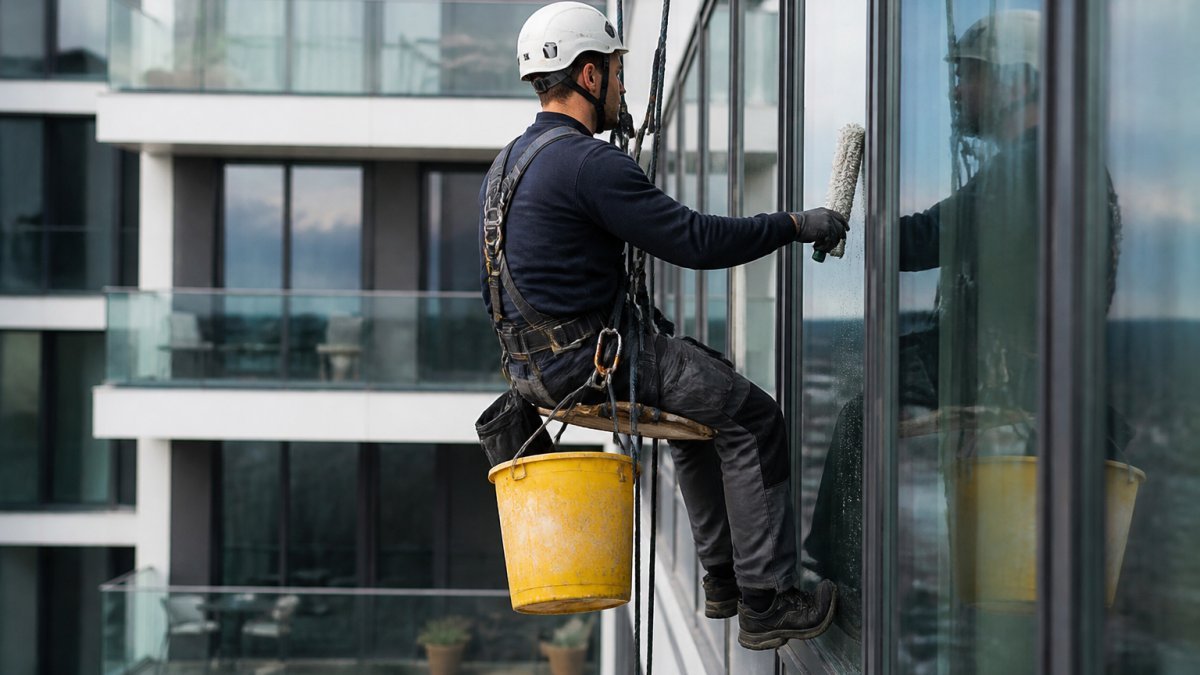
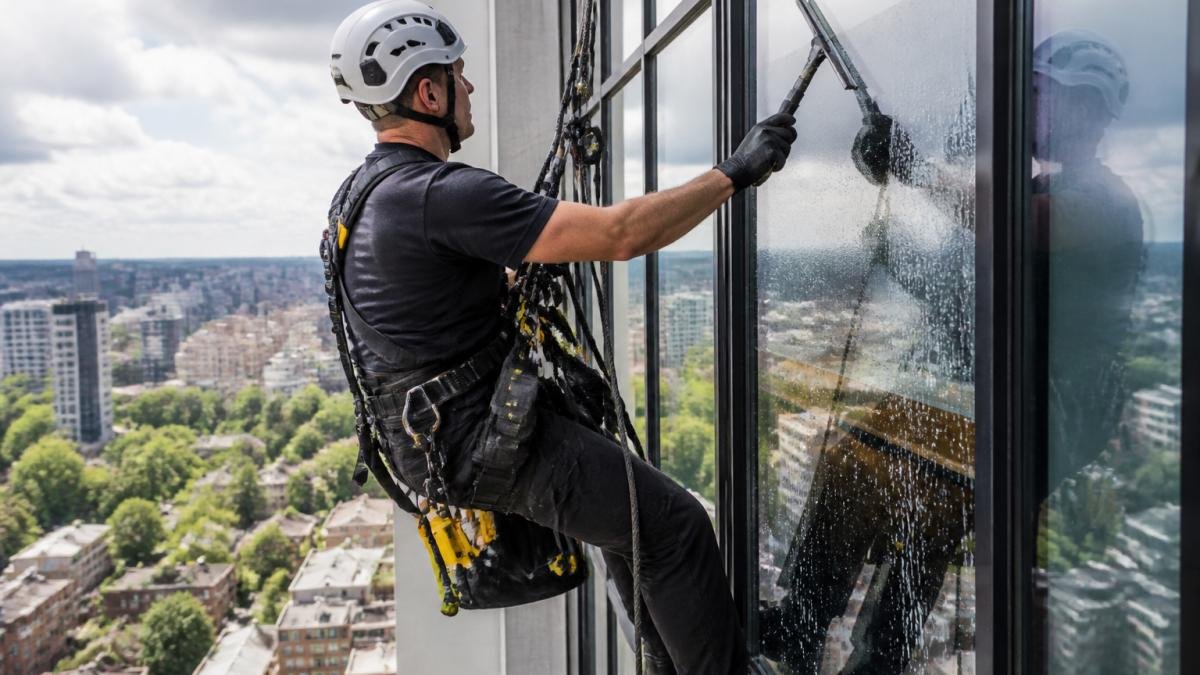
    On the day, expect the crew to work in pairs. One descends while the other manages the rig from above, and they rotate. Glass is cleaned with a pole-fed water system or by hand depending on the elevation and the finish, and the descent is planned so that each section is finished before the next begins. At the end, the ropes come up, the roof is checked, and you should get a walk-round or a photographic record of the completed elevation.

    Pro Tip
    Ask for before-and-after photographs of the elevation, not just the finished result. It is the quickest way to confirm that upper panes and frames were actually cleaned rather than just rinsed from a distance.

    Choosing a Rope Access Window Cleaning Provider

    Choosing a rope access window cleaning provider comes down to four checks: certification, method, scheduling flexibility and evidence. Certification we have covered. Method means a survey before the quote, not a price given over the phone. Scheduling means the crew can fit your building's constraints. Evidence means references from other property managers running similar sites.

    The pricing question deserves a straight answer. Rope access often costs more per visit than ground-level cleaning, because you are paying for trained technicians, equipment and the time it takes to rig safely. What that buys is access to glass that would otherwise go uncleaned, and a building that presents properly from every angle. If a quote looks unusually cheap for high-level work, ask what method is being used and who is going over the edge.

    Ask for references. A provider working regularly with block managers and managing agents will have them ready. Our own clients include property and asset managers across residential and commercial portfolios, and we are happy for prospective clients to hear from them directly.

    • Confirm IRATA certification and current logbooks
    • Ask for a survey before the quote, not a phone estimate
    • Check scheduling flexibility against your building's activity
    • Request references from similar buildings
    • Agree how the finished work will be evidenced

    Health and Safety Executive guidance on working at height


    Upper-floor windows are the part of a managed building that quietly lets the whole property down, and access is almost always the reason. Lion Cleaning Group works at height on apartment blocks, offices and managed portfolios across the UK, with IRATA-trained teams, environmentally friendly cleaning products and scheduling built around how your building actually runs. If your upper elevations have been on the list for months, book a clean with Lion Cleaning Group and get a survey and quote for your site.

    Frequently Asked Questions

    What are the safety regulations for rope access window cleaning in the UK?

    Rope access work in the UK sits under the Work at Height Regulations 2005, with the Health and Safety Executive as the regulator. The industry standard is IRATA certification: technicians train through levels 1 to 3 and revalidate every three years. Employers must also hold insurance, keep equipment inspection records, and plan each job so work is done safely. Lion Cleaning Group's team is IRATA-trained, which gives property and facility managers a clear benchmark when checking any rope access window cleaning provider.

    Why choose rope access instead of a cherry picker for high-rise windows?

    Rope access usually needs no ground space, so it suits apartment blocks where a cherry picker would block entrances, parking or residents' paths. It also reaches recessed windows, internal courtyards and stepped facades that a boom lift cannot get to. On many buildings it is quicker to set up, and there is less movement of heavy machinery on site. For high-level window cleaning, rope access is often the only practical route on tight city-centre plots.

    How do I know the team won't cut corners on the job?

    Ask for named references from similar buildings and speak to those managers directly. A provider that works regularly with block managers and build-to-rent operators will have them. During the visit, expect the team to follow an agreed schedule of elevations and windows, and to report anything they could not reach. Lion Cleaning Group's clients, including block and asset managers, describe the team as professional, polite and consistent, which is the pattern to look for when comparing providers.

    Can you work around our building's schedule and multiple sites?

    Flexible scheduling matters for occupied buildings. Ask for visits outside peak hours, before events, or split across elevations so entrances stay usable. For portfolios, confirm the provider can cover several sites on one contract without quality dropping, and ask how they allocate teams across regions. Commercial window cleaning across the UK can be arranged on daily, weekly or periodic plans, so the schedule fits the building rather than the other way round.
  • Risk Assessment for Working at Height Cleaning

    Risk Assessment for Working at Height Cleaning

    Table of Contents

    Last Updated: 2 October 2026

    What is a Risk Assessment for Working at Height Cleaning?

    A risk assessment for working at height cleaning is a systematic process of identifying hazards, evaluating the risks they pose, and implementing control measures to keep your team safe. When your building has windows above ground level, this assessment becomes essential.

    Working at height means any work where a person could fall more than 2 metres and suffer injury. For window cleaning on apartment blocks, offices, or commercial properties, this applies to most exterior work. The assessment isn't a one-time box to tick, it's an ongoing evaluation that changes with weather, building condition, and equipment wear.

    Lion Cleaning Group conducts these assessments before every high-rise cleaning project. The process identifies what could go wrong, who might be affected, and what controls prevent harm. It's straightforward but thorough.

    The Work at Height Regulations 2005 (as amended) is the UK law that governs all work at height. It applies to any work where a person could fall and suffer injury. Your legal obligation is clear: you must ensure the safety of anyone working above ground level on your property.

    Under these regulations, you must:

    • Avoid work at height where reasonably practicable
    • Use the proper equipment and procedures when height work is necessary
    • Plan and supervise all work at height
    • Ensure workers are competent and properly trained
    • Inspect and maintain all equipment regularly

    The Health and Safety Executive (HSE) enforces these regulations. Failure to comply can result in enforcement action, fines, or prosecution. More importantly, it puts your staff and contractors at real risk.

    For property managers in Greater Manchester and across the UK, this means vetting your cleaning contractors carefully. Ask whether they operate under these regulations. Ask for evidence of risk assessments, training records, and equipment maintenance logs. A contractor who cannot show these documents is operating illegally.

    HSE Hierarchy of Control for Working at Height

    The HSE sets out a clear hierarchy for controlling risks at height. This hierarchy should guide every decision you make about how to manage the work safely.

    The hierarchy works like this:

    1. Elimination – Remove the need for work at height altogether. Can the window be cleaned from ground level? Can permanent protective systems be installed?
    2. Engineering controls – Use equipment or design to reduce the risk. This includes guardrails, safety nets, or work platforms.
    3. Administrative controls – Implement procedures and training. Use permits to work, supervision, and competency checks.
    4. Personal protective equipment (PPE) – Use harnesses, helmets, and lanyards as a last resort when other controls cannot eliminate the risk.

    Most window cleaning at height relies on a combination of engineering controls and administrative controls. PPE alone is never enough.

    The hierarchy matters because it forces you to think systematically. Don't jump to "buy harnesses and rope." Start by asking whether the work is necessary at all. If it is, ask what engineering controls can help. Only then should you rely on PPE and procedures.

    Common Hazards in Working at Height Cleaning

    Understanding the specific hazards on your building helps you plan effective controls. Hazards aren't theoretical, they're the real conditions your team faces.

    Fall risks and exposure

    Falls are the primary hazard in height work. A person can fall from a ladder, platform, or whilst secured to a rope if the equipment fails or the attachment point gives way.

    Common fall scenarios include:

    • Loss of balance on a ladder or platform
    • Slip on wet or dirty surfaces
    • Equipment failure (harness, lanyard, or anchor point breaking)
    • Entanglement of rope or lanyard
    • Failure to clip in or use equipment correctly

    Each scenario requires a different control. A wet surface calls for improved grip or non-slip footwear. An unsecured rope requires a backup lanyard. Incorrect use requires better training and supervision.

    Weather and environmental factors

    Wind, rain, and temperature affect safety at height. Strong winds can push a person off balance. Rain makes surfaces slippery. Ice in winter creates hazardous conditions.

    Weather hazards include:

    • High winds increasing fall risk
    • Rain reducing grip and visibility
    • Frost or ice on surfaces
    • Extreme heat affecting concentration and physical capability
    • Poor visibility in fog or low light

    Your risk assessment must specify wind speed limits for work. Many contractors stop work above 40 km/h wind speed. Rain may require work to stop or additional safety measures like non-slip footwear.

    Equipment failure and maintenance

    Harnesses, ropes, lanyards, and anchor points all wear out. A harness used regularly may degrade faster than one used occasionally. Rope exposed to UV light becomes brittle. Metal anchor points corrode in damp conditions.

    Get a Quote →

    Equipment hazards include:

    • Worn or damaged harnesses
    • Frayed or degraded rope
    • Corroded metal fittings
    • Unsuitable anchor points
    • Inadequate backup systems

    Window Cleaning Safety Equipment Requirements

    Working at height demands specific equipment. The right gear, properly maintained and correctly used, is your primary defence against falls.

    Rope access technician using safety harness for working at height cleaning on a high-rise building facade.
    Rope access technician using safety harness for working at height cleaning on a high-rise building facade.

    Essential equipment includes:

    • Safety harness – A full-body harness distributes fall forces across the body, reducing injury. It must fit properly and be inspected regularly.
    • Lanyard or rope – Connects the harness to a secure anchor point. A shock-absorbing lanyard reduces the force of a sudden stop.
    • Anchor point – A fixed structure strong enough to hold a falling person. Building design, roof edges, or temporary systems can serve as anchor points.
    • Helmet – Protects against head injury from falling objects or impact during a fall.
    • Non-slip footwear – Reduces slip risk on wet or dirty surfaces.
    • Gloves – Improve grip and protect hands from cuts or abrasion.

    Equipment alone doesn't ensure safety. It must be:

    • Correctly selected for the task
    • Properly fitted and adjusted
    • Regularly inspected and maintained
    • Used by trained personnel
    • Combined with other control measures

    Risk Assessment Template for Window Cleaning

    A practical risk assessment follows a simple four-step structure. You can adapt this template for your building and cleaning schedule.

    Step 1: Identify the hazards

    Walk the building and list everything that could cause harm during window cleaning. Don't assume, look at the actual conditions.

    • Height and fall distance
    • Building surfaces (smooth glass, slippery ledges, rough concrete)
    • Weather exposure (wind, rain, temperature)
    • Building features (protruding ledges, sharp edges, unstable surfaces)
    • Nearby hazards (power lines, traffic, pedestrians below)
    • Access routes (stairs, roof access, external platforms)

    Step 2: Decide who might be harmed and how

    Identify everyone affected by the work and describe how they could be injured.

    Affected people include:

    • Window cleaners performing the work
    • Supervisors or managers overseeing the work
    • Other building occupants or staff
    • Members of the public below the work area
    • Maintenance staff who may use the same anchor points later

    Step 3: Evaluate the risks and existing controls

    For each hazard, assess the current level of risk and what controls already exist.

    Use a simple scale:

    • High risk – Serious injury likely if hazard occurs
    • Medium risk – Injury possible but not certain
    • Low risk – Minor injury likely

    Step 4: Record your findings and action plan

    Document the assessment in writing. Include:

    • Hazards identified
    • People at risk
    • Current controls and their effectiveness
    • Any additional controls needed
    • Who is responsible for each action
    • When actions will be completed
    • Date of next review

    Keep records for at least three years. They demonstrate compliance with regulations and provide evidence if an incident occurs.

    A simple one-page form works well:

    Hazard Who is at risk Current controls Additional controls needed Responsible person Target date
    Fall from height Window cleaners Harness, lanyard, anchor point inspection Additional backup lanyard for work above 10m Supervisor 15 October 2026
    Wet surfaces Window cleaners Non-slip footwear Daily surface inspection before work Team lead Ongoing
    Equipment failure Window cleaners Annual harness inspection Monthly visual inspection log Safety officer Ongoing

    Control Measures and Safe Working Practices

    Effective control measures include:

    Pre-work inspection
    Inspect all equipment before every job. Check harnesses for tears or worn stitching. Examine ropes for fraying or brittleness. Test anchor points for stability. Document findings. If anything fails inspection, remove it from service immediately.


    Frequently Asked Questions

    What are the legal requirements for working at height cleaning in the UK?

    The Work at Height Regulations 2005 require employers to ensure anyone working at height is properly trained, supervised, and equipped. You must conduct a risk assessment before work begins, identify all hazards, and implement control measures following the HSE hierarchy. The Health and Safety Executive (HSE) enforces these regulations, and failure to comply can result in enforcement action and fines. Your risk assessment must be documented and reviewed regularly.

    What must be included in a risk assessment template for window cleaning?

    A thorough risk assessment for window cleaning should identify specific hazards (falls, weather exposure, equipment failure), determine who might be harmed, evaluate existing controls, and document findings with action plans. It must assess the building's condition, access points, weather patterns, and worker competence. Include details of the equipment to be used. The assessment should be reviewed annually or whenever working conditions change.

    How does the HSE hierarchy of control apply to working at height cleaning?

    The HSE hierarchy prioritises elimination first (avoid the work), then substitution (use safer methods), engineering controls (guardrails, platforms), administrative controls (procedures, training), and finally personal protective equipment as a last resort. For window cleaning, this means exploring if work can be done from ground level, using alternative methods, installing permanent controls, and only relying on personal protective equipment when higher controls aren't feasible. Each level must be considered before moving to the next.

    What window cleaning safety equipment requirements must be met?

    All equipment must comply with relevant British Standards and be regularly inspected and maintained. Essential items include harnesses, lanyards, helmets, and anchor points. Rope access work requires IRATA certification. Equipment must be certified, stored correctly, and replaced after damage or expiry. Any defective equipment must be removed from service immediately. Staff must receive training on proper use and care of all safety equipment.

  • Commercial Cleaning Audit Checklist for Managers

    Commercial Cleaning Audit Checklist for Managers

    Table of Contents

    Last Updated: September 30, 2026

    Why a Commercial Cleaning Audit Checklist Matters

    A commercial cleaning audit checklist for managers is your first line of defence against poor facility standards and hidden compliance risks.

    Without clear inspection standards, surfaces get missed, high-traffic areas deteriorate, and staff don't know what "clean" means, leading to complaints, reputational damage, and compliance violations.

    A structured audit checklist transforms cleaning into measurable, documented performance. Facility managers who implement rigorous audits see immediate improvements in consistency and accountability.

    A proper cleaning audit checklist does three things:

    • Sets clear standards so your team knows exactly what passes inspection
    • Creates documented evidence of compliance for auditors and regulators
    • Identifies problems early, before they become expensive fixes

    Setting Up Your Audit Methodology and Framework

    Your audit methodology is the foundation. Without a clear framework, audits become subjective.

    Segment your audit into three layers instead of auditing everything at once:

    • Daily inspections: Quick visual checks of high-traffic areas and restrooms
    • Weekly audits: Deeper assessment of surfaces, floors, and common spaces
    • Monthly deep-dives: Detailed inspection of low-traffic areas, equipment, and compliance markers

    Conduct at least one audit per month yourself to spot patterns supervisors might miss and signal that cleanliness matters at leadership level.

    Document your methodology in a one-page audit guide explaining purpose, frequency, and process.

    Pro Tip
    Schedule audits at random times, not on predictable days. If your team knows you always inspect on Friday mornings, they'll clean extra on Thursday. Random audits reveal actual performance standards.

    Cleaning Audit Frequency Best Practices

    Audit frequency depends on facility type, occupancy, and risk profile.

    Residential complexes: daily inspections of common areas, weekly audits of units, monthly assessments of building systems.

    Corporate offices: daily checks of restrooms and high-traffic zones, weekly audits of workspaces, monthly reviews of storage areas.

    Watch Out
    Skipping weekly audits is where most facility managers go wrong. You think you'll save time, but missed audits lead to accumulated problems that require expensive corrective action later. Weekly audits prevent that spiral.

    Document audit frequency in your cleaning contract, specifying how often audits occur and who conducts them.

    Building Your Commercial Cleaning Quality Assurance Template

    Your commercial cleaning quality assurance template is the actual document you use during inspections. It should be simple enough to complete in 10-15 minutes, detailed enough to catch real problems.

    Facility manager using a cleaning audit checklist to inspect office surfaces with a cloth and clipboard.
    Facility manager using a cleaning audit checklist to inspect office surfaces with a cloth and clipboard.

    Daily Inspection Checklist

    Daily inspections focus on visible cleanliness in high-traffic areas. Use a simple yes/no format:

    • Floors free of visible debris and spills
    • Restrooms stocked with supplies (soap, paper towels, tissue)
    • Rubbish bins emptied and lined
    • Surfaces wiped down (reception desks, tables, handles)
    • Toilets clean and flushed
    • Mirrors and glass streak-free
    • Odours absent or minimal

    Weekly Audit Points

    Weekly audits go deeper. You're assessing cleaning quality, not just presence. Include these areas:

    • Floors: Swept, mopped, or vacuumed with no visible dirt or marks
    • Surfaces: Desks, tables, and counters dusted and wiped
    • Restrooms: Toilets scrubbed, sinks cleaned, mirrors polished
    • Corners and edges: Baseboards and corners checked for dust accumulation
    • High-touch points: Door handles, lift buttons, and railings sanitised
    • Waste management: Recycling separated correctly, bins lined and emptied
    • Air quality: No visible dust, no unpleasant odours

    Monthly Deep-Dive Assessment

    Monthly audits examine low-traffic areas to catch deterioration early:

    • Low-traffic spaces: Storerooms, equipment areas, back corridors
    • Cleaning frequency compliance: Verify that cleaning schedules are actually being followed
    • Consumable replenishment: Check that supplies are stocked appropriately
    • Preventative maintenance: Look for signs of damage or wear that need addressing
    • Compliance markers: Verify that health and safety standards are being met

    Scoring Systems and Performance Benchmarking

    A scoring system transforms subjective observations into measurable data, enabling you to track improvement, hold staff accountable, and demonstrate compliance.

    Building a Scoring Framework

    Here's a simple framework that works across facility types:

    Scoring Level Definition Action Required
    Pass (90-100%) All or nearly all items meet standards Document and acknowledge
    Needs Attention (70-89%) Some items below standard; minor issues Plan corrective action within 1 week
    Fail (Below 70%) Multiple items below standard; serious issues Immediate corrective action required

    Calculate your score as a percentage: (items that pass ÷ total items) × 100.

    Key Takeaway
    Your cleaning audit checklist is only useful if you actually use it consistently and act on the results. A perfect checklist gathering dust in a drawer helps nobody.

    Benchmarking and Realistic Performance Targets

    Benchmark targets for most commercial spaces: daily inspections 95%+, weekly audits 90%+, monthly assessments 85%+. If consistently below these, your provider may need training, resources, or schedule adjustment.

    Translating Audit Scores into Executive Dashboards

    Create a simple monthly dashboard that shows:

    Book a Clean →

    1. Overall facility score trend (line graph) showing 12-month average, target benchmark, and corrective actions taken.

    Adjusting Audit Rigour Based on Budget and Contract Tier

    Not all facilities have the same budget or cleaning intensity. Tier your audit approach accordingly.

    Tier 1 (Premium/High-Risk Facilities)

    • Daily inspections of all high-traffic areas and restrooms
    • Weekly deep audits of all zones
    • Monthly compliance and equipment checks
    • Target: 92%+ on weekly audits
    • Suitable for: corporate headquarters, healthcare facilities, luxury residential

    Tier 2 (Standard Commercial)

    • Daily spot-checks of restrooms and reception areas
    • Weekly audits of high-traffic zones; fortnightly for secondary areas
    • Monthly compliance checks
    • Target: 88%+ on weekly audits
    • Suitable for: typical office buildings, retail, standard residential

    Tier 3 (Budget/Low-Occupancy Facilities)

    • Daily visual checks of restrooms only
    • Fortnightly audits of main areas
    • Quarterly deep assessments
    • Target: 85%+ on fortnightly audits
    • Suitable for: storage facilities, low-occupancy buildings, newly acquired properties pending upgrade

    Using Audit Data to Inform Budget and Resource Decisions

    Use audit scores to inform budget and staffing decisions. Consistent underperformance may signal understaffing or unrealistic schedules.

    Watch Out
    If you're consistently auditing below your target benchmark, don't just accept it as "the new normal." Either adjust your benchmark to match reality (and document why), or invest in improving performance. Drifting standards create liability and damage your facility's reputation.

    How to Evaluate Commercial Cleaning Contracts

    When reviewing a cleaning contract, reference your audit checklist and scoring system. Your contract should state:

    • Specific areas to be cleaned and cleaning frequency
    • Quality standards (e.g., "floors must be free of visible debris")
    • Audit schedule and who conducts audits
    • Consequences for failing audits (e.g., corrective action plan required)
    • Performance metrics (e.g., 90% pass rate on weekly audits)

    Documenting Findings and Planning Corrective Actions

    Documentation is where most facility managers fall short. The real challenge lies in how you communicate audit failures and translate them into lasting improvement.

    The Corrective Action Form: Structure and Discipline

    Create a corrective action form that captures:

    1. What failed (specific area or standard, not vague language like "restroom was dirty")
    2. Root cause analysis (insufficient training, inadequate time allocation, unclear standards, supply shortages, scheduling conflicts, or staff capability gaps)
    3. Corrective action (specific, measurable task, e.g., "Retraining on tile-grout cleaning technique" rather than "improve cleaning quality")
    4. Responsible party (cleaning supervisor, facilities team, external provider, or manager)
    5. Deadline (realistic timeframe based on complexity)
    6. Verification method (how you'll confirm the fix worked, e.g., follow-up audit on specific date)
    7. Root cause prevention (what systemic change prevents recurrence)

    Communicating Audit Failures Without Damaging Morale

    Adopt a three-step communication approach:

    Step 1: Frame as collaborative problem-solving. Start with what passed, then address the gap and invite input.

    Tracking Corrective Actions and Identifying Patterns

    File all audit reports and corrective action forms for at least 12 months for compliance and dispute protection.

    Review your corrective action log quarterly for patterns:

    • Same area failing repeatedly: the standard may be unrealistic or the underlying cause unaddressed.
    • Same failure across multiple staff: signals a training or systemic process problem.
    • Corrective actions taking longer than expected: you may be underestimating complexity or resources.
    Pro Tip
    When a corrective action fails a second time, don't reassign the task or increase pressure. Stop and ask: "What did we miss about why this is difficult?" The pattern tells you where to focus resources and support.

    Building Sustainable Change, Not Just Compliance

    The goal of corrective action is to build capability so failures don't recur.

    Health, Safety and Compliance in Your Audit Process

    Your audit checklist must include health and safety compliance markers:

    • COSHH compliance: products stored safely, hazard data sheets accessible, staff trained
    • Hygiene standards: restrooms and food areas meet sanitation requirements
    • Waste management: hazardous waste separated correctly
    • Accident prevention: slip hazards addressed, equipment stored safely

    Address compliance gaps immediately and document your actions.


    Frequently Asked Questions

    What should be included in a commercial cleaning audit checklist?

    A comprehensive cleaning audit checklist covers surface sanitation across all areas, waste management procedures, consumable replenishment (soap, paper towels, bin liners), inspection of high-traffic zones, staff performance monitoring, and compliance with health and safety regulations. Include sections for daily visual checks, weekly detailed inspections, and monthly deep assessments. Document findings against your facility's cleaning protocols and standard operating procedures to track performance against agreed hygiene standards.

    How often should managers conduct commercial cleaning audits?

    Cleaning audit frequency depends on facility type, footfall, and contractual obligations. Most facilities benefit from daily visual inspections, weekly detailed audits of key performance indicators, and monthly comprehensive reviews. High-traffic areas like retail or hospitality venues may need more frequent spot checks. Your audit frequency should be documented in your commercial cleaning contract and reviewed quarterly to ensure it aligns with your operational efficiency goals and compliance monitoring requirements.

    What are the key performance indicators for commercial cleaning services?

    Essential KPIs include surface cleanliness scores, waste management compliance, consumable availability, staff attendance and punctuality, corrective action response times, and customer satisfaction ratings. Measure these against your cleaning quality assurance template using a consistent scoring framework. Track audit documentation over time to identify trends, benchmark performance, and justify budget allocation. Regular performance benchmarking helps identify whether your cleaning protocols are delivering the hygiene standards your facility requires.

    How do I know if a cleaning provider can handle my facility's specific needs?

    When evaluating commercial cleaning contracts, assess their audit methodology, staff training certifications, experience with your facility type, and flexibility for scheduling adjustments. Ask for references from similar operations and review their approach to health and safety compliance, particularly COSHH regulations if chemicals are used. Request their quality assurance template and scoring system to understand how they monitor their own performance. Ensure they can accommodate your facility's peak times and special requirements without compromising service quality.

  • Commercial Window Cleaning for High-Rise Buildings

    Commercial Window Cleaning for High-Rise Buildings

    Table of Contents

    Last Updated: September 23, 2026

    Why Commercial Window Cleaning for High-Rise Buildings Matters

    Commercial window cleaning for high-rise buildings isn't a luxury, it's essential maintenance that directly affects your property's value, safety, and tenant satisfaction. When windows on a 20-storey office block go uncleaned for months, the building's professional image deteriorates rapidly. More importantly, dirty windows obscure structural issues and create genuine safety hazards that inspectors flag during compliance audits.

    The challenge is finding a provider with the technical expertise, certifications, and equipment for high-rise work. Most standard cleaning companies lack these capabilities, leading property managers to face incomplete work, safety violations, or scheduling conflicts.

    High-rise window maintenance requires specialized access methods, rigorous risk assessment, and certified technicians. The Work at Height Regulations 2005 governs every aspect of this work, from the initial site survey through final documentation. Understanding these requirements isn't optional, it's a legal obligation for building owners and facility managers.

    High-Rise Window Maintenance Checklist for Property Managers

    A structured maintenance checklist prevents deterioration, ensures compliance documentation, and avoids reactive problem-solving.

    Pre-cleaning assessment

    Before work begins, walk the building exterior and document window condition, water damage, sealant failures, and architectural features (setbacks, balconies, ledges) that affect access method selection and pricing.

    Identify obstacles (satellite dishes, HVAC units, signage), windows requiring exclusion (recently painted, loose frames), and environmental factors (wind direction, nearby construction, seasonal patterns) affecting scheduling.

    Verify BMU or cradle systems are certified and operational. Confirm building structure accommodates planned access methods. Document total window area and special requirements (tinted glass, heritage windows, sensitive spaces).

    During-cleaning inspection points

    Monitor water quality (deionized water leaves no residue; hard water leaves streaks) and verify technicians use fall protection equipment continuously, brief lapses represent unacceptable risk.

    Verify cleaning method matches the type of glass (low-emissivity glass requires gentler techniques) and that technicians clean entire frames, not just glass panes.

    Monitor progress against schedule and document damage discovered (loose caulking, failed seals, frame deterioration) requiring repair before the next cycle.

    Post-cleaning documentation

    Request a detailed report with before-and-after photographs, completion date/time, weather conditions, issues identified, and areas requiring special attention. This documentation provides legal protection and baseline for future cycles.

    Record access method used, technician count, and hours spent to track budgets and efficiency. Document any safety incidents, near-misses, or environmental concerns for your health and safety file.

    Record cleaning products used, especially for buildings with environmental or health sensitivity requirements, for sustainability reporting and tenant communications.

    Work at Height Regulations 2005 Compliance for Window Cleaning

    The Work at Height Regulations 2005 is statutory law enforced by the HSE. Non-compliance exposes your business to enforcement action, fines, and personal director liability.

    Risk assessment requirements

    Every project requires a formal risk assessment identifying building-specific hazards (wind exposure, traffic proximity, pedestrian areas, weather patterns, structural features) and evaluating team competence, equipment suitability, and emergency procedures.

    The assessment must address fall distances, weather exposure (high-rise buildings experience stronger winds), and how these factors are managed.

    The assessment must document control measures: access method, fall protection equipment, rescue procedures, and communication systems. This becomes your legal evidence of reasonable precautions.

    Method statements and site-specific planning

    Every project requires a site-specific method statement detailing access method, equipment, personnel qualifications, work sequence, and contingency procedures for your building.

    The method statement must address environmental factors (wind speeds halting work, suspension conditions), communication protocols, rescue procedures, and nearest emergency facility.

    A proper method statement is building-specific, not a generic template. Request it in advance; inability to produce one indicates non-compliance with the Work at Height Regulations 2005.

    Access Methods for High-Rise Window Cleaning

    Different high-rise buildings require different access approaches. The method you choose affects cost, scheduling, safety risk profile, and the frequency at which cleaning can realistically occur. Understanding these methods helps you make informed decisions about your building's maintenance strategy.

    Rope access and abseiling

    Rope access (abseiling) is the most flexible method for high-rise window cleaning. Technicians rappel from roof anchor points while secured with harnesses, working on virtually any building shape including irregular façades and setbacks.

    Professional technician secured with full harness and safety equipment performing rope access abseiling on a high-rise building façade, with city skyline visible in background and safety lines anchored to roof structure
    Professional technician secured with full harness and safety equipment performing rope access abseiling on a high-rise building façade, with city skyline visible in background and safety lines anchored to roof structure

    Rope access requires IRATA (Industrial Rope Access Trade Association) certification, representing genuine competence in rope systems, rescue procedures, and working-at-height safety.

    Rope access requires no building modifications or permanent equipment, works in most weather except extreme winds, and is often the only option for buildings without BMUs or MEWP access.

    Rope access is labour-intensive; each technician covers limited area daily, making it expensive for large buildings or frequent cleaning cycles.

    Book a Clean →

    Building Maintenance Units (BMU)

    A BMU is a permanent roof-mounted mechanical system with a powered cradle that lowers technicians along the façade, controlled by an operator from the roof.

    BMU systems allow multiple simultaneous technicians and faster progress than rope access, delivering best cost-per-clean for buildings requiring frequent maintenance.

    BMU installation requires structural engineering and roof modifications. Systems are practical only for buildings over 15 storeys requiring quarterly or more frequent maintenance.

    Mobile Elevating Work Platforms (MEWP)

    Mobile Elevating Work Platforms (MEWPs) are self-propelled platforms with extending booms (scissor or boom lifts) suitable for mid-rise buildings (4-10 storeys) with ground-level access space.

    MEWPs offer speed and simplicity with straightforward setup and widely available hire equipment. For buildings with adequate ground clearance and moderate height, they're often most cost-effective.

    MEWPs require clear ground space and become unstable in strong winds, limiting use in dense urban areas and during windy conditions.

    Water-fed pole systems

    Water-fed poles are telescoping poles (10-20 metres) with brush heads delivering deionized water that leaves no mineral residue, operated from ground level.

    Water-fed poles are ideal for low to mid-rise buildings (up to 6 storeys) and most cost-effective, requiring no installation, harnesses, or extensive training.

    Water-fed poles are impractical beyond 6 storeys and depend on weather conditions. For large window areas, they're labour-intensive.

    Frequency of Commercial Window Cleaning for High-Rise Properties

    Optimal cleaning frequency depends on building type, location, environmental exposure, and business objectives. Most commercial properties follow quarterly schedules.

    Quarterly maintenance schedules

    Quarterly cleaning maintains professional appearance, prevents environmental deposit accumulation, and identifies emerging problems (failed seals, frame deterioration) before costly repairs.

    Quarterly frequency suits office buildings where window condition affects lease value, retail/hospitality venues requiring professional appearance, and residential complexes preventing tenant complaints.

    Quarterly maintenance provides predictable annual costs, enabling single-provider contracts with negotiated pricing and consistent building appearance year-round.

    Environmental and weather factors

    Environmental exposure affects frequency: motorway-adjacent buildings accumulate diesel particulates; coastal buildings experience salt spray requiring quarterly cleaning plus additional winter cycles.

    Safety Compliance and Equipment Requirements

    Safety is foundational in high-rise window cleaning. Cutting corners creates liability exposure, HSE enforcement risk, and genuine injury/death risk.

    Fall protection and PPE standards

    Every technician must wear harness, safety line, and PPE (mandatory under Work at Height Regulations 2005). Harnesses distribute fall forces; safety lines prevent free fall.

    Certified technician qualifications

    Technicians must hold IRATA Level 1, 2, or 3 certification (depending on complexity), requiring formal training, practical assessment, and annual refresher training.

    Public liability insurance and HSE compliance

    Your cleaning provider must carry public liability insurance covering damage to your building, injury to your staff or tenants, or damage to neighbouring properties. Minimum coverage should be £10 million for high-rise work. Request a copy of their insurance certificate before work begins and verify it covers the specific work being performed.

    Choosing a Professional High-Rise Window Cleaning Provider

    Selecting the right provider is critical. The wrong choice creates safety risks, schedule disruptions, and quality issues that consume your time managing problems instead of focusing on your business.

    Verifying credentials and experience

    Ask potential providers for references from other property managers managing similar buildings. Call those references and ask specific questions: Did the provider complete work on schedule? Was quality consistent across all building sections? How did they handle unexpected issues? Did they respond quickly to concerns?

    Evaluating flexibility and nationwide coverage

    Can the provider accommodate your scheduling needs? If you need cleaning on specific dates to avoid tenant disruption, can they guarantee availability? Do they have backup crews if their primary team is delayed? For multi-site portfolios, can they coordinate work across multiple locations efficiently?


    Frequently Asked Questions

    High-rise window cleaning must comply with the Work at Height Regulations 2005, which requires a formal risk assessment before work begins. A site-specific method statement must be prepared, detailing the access method, fall protection systems, and emergency procedures. All work must be carried out by certified technicians trained in working at height. Public liability insurance is mandatory, and the Health and Safety Executive (HSE) standards for façade maintenance must be followed throughout the project.

    How often should commercial windows on high-rise buildings be professionally cleaned?

    Quarterly maintenance schedules are standard for most high-rise commercial properties, though frequency depends on environmental exposure, location, and building type. Properties near coastal areas or industrial zones may require cleaning every 6-8 weeks due to salt spray and pollution. Urban office buildings typically benefit from quarterly cleaning to keep the glass in good condition and the building looking sharp. Weather conditions and seasonal accumulation of dirt should inform your cleaning frequency decision.

    What access methods are safest for high-rise window cleaning?

    The safest method depends on building design and access points. Rope access (abseiling) suits buildings without existing access equipment and offers flexibility for complex façades. Building Maintenance Units (BMUs) provide permanent solutions for regular cleaning on large commercial properties. Mobile Elevating Work Platforms (MEWPs) work well for moderate heights with safe ground-level positioning. Water-fed pole systems can clean lower floors safely from ground level. Professional providers assess your building's specific requirements and select the most appropriate method.

    How do I know if a window cleaning contractor is properly qualified for high-rise work?

    Verify that technicians hold current certifications in rope access (IRATA certification), MEWP operation, or BMU training as relevant to your project. Confirm they carry adequate public liability insurance (typically £10 million minimum for high-rise work) and hold HSE-compliant method statements for your building type. Ask for references from other property managers managing similar multi-site portfolios or apartment complexes. Ensure they conduct a formal risk assessment and provide documentation before work begins.

  • Benefits of Eco-Friendly Commercial Cleaning Products

    Benefits of Eco-Friendly Commercial Cleaning Products

    Table of Contents

    Last Updated: September 25, 2026

    Why Eco-Friendly Commercial Cleaning Products Matter

    Switching to eco-friendly commercial cleaning products is a practical business decision affecting workforce health, costs, and compliance. Many facility managers assume green alternatives lack cleaning power or cost too much, both assumptions warrant scrutiny.

    Modern eco-friendly commercial cleaning products deliver comparable efficacy while eliminating toxic exposure risks. For large facilities, apartment complexes, corporate offices, and retail spaces, this shift unlocks tangible benefits: reduced absenteeism, lower occupational health liability, and alignment with environmental standards affecting procurement decisions.

    At Lion Cleaning Group, we've worked with UK facility managers making this transition. Initial performance concerns consistently fade once teams see actual results.

    Improved Indoor Air Quality and Reduced Toxic Exposure

    Traditional cleaning chemicals release volatile organic compounds (VOCs) that linger in enclosed spaces, accumulating in poorly ventilated areas and contributing to respiratory irritation, headaches, and fatigue.

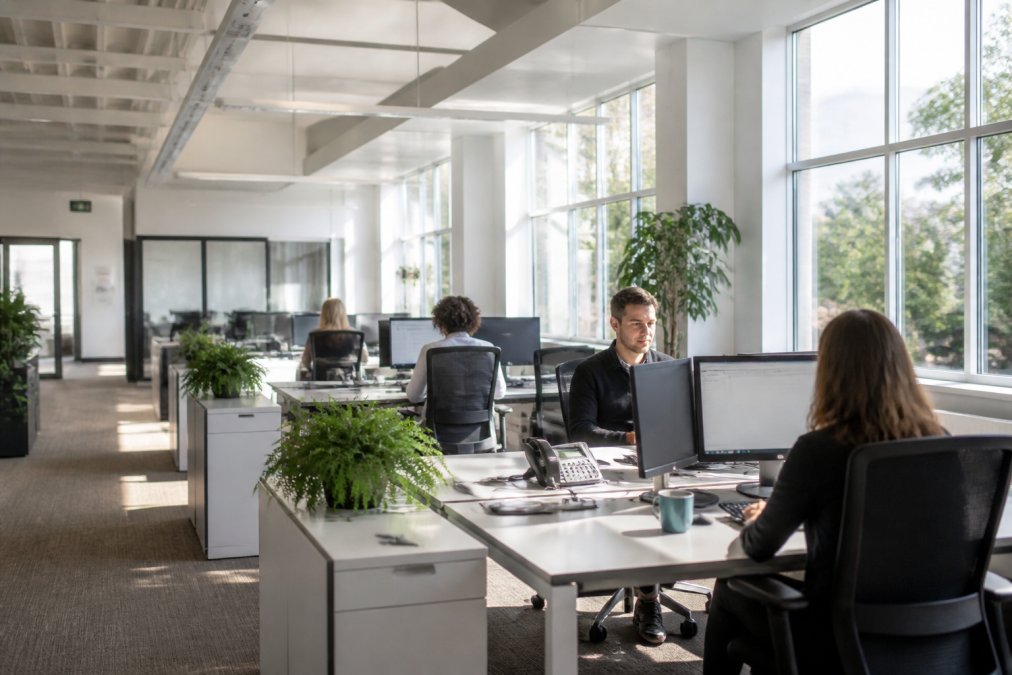
    Bright, modern office space with large windows showing natural light streaming across desks where employees work comfortably at their workstations
    Bright, modern office space with large windows showing natural light streaming across desks where employees work comfortably at their workstations

    Eco-friendly commercial cleaning products eliminate or dramatically reduce VOC emissions, breaking down naturally rather than off-gassing into your building's air system. For multi-storey buildings and apartment complexes, occupants breathe cleaner air throughout the day.

    Chemical residues from conventional cleaners accumulate on frequently-touched surfaces, creating repeated toxic exposure pathways. Non-toxic products leave no residue burden, which matters especially in high-traffic areas cleaned daily.

    Pros of eco-friendly products for air quality:

    • Eliminates volatile organic compounds from indoor air
    • Reduces chemical residues on frequently-touched surfaces
    • No lingering off-gassing after cleaning is complete
    • Supports natural ventilation without chemical odours masking poor air circulation

    Health Benefits for Employees and Occupants

    Staff working in spaces cleaned with non-toxic products report fewer respiratory issues, headaches, and skin irritation. Reduced chemical exposure translates to lower absenteeism and fewer occupational health claims.

    Using non-hazardous alternatives reduces liability exposure and simplifies duty-of-care obligations under occupational health and safety frameworks.

    Eco-friendly formulations avoid fragrances, dyes, and surfactants that trigger respiratory reactions, making cleaned spaces safer for staff and visitors with asthma or allergies.

    Health benefits:

    • Reduced respiratory irritation and headaches among cleaning staff
    • Lower rates of skin reactions and contact dermatitis
    • Decreased asthma and allergy triggers in cleaned spaces
    • Fewer occupational health claims related to chemical exposure

    Green Cleaning Certification for Businesses

    Green cleaning certification provides third-party validation of environmental and health standards, directly influencing procurement eligibility, insurance requirements, and compliance documentation.

    The most relevant certifications for commercial cleaning in the UK include:

    EU Ecolabel (ECOS), The most widely recognised scheme across European facilities. Products carrying the EU Ecolabel must meet strict criteria for biodegradability (>60% in 28 days), aquatic toxicity limits, and packaging waste reduction. Ecolabel certification requires independent testing and annual audits, making it a reliable indicator of genuine environmental performance rather than greenwashing.

    Green Seal Certification, Recognised internationally and increasingly required by large UK facility management contracts. Green Seal standards cover not just product formulation but also manufacturing processes, packaging, and company environmental practices. Products must demonstrate cleaning efficacy equivalent to conventional alternatives, addressing the performance concern facility managers often raise.

    EcoLogo Certification, A North American standard increasingly referenced in UK procurement specifications, particularly for multinational organisations. EcoLogo covers product lifecycle impacts, including manufacturing carbon footprint and water usage during production.

    BSI Kitemark for Environmental Management, Relevant for facilities pursuing ISO 14001 environmental management certification. Products certified under BSI schemes provide documentation that supports formal environmental management systems.

    Verify that certification bodies conduct independent testing and specify cleaning efficacy requirements, not just environmental attributes.

    Certification simplifies procurement evaluation by providing objective standards for comparing products in tender documents, eliminating subjective assessments.

    Many large organisations now require certified products from suppliers, making certification a competitive requirement. If your facility serves corporate clients, government contracts, or NHS facilities, certification eligibility may be non-negotiable.

    Pursuing certified cleaning programmes typically drives holistic workflow reviews, waste segregation, staff training, equipment maintenance, chemical storage, identifying cost savings and efficiency gains that offset product premiums.

    Certification advantages:

    • Third-party validation prevents greenwashing and confirms genuine environmental performance
    • Simplifies procurement evaluation and supports tender specifications
    • Provides documented evidence for corporate sustainability reporting
    • Increasingly required by large corporate clients and government contracts
    • Supports ISO 14001 and other formal environmental management systems

    Due diligence when selecting certified products:

    • Verify certification includes cleaning efficacy testing, not just environmental attributes
    • Confirm independent testing and annual renewal requirements
    • Request safety data sheets to confirm COSHH classification

    COSHH Compliance for Cleaning Chemicals

    COSHH (Control of Substances Hazardous to Health) regulations require businesses to assess and manage exposure to hazardous substances, including cleaning chemicals (Heath and Safety).

    Non-hazardous formulations simplify COSHH compliance by eliminating respirators, hazard labelling, and exposure monitoring protocols, reducing administrative burden and compliance costs.

    "Eco-friendly" does not automatically mean "non-hazardous under COSHH." Always review product safety data sheets to confirm classification before assuming compliance.

    COSHH benefits of eco-friendly products:

    • Eliminates or reduces hazard classification requirements
    • Simplifies personal protective equipment (PPE) requirements
    • Reduces exposure monitoring and record-keeping obligations
    • Lowers liability risk for occupational exposure claims

    Cost-Effectiveness of Green Cleaning

    Total cost of ownership for eco-friendly commercial cleaning products differs significantly from per-unit pricing. A framework for calculating ROI helps justify the switch to budget holders.

    Book a Clean →

    Product Cost Comparison

    Eco-friendly products often appear more expensive per litre, but concentrated formulations mean you use less per application. A 1:10 dilution produces ten litres of working solution from one litre of concentrate, delivering lower cost per cleaned area than diluted conventional products.

    Occupational Health Cost Reduction

    Waste Disposal Cost Reduction

    Equipment and Infrastructure Savings

    ROI Calculation Framework

    Total annual cost of ownership comparison:

    Conventional cleaning programme (annual):

    • Product cost: £3,000
    • Hazardous waste disposal: £1,200
    • PPE and compliance infrastructure: £2,500
    • Absenteeism cost (2% higher rate): £5,280
    • Total: £12,000

    Eco-friendly cleaning programme (annual):

    • Product cost: £2,500 (slightly lower due to concentrate efficiency)
    • Standard waste disposal: £300
    • PPE and compliance infrastructure: £400
    • Absenteeism cost (reduced 3%): £0
    • Total: £3,200

    Implementation Cost Consideration

    Cost factors favouring eco-friendly products:

    • Lower insurance premiums and occupational health claims reduce indirect costs

    Calculating ROI for your facility:

    • Document current annual spending on cleaning products, waste disposal, PPE, and compliance
    • Estimate absenteeism cost using (staff count × annual working days × absence rate × daily cost)
    • Request quotes from eco-friendly suppliers for equivalent products
    • Calculate the difference; most facilities see positive ROI within 6-12 months

    Environmental Impact and Long-Term Sustainability

    Biodegradable formulations break down naturally in water systems rather than accumulating as persistent chemical pollution. This matters both for your facility's environmental footprint and for regulatory compliance with water quality standards.

    Volatile organic compounds released during application contribute to atmospheric pollution and indoor air quality degradation (pubmed.ncbi.nlm.nih.gov). Eliminating VOC emissions reduces your facility's air pollution impact.

    Resource efficiency in eco-friendly product manufacturing also contributes to lower environmental impact. Many green cleaners use plant-based surfactants and mineral-based ingredients rather than petroleum-derived chemicals. This reduces carbon footprint and dependence on finite fossil fuel resources.

    For businesses pursuing net-zero commitments or environmental stewardship goals, switching to eco-friendly commercial cleaning products is a concrete, measurable action. It demonstrates commitment beyond public statements and provides documentation for sustainability reporting.

    Environmental benefits:

    • Biodegradable formulations prevent chemical accumulation in water systems
    • Reduced volatile organic compound emissions lower air pollution
    • Plant-based ingredients reduce fossil fuel dependence
    • Lower manufacturing carbon footprint compared to conventional chemicals
    • Supports corporate sustainability and net-zero commitments

    Measurement consideration:

    • Document baseline chemical usage and switch to track environmental impact reduction

    Implementation Roadmap for Facility Managers

    Moving from conventional to eco-friendly commercial cleaning products requires planning. A phased approach minimises disruption and allows staff to adapt to new products and techniques.

    Start by auditing your current product inventory and identifying which products drive the highest volume of usage. Cleaning floors typically consumes more product than any other task, so prioritising floor cleaners often delivers the largest impact with minimal disruption. Next, identify high-traffic or sensitive areas, offices where staff report respiratory issues, apartment complexes with residents who have allergies, retail spaces where customers linger.

    Pilot the switch in one building or one floor. This allows your cleaning team to experience the new products, identify any technique adjustments needed, and assess performance before rolling out across your entire portfolio. Many facility managers find that staff concerns about cleaning power fade once they see results firsthand.

    Communicate the change to occupants and staff.

    Implementation steps:

    • Audit current product usage and identify highest-volume items
    • Identify buildings or areas where switching delivers greatest health benefit
    • Pilot new products in one location before full rollout
    • Train cleaning staff on application and dilution protocols
    • Communicate benefits to occupants and staff
    • Monitor performance and gather feedback during transition period
    • Document product changes for compliance and sustainability reporting

    Timeline consideration:

    • A phased implementation typically spans 3-6 months for large multi-site operations
    • Allows staff adaptation and confidence-building without abrupt operational disruption

    Frequently Asked Questions

    Are eco-friendly commercial cleaning products as effective as traditional chemical cleaners?

    Yes. Modern eco-friendly cleaning products are formulated to match or exceed the cleaning efficacy of conventional chemicals. They work through plant-based surfactants and biodegradable enzymes rather than harsh synthetic compounds. The key difference is that they achieve the same results without leaving toxic chemical residues or volatile organic compounds (VOCs) in your facility. Many facility managers report no compromise in cleaning quality after switching.

    What certifications should businesses look for in eco-friendly commercial cleaning products?

    Look for recognised eco-labels such as EU Ecolabel certification. In the context of workplace safety, products should comply with COSHH (Control of Substances Hazardous to Health) regulations and be assessed under the Health and Safety Executive's guidance. Green cleaning certification for businesses typically requires third-party verification of biodegradability, non-toxicity, and environmental safety. Request Safety Data Sheets (SDS) from your supplier to confirm compliance.

    How do eco-friendly products help reduce absenteeism and improve employee productivity?

    Eco-friendly products eliminate volatile organic compounds and toxic chemical exposure that trigger respiratory issues, allergies, and asthma in occupants. Reduced allergen and chemical pollution in indoor air quality directly correlates with fewer sick days and improved focus. Employees working in cleaner, healthier environments report better concentration and morale. This translates to measurable productivity gains and lower absenteeism rates across your workforce.

    What is the ROI of switching to eco-friendly commercial cleaning products?

    Cost-effectiveness of green cleaning depends on several factors: concentrated formulas often require less product per application, reducing consumption; lower occupational health claims and absenteeism decrease indirect costs; and many products are biodegradable, reducing waste disposal fees. While upfront pricing may differ, the long-term savings through reduced chemical inventory, lower health-related absences, and extended equipment life typically offset initial investment. Facility managers should calculate total cost of ownership, not just per-unit pricing.

  • Maintaining Cleaning Standards in Apartment Blocks

    Maintaining Cleaning Standards in Apartment Blocks

    Table of Contents

    Last Updated: September 27, 2026

    Why Cleaning Standards Matter in Apartment Blocks

    Maintaining cleaning standards in apartment blocks goes far beyond aesthetics. When residents walk through a clean, well-maintained lobby or stairwell, they feel valued. They're more likely to stay, renew leases, and recommend the building to others. Poor cleaning standards damage reputation and create genuine health risks for everyone inside.

    The real issue isn't just dirt, it's consistency. A building that's spotless one week and neglected the next erodes trust faster than one that's reliably adequate. Residents notice. They talk. And property managers end up fielding complaints that could have been prevented with a structured approach.

    At Lion Cleaning Group, we've worked with property managers across the country who discovered that the difference between a problem building and a thriving one often comes down to one thing: a clear, documented cleaning standard that everyone understands and follows. Without it, cleaning becomes reactive. With it, cleaning becomes predictable.

    This guide covers the practical steps for maintaining cleaning standards in apartment blocks. We'll show you how to build a system that works, how to monitor it, and how to adapt it as your building's needs change.

    Understanding Health and Safety Regulations for Residential Buildings

    Health and safety regulations exist to protect residents and staff. The Health and Safety at Work etc. Act 1974 sets the baseline for workplace safety, and it applies to communal areas in residential buildings. As a property manager or landlord, you're responsible for ensuring communal areas meet these standards.

    The key regulation is the Workplace (Health, Safety and Welfare) Regulations 1992, which covers things like cleanliness, temperature, lighting, and ventilation in communal spaces. Neglecting these isn't just poor practice, it can create liability if someone is injured or falls ill due to poor hygiene.

    Beyond legislation, many councils and housing associations follow guidance from the Housing Ombudsman or their local authority. Some buildings operate under service charge agreements that specify exact cleaning frequencies. Understanding what applies to your building is step one.

    Here's what regulators typically require:

    • Communal areas must be kept clean and free of debris
    • High-touch surfaces must be disinfected regularly
    • Floors must be safe (no trip hazards, spills cleaned promptly)
    • Waste must be managed so it doesn't attract pests or create odours
    • Ventilation must work to prevent mould and damp

    The standard isn't "perfect", it's "reasonably clean and safe." What that means in practice depends on foot traffic, the building's age, and local expectations. A high-rise apartment block in a city centre faces different pressures than a converted Victorian house with six flats.

    Watch Out
    Failing to maintain basic hygiene standards in communal areas can expose you to enforcement action from local authorities and complaints to the Housing Ombudsman. More importantly, it puts residents' health at risk. Mould, pest infestations, and poor sanitation spread quickly in shared spaces.

    Creating a Communal Area Cleaning Checklist

    A cleaning checklist is your foundation. Without one, cleaning becomes guesswork. With one, it becomes measurable.

    Your checklist should cover every communal area in your building. Start by listing each space: lobby, stairwells, corridors, lifts, communal gardens, bin storage, parking areas, and any shared facilities. Then, for each space, identify what needs cleaning and how often.

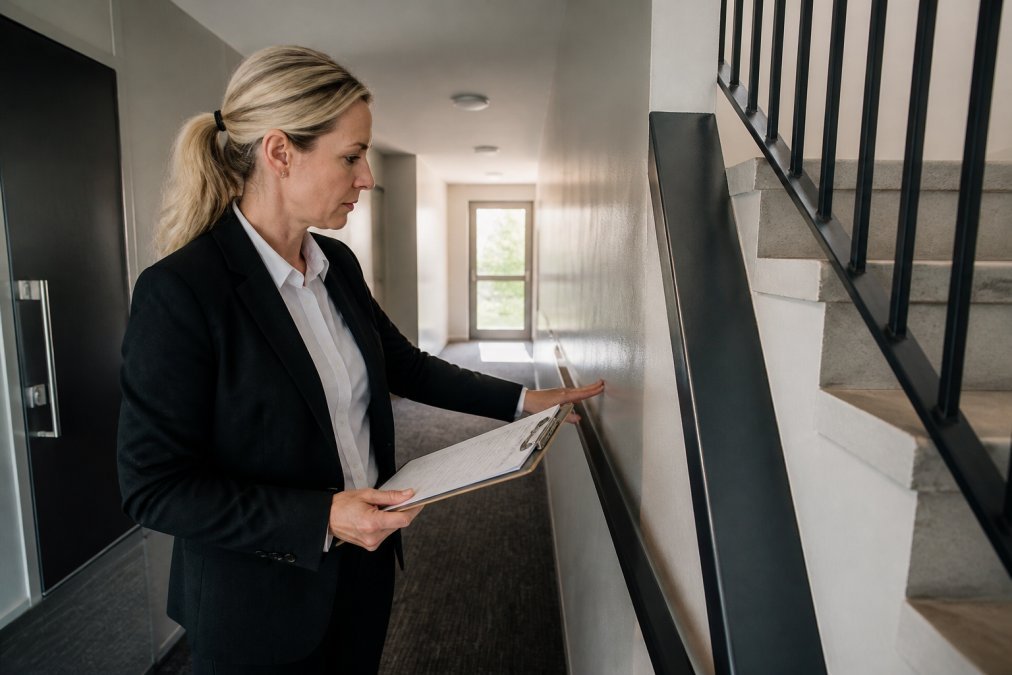
    Professional property manager in business attire holding clipboard with cleaning checklist, inspecting a communal apartment hallway with neutral-coloured walls, examining surfaces and high-touch points for dust and debris under natural daylight
    Professional property manager in business attire holding clipboard with cleaning checklist, inspecting a communal apartment hallway with neutral-coloured walls, examining surfaces and high-touch points for dust and debris under natural daylight

    A practical checklist includes:

    Daily tasks:

    • Empty bins and replace liners
    • Sweep lobby and main corridors
    • Wipe high-touch surfaces (door handles, lift buttons, handrails)
    • Check for spills or hazards

    Weekly tasks:

    • Mop hard floors in communal areas
    • Clean windows (ground floor and lobby)
    • Disinfect lift interior
    • Inspect stairwells for litter and damage

    Monthly tasks:

    • Deep clean carpeted areas
    • Wash communal walls and paintwork
    • Check graffiti and arrange removal if needed
    • Inspect ventilation grilles and vents

    Quarterly tasks:

    • Professional carpet cleaning
    • High-level window cleaning (working at height)
    • Deep clean of lift machinery and mechanics
    • Pressure wash external areas

    The checklist should include who is responsible for each task, what products or equipment are needed, and any safety precautions. If you work with a cleaning contractor, they should sign off on each task as it's completed.

    Pro Tip
    Use a digital checklist app or a simple printed sheet. The format matters less than consistency. What matters is that someone checks it every single day and records what was done. Missing tasks become obvious quickly, and you can address them before residents complain.

    Developing an Apartment Block Cleaning Schedule Template

    A cleaning schedule transforms your checklist into a real plan. It tells your cleaning team exactly what happens on which days, at what times, and who does it.

    Start with your building's constraints. High-rise blocks need different timing than low-rise. A building with 200 residents has different needs than one with 40. A building with a busy lobby needs more frequent cleaning than a quieter one. Your schedule must fit your building's actual use patterns.

    Book a Clean →

    Here's a practical template structure:

    Monday through Friday:

    • 06:00-07:00: Lobby sweep, bin collection, high-touch surface wipe
    • 10:00-11:00: Corridor inspection and spot cleaning
    • 16:00-17:00: Stairwell sweep, lift interior clean

    Saturday:

    • 08:00-12:00: Deep floor clean (mop and disinfect)
    • 12:00-14:00: Window cleaning (ground floor)

    Sunday:

    • 10:00-12:00: Communal garden maintenance and litter removal

    The times matter because residents expect certain tasks to happen when they won't be disrupted. Early morning cleaning (6-7 a.m.) catches overnight mess and sets the tone for the day. Afternoon cleaning (4-5 p.m.) addresses accumulated dirt before evening. Avoid peak times when residents are coming and going.

    For larger buildings, you might need two cleaning staff working different shifts. For smaller buildings, one person might cover all tasks but need to adjust timing based on what's realistic.

    Your schedule should also include contingencies.

    Key Takeaway
    A schedule that's realistic beats one that's perfect on paper but never happens. Build in buffer time, account for staff absences, and adjust based on what actually works in your building.

    How to Monitor Cleaning Performance and Compliance

    Beyond sign-offs, do visual inspections. Walk the building yourself at least twice a week, ideally at different times of day. Check:

    • Are floors clean and free of debris?
    • Are high-touch surfaces visibly clean?
    • Are bins properly managed?
    • Is there any damage, graffiti, or hazards?
    • Are communal areas well-lit and properly ventilated?

    Many property managers use a simple scoring system:

    • Green: All tasks completed to standard
    • Amber: 1-2 minor tasks missed or done poorly
    • Red: Multiple tasks missed or significant issues
    Watch Out
    Monitoring isn't about being punitive, it's about catching problems early. A building that's monitored consistently stays clean. A building that isn't monitored gradually deteriorates as standards slip.

    For larger buildings or multi-site operations, software tools can help. But a spreadsheet and a camera phone work just as well if you're consistent.

    Managing Tenant Responsibilities and Landlord Duties

    The law is clear: landlords are responsible for maintaining communal areas. Tenants are responsible for their own flats. But the line gets blurry in practice.

    Common disputes arise over:

    • Litter in corridors (landlord's responsibility to clean, but tenant shouldn't be leaving it)
    • Damage to communal paintwork (landlord repairs, but tenant pays if they caused it)
    • Pest infestations (landlord's responsibility to manage, but tenants must report quickly)
    • Blocked drains (usually landlord, unless caused by tenant misuse)

    Implementing Sustainable and Cost-Effective Cleaning Practices

    Consider these cost-saving approaches:

    Use microfibre cloths instead of disposable ones. They clean better with less product, last months, and wash easily. Initial cost is higher, but you save money within weeks.

    Pro Tip
    Track your cleaning costs monthly. Break them down by category: labour, products, equipment, waste disposal. Look for patterns. If one area costs significantly more than others, investigate why. Small changes often yield big savings.

    Conclusion


    Maintaining cleaning standards in apartment blocks requires three things: a clear standard, consistent monitoring, and the right support. Without any one of these, standards slip.

    Task Frequency Responsibility Compliance Check
    High-touch surface disinfection Daily Cleaning staff Daily sign-off
    Floor sweep and mop Daily/Weekly Cleaning staff Visual inspection
    Communal area deep clean Monthly Cleaning staff Photographic record
    Graffiti removal As needed Landlord/contractor Within 48 hours
    Pest prevention inspection Quarterly Landlord Documented report
    Health and safety audit Quarterly Property manager Compliance checklist

    Frequently Asked Questions

    How often should communal areas in apartment blocks be cleaned?

    Communal areas require cleaning at least weekly, with high-traffic zones like lobbies, stairwells, and lift areas cleaned 2-3 times per week or daily depending on foot traffic and building size. High-touch surfaces such as handrails, door handles, and lift buttons need daily disinfection to reduce hygiene risks. Your cleaning schedule should reflect your building's specific usage patterns and tenant density. A professional cleaning audit can determine the optimal frequency for your property.

    What should a communal area cleaning checklist include?

    A comprehensive checklist must cover floor maintenance (sweeping and mopping), high-touch surface disinfection, waste collection and bin storage areas, stairwell and lobby cleaning, graffiti removal protocols, and ventilation checks. Include specific tasks for each zone, required products, time allocations, and sign-off procedures. Document cleaning frequency for each task, safety hazards to watch for, and contractor compliance requirements. Regular visual inspections against this checklist ensure consistent hygiene standards across all residential areas.

    How can property managers monitor whether cleaning contractors are meeting standards?

    Implement a formal cleaning audit process using your checklist as the baseline. Conduct unannounced visual inspections weekly, photograph high-risk areas to track consistency, and establish a sign-off system where staff or residents report missed spots. Set clear contractor compliance expectations in your tenancy agreement or service charge terms. Track detritus levels, sanitization effectiveness, and preventative maintenance completion. Regular feedback loops and performance metrics help identify trends and address issues before they affect tenant satisfaction or health and safety compliance.

    What are the legal requirements for cleanliness in residential common areas?

    Landlords must maintain communal areas to a safe and hygienic standard under the Health and Safety at Work etc. Act 1974 and the Housing Act 2004. Buildings must comply with fire safety regulations and ensure adequate ventilation and waste management. Service charges can be used to fund professional cleaning, provided costs are reasonable and transparent. Local environmental health departments may inspect residential blocks for compliance. Documented cleaning schedules, audits, and contractor records demonstrate your commitment to regulatory compliance and protect against liability claims.

  • Flexible Cleaning Schedules for Office Buildings

    Flexible Cleaning Schedules for Office Buildings

    Table of Contents

    Last Updated: September 28, 2026

    Why Flexible Cleaning Schedules Matter for Modern Offices

    The modern office is nothing like it was five years ago. Hybrid work has transformed how buildings get used. Some days your office is full. Other days it's half-empty. Fixed cleaning schedules made sense when everyone came in five days a week. They don't anymore.

    Flexible cleaning schedules for office buildings adapt to how your space is actually used. Instead of cleaning the same way every single day, you adjust based on occupancy. You clean more thoroughly on busy days. You scale back on quieter ones. This approach cuts waste, improves hygiene, and saves money.

    At Lion Cleaning Group, we've worked with facility managers across the UK who have seen the benefits of flexible cleaning schedules. They found that aligning cleaning efforts with actual usage can lead to more efficient resource allocation and improved hygiene.

    The challenge most facilities face is figuring out where to start. How do you measure occupancy? Which areas need daily attention? How do you actually schedule around fluctuating patterns? Below, we'll show you exactly how to build a flexible cleaning schedule that works for your building.

    Assessing Your Office Cleaning Needs

    Before you change anything, you need to understand what your building actually needs. This starts with two questions: How full is your office on any given day? Which areas matter most?

    Measuring occupancy patterns

    Your occupancy pattern is the foundation of everything. Track how many people use your building each day for two to four weeks. Look at patterns by day of the week. Mondays often see higher occupancy than Fridays in hybrid offices.

    Use simple tools to measure:

    • Badge access logs from your building entry system
    • Desk booking data if you use hot-desking software
    • Parking occupancy counts
    • Manual headcount during peak hours

    Once you have the data, you'll spot the pattern. Many offices see 30-40% occupancy on Mondays, climbing to 60-70% by mid-week, then dropping again Friday. Some see the opposite. Your pattern is unique to your business.

    Document these numbers. They become your baseline for scheduling decisions.

    Identifying high-priority cleaning areas

    Not every part of your office needs the same level of attention. Some areas are touched by dozens of people daily. Others sit empty most of the time.

    High-priority areas include:

    • Reception and entry points
    • Toilet facilities and washrooms
    • Kitchen and break areas
    • Lift buttons and handrails
    • Shared meeting room tables and chairs
    • Door handles throughout the building

    Lower-priority areas might include:

    • Individual desk spaces (especially in hot-desking setups)
    • Rarely-used storage rooms
    • Hallways with minimal foot traffic
    • Outdoor areas unless they're customer-facing

    The key insight here: focus your effort where people actually are. If occupancy is low, don't deep-clean empty desks. Concentrate on the spaces where germs spread fastest.

    Hybrid Office Cleaning Requirements and Task Allocation

    Hybrid working creates a specific challenge. You can't predict exactly who will be in the building or when. Your cleaning schedule needs to be flexible enough to handle that uncertainty while maintaining standards.

    Daily tasks versus weekly deep cleans

    A practical approach separates tasks by frequency. Daily tasks keep the building hygienic day-to-day. Weekly deep cleans handle what daily cleaning misses.

    Daily tasks focus on high-touch surfaces and visible dirt:

    • Emptying bins in all areas
    • Restocking toilet paper, soap, and hand towels
    • Wiping down high-touch surfaces (door handles, lift buttons, handrails)
    • Spot-cleaning visible spills or marks
    • Cleaning toilet seats and urinals
    • Mopping entrance areas where dirt accumulates

    Weekly deep cleans go deeper:

    • Vacuuming all carpeted areas thoroughly
    • Cleaning under and behind furniture
    • Washing windows and glass partitions
    • Deep-cleaning kitchen appliances
    • Sanitising meeting room chairs and tables
    • Cleaning air vents and light fixtures

    The split lets you maintain hygiene daily without the cost of a full deep clean every single day. On low-occupancy days, you can skip some daily tasks. On high-occupancy days, you might add extra passes through high-traffic areas.

    High-touch surface disinfection protocols

    High-touch surfaces are where germs concentrate (Checking your browser). These areas need regular attention, especially in shared spaces.

    Your disinfection protocol should identify which surfaces need attention and how often:

    • Door handles: at least twice daily in high-occupancy areas
    • Lift buttons: three times daily minimum
    • Toilet flush handles: after each use or at minimum twice daily
    • Handrails: twice daily
    • Shared desk equipment (printers, scanners): daily
    • Meeting room tables and chairs: after each use or daily
    • Kitchen appliances and handles: twice daily

    The frequency depends on occupancy. On days when occupancy is above 60%, increase the frequency. On days below 40%, you can maintain once-daily passes for most surfaces.

    Environmentally friendly products are used by Lion Cleaning Group. They are designed to meet hygiene standards while being safer for staff and building users.

    Book a Clean →

    Commercial Cleaning Frequency Standards and Best Practice

    The cleaning frequency your office needs depends on several factors: industry type, occupancy levels, customer-facing areas, and regulatory requirements.

    Most office buildings benefit from a baseline of daily cleaning for high-traffic and high-touch areas, with weekly deep cleans. Some industries need more frequent sanitisation. Healthcare facilities, for example, require more rigorous disinfection protocols than general offices.

    For a typical hybrid office, this framework works well:

    • High-touch surfaces: daily disinfection
    • Common areas (kitchens, toilets, breakrooms): daily cleaning
    • Floors in high-traffic zones: daily mopping
    • General office areas: twice-weekly vacuuming
    • Deep cleans of all areas: weekly
    • Carpet shampooing and window cleaning: monthly
    • HVAC vent cleaning and deep sanitisation: quarterly

    The best practice approach is to adjust these frequencies based on your occupancy data. If your office hits 70% occupancy on Tuesdays and Wednesdays, those days get your full cleaning schedule. If occupancy drops to 20% on Fridays, you scale back to essential tasks only.

    This flexibility is what makes modern cleaning schedules work. You're not locked into a one-size-fits-all approach.

    Creating an Office Cleaning Checklist Template

    A good checklist ensures nothing gets missed and gives your cleaning team clear direction. It also creates accountability and makes it easy to spot where standards might slip.

    Your checklist should break down by area and frequency.

    Area Daily Task Frequency Notes
    Entrance/Reception Sweep, mop, bin empty Daily Increase frequency on high-occupancy days
    Toilet Facilities Clean, disinfect, restock Daily Check after lunch and end of day
    Kitchen/Breakroom Wipe surfaces, clean appliances Twice daily Morning and evening
    High-touch surfaces Disinfect door handles, lifts, rails Daily minimum 2-3 times on high-occupancy days
    Meeting rooms Wipe tables, chairs, check bins Daily Clean after scheduled bookings
    Office floors Vacuum carpets, mop hard floors 2x weekly Daily in high-traffic zones
    Windows/Glass Clean interior surfaces Weekly Monthly deep clean outside
    Deep clean all areas Full sanitisation Weekly Saturday or after-hours

    Implementing Occupancy-Based and Variable-Day Scheduling

    This is where theory becomes practice. You've measured occupancy and identified priorities. Now you build a schedule that adapts to actual usage patterns.

    Professional cleaning team using flexible cleaning schedules to sanitize office desks and surfaces
    Professional cleaning team using flexible cleaning schedules to sanitize office desks and surfaces

    Adapting schedules to fluctuating office occupancy

    Start with your occupancy data. Plot it by day of the week and time of day if possible. You'll see patterns emerge.

    Most hybrid offices follow one of these patterns:

    • Peak mid-week (Monday-Wednesday high, Thursday-Friday low)
    • Consistent mid-week, quiet Fridays
    • Unpredictable (varies week to week based on projects)

    On high-occupancy days (60%+ occupancy):

    • Full daily cleaning of all areas
    • Three passes on high-touch surfaces
    • Extra attention to break areas and toilets
    • Immediate spot-cleaning of spills

    On medium-occupancy days (40-60% occupancy):

    • Standard daily cleaning schedule
    • Two passes on high-touch surfaces
    • Focus on areas where people actually are
    • Skip deep cleaning of empty zones

    On low-occupancy days (below 40% occupancy):

    • Maintenance cleaning only (bins, toilets, high-touch surfaces)
    • Skip some daily tasks in quiet areas
    • Use the time for weekly deep-clean tasks
    • Reduce team size if possible

    Managing downtime and resource allocation

    Flexible scheduling only works if you manage resources efficiently. You can't have a full team standing around on quiet days, and you can't scramble to find staff on busy ones.

    The solution is variable staffing:

    • Core team: always present, handles essential daily tasks
    • Flex team: scheduled based on occupancy forecast
    • Specialist team: handles weekly deep cleans and detailed work

    Measuring ROI and Operational Efficiency Gains

    Flexible scheduling delivers financial and operational benefits. Measuring them shows whether the approach is working and where you might adjust.

    Track these metrics:

    • Cost per square metre per week (should decrease as you optimise)
    • Staff hours used per week (should align more closely with actual need)
    • Cleanliness audit scores (should stay consistent or improve)
    • Occupant satisfaction with cleanliness (survey quarterly)
    • Absenteeism due to illness (track over time)
    • Energy use for cleaning equipment and supplies (should decrease)

    Frequently Asked Questions

    How often should an office building be cleaned?

    Commercial cleaning frequency standards depend on occupancy levels, foot traffic, and industry type. Most offices require daily cleaning of high-touch areas such as door handles, lift buttons, and kitchen surfaces, combined with weekly deep cleans of carpets and less-frequented zones. Hybrid offices may benefit from occupancy-based schedules that adjust cleaning intensity on days when fewer staff are present, reducing unnecessary resource allocation while maintaining workplace hygiene standards.

    What should be included in a professional office cleaning checklist template?

    A comprehensive office cleaning checklist template must cover daily tasks (emptying bins, sanitising surfaces, mopping floors), weekly tasks (carpet cleaning, window wiping, deep-cleaning bathrooms), and monthly preventative maintenance. For hybrid workplaces, prioritise high-touch surfaces. Include task frequency, assigned staff, and sign-off procedures to ensure accountability.

    What are the benefits of flexible cleaning schedules for hybrid offices?

    Flexible cleaning schedules for hybrid offices align cleaning intensity with actual occupancy levels, and maintain consistent disinfection protocols on days when staff are present. Variable-day scheduling allows facility managers to redirect resources to high-priority areas and supports workplace hygiene.

    How do you adapt cleaning schedules for fluctuating office occupancy?

    Track occupancy data weekly to identify patterns in when staff are present, then adjust task frequency accordingly. On high-occupancy days, increase cleaning of high-touch surfaces and common areas. On low-occupancy days, prioritise preventative maintenance and deep cleans of less-used zones. Use occupancy-based cleaning to shift resources toward areas that need them most and maintain hygiene standards.

  • Commercial Cleaning Quotes: What to Expect

    Commercial Cleaning Quotes: What to Expect

    Table of Contents

    Last Updated: September 21, 2026

    What Is Included in a Commercial Cleaning Quote

    A commercial cleaning quotes typically covers labour costs, materials, equipment, frequency of service, and specialised work like window cleaning or floor maintenance, itemised separately so you understand what you're paying for.

    Professional quotes specify which areas get cleaned, frequency, and cleaning specifications, including whether deep cleaning, daily routines, or working at height are included.

    Strong quotes outline service level agreements (SLAs), response times, and consequences for missed sessions, preventing surprises and demonstrating commitment.

    Pro Tip
    Request itemised quotes from multiple providers. A single line item "office cleaning, £500/month" tells you nothing. You need line-by-line breakdowns so you can compare apples to apples and spot where one provider cuts corners.

    How to Calculate Commercial Cleaning Prices

    Pricing typically starts with cost per square foot, multiplied by total area. Rates vary by building type, cleaning intensity, and frequency.

    Labour costs form the bulk of commercial cleaning quotes. A team's hourly rate multiplied by estimated cleaning time gives a baseline, but most providers add materials, equipment wear, and overhead. Understanding these additions is crucial to evaluating competitiveness.

    The Hidden Costs Most Quotes Don't Itemise

    Beyond labour and materials, several cost categories often appear as lump sums or percentages rather than line items, making them difficult to compare across providers:

    Insurance and Liability Markup. Many providers add 8-15% to base labour to cover mandatory professional indemnity and public liability insurance. This should be stated separately to avoid double-charging.

    Supply and Equipment Markups. Providers typically mark up cleaning products and consumables by 20-40% above cost. A transparent quote breaks this out separately; if not mentioned, ask whether supplies are included or billed at cost-plus markup.

    Holiday and Bank Holiday Premiums. Expect a 25-50% surcharge for bank holidays or festive periods, reflecting higher staff wages. Many quotes don't mention this until asked, leading to surprise invoices.

    Emergency and Out-of-Hours Call-Out Fees. Emergency cleaning (spillage, pest incidents) is rarely included in base price. Typical fees range £150-£400. Clarify whether your contract includes free emergency visits or charges per call.

    Frequency Discounts and Volume Rebates. Providers often discount longer contracts or multiple-site arrangements. Weekly service may cost £6-£9 per square foot annually versus £8-£12 for daily. Negotiate if managing multiple buildings.

    Building a Transparent Price Model

    When comparing quotes, ask each provider to itemise:

    1. Labour cost (hourly rate × estimated hours per visit × frequency per month)
    2. Materials and consumables (as a percentage of labour or fixed monthly amount)
    3. Insurance and overhead (stated as a percentage or fixed fee)
    4. Specialised services (window cleaning, carpet shampooing, floor stripping, priced separately)
    5. Holiday and out-of-hours premiums (if applicable to your contract)
    6. Any volume discounts (applied to the total if you're committing to multiple sites or a longer term)

    With itemised breakdowns from multiple providers, you can compare true cost of ownership. A £2,500/month quote with no emergency cover and £300 per call-out may cost more than £2,800/month with two free emergency visits included.

    Watch Out
    Never accept a quote that lumps everything into a single monthly figure without itemisation. Insist on a detailed breakdown. If a provider resists, that's a red flag, they may be hiding cost inflation or planning to add charges later.

    Factors That Affect Your Cleaning Costs

    Building size affects cost, but size alone doesn't determine price.

    Building type matters significantly. Offices with standard surfaces cost less than apartment complexes with communal areas and high-rise windows. Retail and hospitality venues require more frequent sanitisation, increasing costs.

    Cleaning frequency directly impacts total spend. Daily service costs more per visit but ensures consistency; weekly or fortnightly is cheaper per session but requires intensive deep cleaning to maintain appearance.

    Carpet cleaning, high-rise window cleaning, and specialist floor treatments add to base price.

    Sustainability and Green Cleaning Certifications

    Environmentally friendly cleaning products cost 15-30% more than standard chemical alternatives, but this premium is now a material factor in many commercial cleaning quotes. Understanding what you're paying for is essential.

    Standard Chemical vs. Eco-Certified Products. Eco-certified alternatives use plant-based surfactants or enzymatic cleaners, safer for staff with respiratory sensitivities.

    For facilities with staff or vulnerable populations with sensitivities, eco-friendly products are justified.

    Book a Clean →

    Relevant Certifications. Not all "green" or "eco-friendly" claims are equal. Look for providers using products certified by:

    • EU Ecolabel – The most rigorous environmental standard for cleaning products in Europe. Products must meet strict criteria on biodegradability, toxicity, and packaging.
    • Nordic Swan – A Scandinavian eco-label with high standards for environmental impact and worker safety.
    • Cradle to Cradle – Certifies that products are designed for recycling or safe biodegradation.
    • ISOIEC 14001 – An environmental management system certification that shows the provider's entire operation (not just products) meets sustainability standards.

    Post-Pandemic Sanitisation Standards

    Since 2020, sanitisation has become a distinct cost line in most commercial cleaning quotes. It's no longer optional for facilities with public access or shared spaces. Understanding what's included, and what costs extra, is critical.

    Standard Cleaning vs. Sanitisation. Standard cleaning removes dirt and debris; sanitisation uses approved disinfectants to reduce pathogens on high-touch surfaces. Most commercial cleaning now includes baseline sanitisation of door handles, light switches, lift buttons, and desks, though frequency varies.

    High-Touch Surface Protocols. Many providers now offer tiered sanitisation:

    • Basic tier (included in standard cleaning): Daily wipe-down of door handles, lift buttons, and reception desks with approved disinfectant.
    • Enhanced tier (+10-15% cost): Twice-daily sanitisation of high-touch surfaces, plus sanitisation of shared equipment (keyboards, phones, conference room tables).
    • Deep sanitisation tier (+25-40% cost): Electrostatic spraying of entire rooms with hospital-grade disinfectant, or UV-C light treatment of surfaces. This is typically done weekly or monthly, not daily.

    For office buildings, the basic tier is now standard and usually included in quotes. For healthcare facilities, care homes, or hospitality venues, enhanced or deep sanitisation is often mandatory under health and safety regulations, and costs are higher.

    Disinfectant Product Costs. The type of disinfectant affects cost. Hospital-grade disinfectants (e.g., chlorine-based or quaternary ammonium solutions approved by the Health and Safety Executive) cost more than standard surface cleaners. If your facility has specific infection control requirements (e.g., you're cleaning after a known outbreak), providers may need to use higher-specification products, adding 5-15% to the quote.

    Ask your provider whether their sanitisation protocol meets current Health and Safety Executive (HSE) guidance and whether they use products on the approved list for your sector. For care homes and healthcare settings, this is non-negotiable; for offices, it's increasingly expected.

    Location, Accessibility, and Specialist Requirements

    Location and building accessibility affect labour costs. Remote sites or difficult access (narrow corridors, multiple floors, working at height) require more time and specialist equipment.

    Working at height (cleaning high-rise windows, external facades, or skylights) requires staff trained and certified under the Work at Height Regulations 2005. This training adds cost, and the work itself is slower and requires specialist equipment (cradles, harnesses, safety lines).

    Watch Out
    Always confirm whether your building's specific requirements, working at height, specialist floor treatments, hazardous material handling, are included in the base quote or charged as extras. A provider quoting low for standard cleaning but charging heavily for height work may not be the cheapest overall.

    What to Include in a Commercial Cleaning Proposal

    A commercial cleaning proposal must state service start date, contract length, renewal terms, and explicitly list which areas are included or excluded.

    Detail cleaning frequency and timing.

    Understanding Commercial Cleaning Contract Templates

    A cleaning contract sets expectations, defines responsibilities, and creates dispute resolution framework. A solid template covers scope, pricing, term, and termination clauses.

    Pro Tip
    Don't accept a provider's template without review. Have your legal team check it, or use a standard template from a business support organisation. A few hours reviewing terms upfront saves weeks of friction later.

    Comparing Cleaning Service Providers and Evaluating Proposals

    Compare multiple commercial cleaning quotes systematically using a table with provider name, price, scope, frequency, SLA, and specialised services.

    Evaluation Criteria What to Look For Red Flags
    Pricing Itemised quote, fixed term, clear renewal terms Single line item, vague pricing, hidden fees
    Scope Detailed service list, specific areas covered, frequency stated Generic description, "as needed" language
    SLA Response times, service credits for failures, contact procedures No SLA mentioned, vague promises
    Staff DBS checked, trained, consistent team assigned No mention of training or vetting
    References Comparable facilities, recent clients, verifiable contacts No references offered, dated testimonials
    Flexibility Adjusts to your schedule, handles special requests Rigid scheduling, no accommodation for changes

    Questions to Ask Before Accepting a Cleaning Quote

    Ask whether the provider has worked with buildings like yours. For high-rise complexes, confirm working at height experience. For retail venues, confirm they handle heavy sanitisation during busy trading hours.

    Facility manager reviewing commercial cleaning quotes at a desk in a bright, modern office building
    Facility manager reviewing commercial cleaning quotes at a desk in a bright, modern office building

    Ask for a trial period.


    Frequently Asked Questions

    What factors influence the cost of commercial cleaning services?

    Several factors shape commercial cleaning costs: building size (measured in square metres), cleaning frequency (daily, weekly, or monthly), service type (standard janitorial, deep cleaning, or specialist work like window cleaning at height), site condition, and specific requirements such as environmentally friendly products or post-pandemic hygiene standards. Labour costs, travel to multiple locations, and equipment needs also affect the final quote. A tailored assessment of your facility ensures accurate pricing.

    What should be included in a professional commercial cleaning contract?

    A solid commercial cleaning contract must specify the scope of work (which areas and tasks), service frequency and timing, pricing structure and payment terms, performance standards and service level agreements (SLAs), staff vetting requirements (such as DBS checks), insurance and liability coverage, cleaning supplies and sustainability practices, cancellation or change policies, and dispute resolution procedures. Clear specifications prevent misunderstandings and protect both parties.

    How do I compare quotes from different cleaning companies?

    Compare quotes by ensuring they cover the same scope of work and frequency. Look beyond price: evaluate whether providers offer flexibility around your schedule, have experience with buildings similar to yours, provide references from other facility managers, and hold relevant certifications. Check if they use environmentally friendly products, have working-at-height capabilities if needed, and offer transparent SLAs. Request itemised proposals so you understand what each cost covers.

    Are commercial cleaning quotes usually fixed or variable?

    Most commercial cleaning quotes are structured as fixed monthly or weekly fees based on a site inspection and agreed scope of work. However, additional services (deep cleaning, emergency work, or expanded square footage) may incur variable costs. Some providers offer tiered pricing based on service frequency. Always clarify whether your quote includes contingencies for seasonal variations or building changes, and confirm the contract terms for price adjustments.

  • Preventing Staff Illness With Professional Cleaning

    Preventing Staff Illness With Professional Cleaning

    Table of Contents

    Last Updated: September 20, 2026

    How Professional Cleaning Prevents Staff Illness

    Preventing staff illness with professional cleaning is one of the most overlooked levers for reducing workplace absenteeism and maintaining productivity. When a workspace isn't cleaned to clinical standards, pathogens accumulate on surfaces, in the air, and on shared equipment. The result: employees catch infections more easily, take sick leave more frequently, and your operation suffers.

    The connection is direct. High-touch surfaces like door handles, light switches, and desk phones become vectors for bacterial transmission. A single contaminated surface touched by dozens of people daily becomes a pathogen distribution point. Professional cleaning eliminates this risk through systematic sanitisation protocols and validated disinfection frequencies.

    Fewer pathogens in the environment means fewer infections. Fewer infections mean fewer people calling in sick. The reason isn't complicated: fewer pathogens in the environment means fewer infections. Fewer infections mean fewer people calling in sick.

    Pro Tip
    The most critical surfaces in any workplace are those touched by multiple people within minutes. A professional cleaning service prioritises these high-touch areas, not just the visible floor space.

    Reducing Employee Sick Leave Through Cleaning

    Employee sick leave costs British businesses significantly. When staff absence increases, productivity drops, customer service suffers, and remaining employees become overloaded. The hidden cost of preventable illness is substantial.

    Professional cleaning directly reduces employee sick leave by lowering the pathogenic load in shared spaces. When bathrooms are cleaned multiple times daily, break rooms are sanitised between uses, and high-touch surfaces are disinfected on a validated schedule, the transmission of respiratory infections, stomach bugs, and other contagious illnesses drops measurably.

    The mechanism is straightforward: fewer viable pathogens on surfaces means fewer people become infected. This isn't about making spaces look clean, it's about reducing the actual microbial load through evidence-based disinfection. A professional service uses appropriate cleaning chemicals, applies them at correct concentrations, and follows contact times that actually kill pathogens rather than just wiping surfaces.

    The improvement accelerates as staff confidence in workplace hygiene grows and fewer people arrive at work already ill.

    Key Takeaway
    Sick leave reduction is one of the most measurable ROI indicators of professional cleaning. Track absence rates before and after implementation to quantify the financial benefit.

    High-Touch Surface Sanitisation in the Workplace

    High-touch surfaces are the primary transmission route for infections in shared workplaces. These are surfaces touched by many people throughout the day: door handles, light switches, lift buttons, desk phones, keyboard and mouse, bathroom taps, and communal equipment.

    Professional cleaner in protective gloves and uniform sanitising a door handle, light switch, and keyboard in a modern office environment with natural window lighting
    Professional cleaner in protective gloves and uniform sanitising a door handle, light switch, and keyboard in a modern office environment with natural window lighting

    Pathogen reduction on these surfaces requires more than standard cleaning. A damp cloth removes visible dirt but leaves viable pathogens behind. Effective sanitisation requires contact with an appropriate disinfectant for a specified duration, typically 30 seconds to several minutes depending on the product and target pathogen.

    Professional cleaning services understand disinfection frequency requirements for different surfaces and environments. High-touch surfaces in healthcare settings require different protocols than office spaces, which differ from retail environments. A validated approach targets the specific pathogens likely in each setting.

    Cross-contamination between areas is a common failure point in amateur cleaning. A cleaner using the same cloth to wipe multiple surfaces actually spreads pathogens rather than containing them. Professional teams use colour-coded cloths, change them frequently, and follow protocols that prevent cross-contamination between zones.

    The result is measurable: viable pathogen counts drop significantly on properly sanitised surfaces. This directly translates to fewer infections among staff.

    Commercial Cleaning Health and Safety Standards

    Cleaning itself poses occupational health risks if not managed properly. Cleaning chemicals can irritate respiratory systems, cause skin reactions, and create hazardous fumes when mixed incorrectly. Staff exposure to these risks must be controlled through proper training, ventilation, and safe handling procedures.

    In the UK, the Control of Substances Hazardous to Health Regulations (COSHH) require employers to assess chemical risks and implement control measures (Control of Substances Hazardous to Health (COSHH)). This includes ensuring cleaning staff understand the hazards of products they use, proper dilution rates, required personal protective equipment, and ventilation needs.

    Professional cleaning services carry COSHH compliance as a core responsibility. Their staff receive training on chemical safety, use appropriate protective equipment, and follow manufacturer guidance on application and contact times. This protects both cleaning staff and building occupants.

    Environmentally friendly cleaning products have become increasingly effective at pathogen reduction. Lion Cleaning Group uses products that deliver disinfection efficacy without the respiratory irritation or environmental impact of traditional harsh chemicals. These products meet health and safety standards whilst reducing exposure risks for staff and occupants.

    Proper waste management is another critical standard. Used cleaning materials, chemical containers, and potentially contaminated waste require appropriate disposal. Professional services manage this responsibility, ensuring compliance with environmental and occupational health regulations.

    Watch Out
    Mixing cleaning chemicals, particularly bleach with other products, creates toxic fumes and can cause serious respiratory harm. Professional services prevent this through proper training and chemical storage protocols.

    Indoor Air Quality and Respiratory Health

    Workplace air quality directly affects respiratory health and staff wellbeing. Airborne pathogens, dust, allergens, and chemical residues accumulate in poorly maintained spaces. Staff working in these environments experience more respiratory infections, allergies, and general illness.

    Professional cleaning reduces airborne pathogens through several mechanisms. Regular surface cleaning removes dust and allergen sources that become airborne. Proper ventilation during and after cleaning prevents chemical residues from lingering in the air.

    Respiratory health becomes particularly critical in shared spaces like open-plan offices, meeting rooms, and break areas where air is recirculated. A single person with a respiratory infection can contaminate the shared air, affecting colleagues throughout the day. Cleaning protocols that address both surfaces and air quality reduce this transmission pathway.

    Many organisations have upgraded their approach to indoor air quality since 2020, recognising the link between air quality, infection prevention, and employee wellbeing. Professional cleaning services that understand this connection, and can articulate their approach to both surface and air hygiene, deliver measurable health benefits.

    Humidity control is another factor. Excessive moisture encourages mould and bacterial growth; excessive dryness irritates respiratory systems. Professional facilities management addresses these factors as part of comprehensive hygiene protocols.

    Book a Clean →

    The ROI of Professional Cleaning Services

    The financial case for professional cleaning extends beyond appearance. When you calculate the true cost of employee sick leave, lost productivity, overtime for remaining staff, customer service impact, and reduced output, professional cleaning becomes a cost-saving measure rather than an expense.

    Building a cost-benefit model for your workplace:

    Start with your baseline. Calculate your organisation's average sick leave cost per employee per year. The true cost to your business includes lost output, temporary cover, and management overhead.

    Next, estimate your current infection-related absence rate. Track respiratory infections, stomach bugs, and other contagious illnesses separately from other absence types. This gives you a baseline transmission rate.

    Then, research professional cleaning costs for your facility size. Larger facilities benefit from economies of scale. Healthcare settings and food-handling environments typically require more intensive protocols and cost more.

    Now apply the reduction factor. Use a conservative figure for your initial calculation.

    Worked example:

    • 50-person office

    This calculation excludes secondary benefits: improved employee morale, reduced presenteeism (staff working whilst ill), lower staff turnover, and improved customer perception. Many organisations find these intangible benefits justify the investment even if infection-related absence reduction is modest.

    Variables that improve ROI:

    High-touch, high-occupancy environments (call centres, open-plan offices, retail, education, healthcare) see faster payback because infection transmission is higher. Organisations with high baseline sick leave see more dramatic improvements. Seasonal factors matter: winter months typically show 40-60% higher respiratory infection rates, so cleaning investments show faster ROI in autumn and winter.

    Customer-facing businesses benefit from a secondary ROI: improved hygiene perception increases customer confidence and retention. A retail business or hospitality venue that visibly invests in professional cleaning often sees measurable improvements in customer satisfaction scores and repeat business.

    Best For
    Organisations with 30+ employees, high baseline sick leave (above 5 days per employee per year), or customer-facing operations. The ROI calculation becomes compelling within 12-18 months in these environments. Smaller teams or those with already-low absence rates should focus on the wellbeing and perception benefits rather than pure financial ROI.

    Sustainable Cleaning and Employee Wellbeing

    Sustainable cleaning practices, using environmentally responsible products and methods, align with both employee wellbeing and corporate responsibility. But the wellbeing benefit extends far beyond chemical safety: the psychological impact of a visibly clean, well-maintained workspace directly influences employee stress, confidence, and mental health.

    The psychology of workplace cleanliness:

    Research in occupational psychology consistently shows that employees working in clean, orderly environments report lower stress levels, higher job satisfaction, and greater sense of control over their work conditions.

    Sustainable products and respiratory confidence:

    Visible cleanliness and retention:

    Environmental responsibility and staff pride:

    Key Takeaway
    The wellbeing ROI of professional cleaning includes three layers: infection prevention (measurable, clinical), psychological safety (perception-driven but real in its health impact), and organisational values alignment (retention and engagement). Sustainable products amplify all three by signalling care for both employee health and environmental responsibility.

    Frequently Asked Questions

    What are the most common high-touch areas that spread office illness?

    Door handles, light switches, lift buttons, desks, keyboards, and communal kitchen equipment are the primary vectors for bacterial and viral transmission. These surfaces are touched dozens of times daily by multiple staff members, making them critical points for cross-contamination. Regular sanitisation of high-touch surfaces significantly reduces pathogen load and infection prevention in shared workspaces.

    How often should commercial premises be deep cleaned to prevent illness?

    Daily sanitisation of high-touch surfaces combined with weekly deep cleaning is the standard practice for most offices. During periods of heightened illness risk, increased frequency may be necessary. Professional cleaning schedules should be tailored to your facility's foot traffic, number of staff, and occupancy patterns. Consistent preventative maintenance reduces viral load and bacterial transmission more effectively than sporadic deep cleans.

    What are the legal responsibilities of employers regarding workplace hygiene?

    Under the Health and Safety at Work etc. Act 1974 and the Control of Substances Hazardous to Health (COSHH) Regulations, employers must provide a safe, hygienic workplace. This includes implementing cleaning schedules, using approved disinfection methods, and maintaining occupational health standards. Professional cleaning services ensure compliance with these regulations whilst reducing liability and demonstrating duty of care to employees.

    Can environmentally friendly cleaning products effectively kill bacteria and viruses?

    Modern eco-friendly disinfectants are formulated to meet stringent efficacy standards whilst minimising environmental impact. They effectively reduce bacterial transmission and viral load when used correctly at appropriate concentrations. The key is using products validated against relevant pathogens and maintaining proper contact times. Professional cleaners understand which sustainable products work best for specific surfaces and infection prevention goals.

  • Cleaning Services for Apartment Building Property Managers

    Cleaning Services for Apartment Building Property Managers

    Table of Contents

    Last Updated: September 19, 2026

    Why Apartment Building Cleaning Is a Contract, Not a Chore

    Cleaning services for apartment building property managers are a contracted, compliance-driven operation, not an ad-hoc tidy-up. A residential block is a shared asset watched by residents, visitors and insurers.

    Key Takeaway
    A cleaning contract for a residential block should specify outcomes (inspection-ready communal areas, documented visits) rather than hours on site. Outcomes survive staff turnover; hours do not.

    Communal Area Cleaning Standards That Hold Up to Inspection

    Communal area cleaning standards are the written benchmarks a block manager measures a contractor against, covering every shared space from the entry door to the bin store. Without them, quality drifts within weeks.

    Cleaner polishing a lobby handrail as a property manager inspects the work for high-quality cleaning services.
    Cleaner polishing a lobby handrail as a property manager inspects the work for high-quality cleaning services.

    A workable standard covers:

    • Entry and lobby: door glass and push plates sanitised, floors mopped, mats vacuumed, fingerprints removed from lift doors and call panels
    • Stairs and corridors: handrails wiped, edges and corners vacuumed, litter picked, scuff marks treated
    • Lifts: interior polished, tracks cleared of debris, mirrors and panels streak-free
    • Bin stores and waste management: bins wiped, floors washed, odour treated, external litter picked
    • External areas: paths swept, entrances cleared, windows cleaned on an agreed cycle

    What a Quality Assurance Visit Should Check

    A quality assurance visit is a scheduled inspection where the block manager and contractor score the building against the agreed standard. It should happen monthly for most residential blocks and produce a written report, not a verbal nod.

    Deep Cleaning Schedules for Apartment Buildings: Daily, Weekly and Periodic

    Deep cleaning schedules for apartment buildings split work into three tiers: daily, weekly and periodic deep cleans. Treating everything as “weekly” leaves grimy lift tracks and stained stair carpets.

    Frequency Typical Tasks Who Notices If Missed
    Daily Lobby mopping, litter pick, entry door sanitisation, lift polishing Residents, visitors
    Weekly Stairwell vacuuming, handrail wiping, bin store wash-down Block manager
    Periodic (monthly/quarterly) Carpet deep clean, window cleaning, floor maintenance, high-level dusting Insurers, auditors

    Planning Around Lease Transitions and Vacant Units

    Lease transitions and vacant units are when a block’s presentation is judged hardest. A move-out leaves marks, abandoned items and worn carpets a routine visit will not fix.

    Building an Apartment Block Cleaning Contract Template

    An apartment block cleaning contract template converts a verbal agreement into a measurable service, short enough to read in one sitting, specific enough to settle disputes without a phone call.

    A workable template includes:

    1. Scope of work by area, with the standard for each
    2. Frequency per task (daily, weekly, periodic)
    3. Service level agreement with response times for complaints
    4. Site inspection schedule and scoring method
    5. Reporting format and delivery (see technology-driven reporting below)
    6. Insurance, vetting and health and safety compliance evidence
    7. Transparent pricing breakdown by area and frequency
    8. Termination and remedy clauses

    Clauses That Protect the Block, Not Just the Cleaner

    The clauses most often missing protect the client. Insist on a remedy clause: if inspection scores fall below the agreed threshold for two consecutive visits, the contractor must present a corrective plan within a set number of working days.

    Watch Out
    A contract without a remedy clause leaves you chasing the same missed spots every month. Insist on a written corrective plan with a deadline, or the service level agreement is unenforceable.

    Health and Safety Compliance, Staff Vetting and Working at Height

    Health and safety compliance is the non-negotiable layer under any cleaning contract, and it is where cheap providers cut corners. Under the Health and Safety Executive’s guidance on working at height, employers must avoid work at height where reasonably practicable, prevent falls where it cannot be avoided, and minimise the consequences of a fall.

    Pro Tip
    Ask how they plan to handle high-level work on your specific building, not a generic answer. A contractor who can’t explain exactly how they’ll access your building safely is a liability, not a bargain.

    What Professional Cleaning Actually Costs and Where the Money Goes

    Pricing for block cleaning depends on communal area size, visit frequency, access requirements and whether working at height is involved. Any quote ignoring these factors is a guess.

    A transparent quote breaks the price into:

    • Labour: hours on site, adjusted for frequency and building size
    • Equipment and access: lifts, harnesses, water-fed poles for high-rise windows
    • Consumables: products, cloths, bin liners, odour treatments
    • Management: site inspections, reporting, supervision
    • Compliance: training, insurance, vetting

    Building a Cleaning Budget Line by Line

    Most block managers inherit a single annual cleaning figure and never interrogate it. A defensible budget is built from four inputs, each visible in the quote:

    1. Measurable area, the square metres of communal floor, stair, lift and external paving. Ask the contractor to state the area they priced; if they cannot, the price is a guess.
    2. Visit frequency, daily, three times weekly, weekly or fortnightly. Frequency drives labour cost more than any other variable.
    3. Access complexity, secure entry, fob systems, plant room access, roof access and any working-at-height requirement.
    4. Periodic works, carpet deep cleans, window cleaning cycles and floor maintenance, which should be budgeted separately from routine visits so they are not quietly dropped.

    Contracted Cleaning Versus In-House: A Like-for-Like Comparison

    In-house cleaning looks cheaper on a wage comparison and rarely is once the full cost base is counted. Put both on the same footing:

    Cost line In-house Contracted
    Wages and on-costs Employer National Insurance, pension contributions, holiday and sick cover Included in contract rate
    Equipment and consumables Purchased and stored by the block Supplied by contractor
    Training and compliance Block’s responsibility Contractor’s responsibility
    Cover for absence Block must arrange Contractor must arrange
    Insurance and vetting Block’s liability Contractor’s liability
    Management and inspection Block manager’s time Built into contract

    What to Ask Before Signing a Quote

    • Which areas, in square metres, does this price cover?
    • Which tasks are routine and which are periodic, and is each priced separately?
    • What is the notice period and cost for additional deep cleans?
    • Are consumables included, and are they specified by brand or type?
    • What is the uplift for out-of-hours or emergency callouts?
    Key Takeaway
    A quote you cannot break into area, frequency, periodic works and compliance is a quote you cannot audit. Ask for the breakdown before you compare bottom lines, and compare contracted cleaning against in-house on total cost of ownership, not on wage rates.

    Green Cleaning, Reporting Technology and Emergency Response

    Green cleaning, reporting technology and emergency response are where a modern block cleaning contract earns its keep.

    Green Cleaning: What to Specify, Not Just What to Claim

    “Eco-friendly” is a marketing word until pinned to a standard. When a contractor claims green cleaning, ask what they can evidence:

    • Product certification, cleaning chemicals carrying recognised ecolabel certification, which restricts the surfactants, solvents and phosphates permitted in the formulation.
    • Dilution control, closed-loop or pre-dosed systems that prevent over-concentration, the single biggest cause of unnecessary chemical load in enclosed communal areas.
    • Packaging and waste, concentrated refills rather than ready-to-use bottles, and a stated position on plastic waste from cloths, mop heads and liners.
    • Microfibre systems, microfibre cloths and mops reduce both water and chemical use compared with traditional methods, and are a practical, verifiable choice rather than a slogan.

    Reporting Technology: Digital Proof of Service

    Visits can now be proven rather than asserted. A contractor using digital reporting typically provides:

    • Timestamped checklists, each task signed off on a handheld device at the point of completion, with the time and operative recorded.
    • Photo evidence, before-and-after images for periodic works such as carpet deep cleans or bin store wash-downs.
    • Automated site reports, a monthly PDF or dashboard summarising visits completed, tasks signed off, and any issues logged.
    • Issue logging, a route for operatives to report damage, graffiti, blocked drains or antisocial behaviour back to the block manager, turning the cleaning team into an extra set of eyes on the building.

    Emergency Response: Define the Protocol Before You Need It

    Emergency response is the piece most contracts forget, and the piece residents remember longest. Spills, floods, vandalism, broken glass and post-event clean-ups cannot wait for the next scheduled visit.

    A workable emergency protocol specifies four things:

    1. What counts as an emergency, for example, a biohazard spill, flooding, broken glass in a communal area, or graffiti containing offensive material.
    2. Response time, a defined window for attendance, split between in-hours and out-of-hours. A common pattern is same-day attendance for in-hours callouts and a set number of hours for out-of-hours.
    3. Who authorises the callout, name the roles (block manager, managing agent, out-of-hours director) who can trigger the response, and the spend limit above which further approval is needed.
    4. How it is charged, a pre-agreed callout rate and hourly rate, so an emergency does not become a pricing negotiation at the worst possible moment.

    Waste Duty of Care

    Green cleaning and emergency clean-ups both generate waste, and waste from a block is regulated. According to the Environment Agency’s guidance on waste duty of care, businesses must ensure waste is stored, transferred and disposed of safely and only by authorised carriers. Confirm your contractor can evidence this for every waste collection from your site, including a written description of the waste and a transfer note.

    Watch Out
    An emergency clause without a defined response time and a pre-agreed callout rate is not a protocol, it is a promise. Specify both, or you will be negotiating price while a corridor is flooded.

    Choosing Cleaning Services for Apartment Building Property Managers

    Choosing cleaning services for apartment building property managers comes down to evidence: documented standards, vetted staff, transparent pricing and a contract that protects the block. Everything else is marketing.

    1. Site-specific risk assessments for high-level and window work
    2. Vetted, CRB checked operatives with named site assignments
    3. A written quality assurance process with scoring and reporting
    4. Transparent pricing broken down by area and frequency
    5. A remedy clause that makes the service level agreement enforceable

    NHS guidance on cleaning to reduce infection risk

    Frequently Asked Questions

    What services are included in apartment building cleaning contracts?

    Most contracts cover communal area cleaning: entrance halls, stairwells, corridors, lifts, bin stores and external litter picks. Many also include window cleaning, floor maintenance and waste management. Bespoke cleaning packages can add end of tenancy deep cleans, vacant unit preparation and emergency call-outs. Ask for a written service level agreement that names every task, its frequency and the standard expected, so there is no dispute later about what was included.

    How often should common areas in apartment buildings be cleaned?

    Frequency depends on footfall. A low-rise block may need two or three visits a week, while a busy high-rise with heavy traffic usually needs daily attendance. High-traffic areas such as lifts, entry doors and bin stores need the most attention. Set deep cleaning schedules for apartment buildings alongside routine visits, so carpets, hard floors and upholstery get periodic treatment rather than just a daily wipe-down.

    What are the health and safety requirements for cleaning residential blocks?

    Cleaning providers must carry out risk assessments and follow safe systems of work under the Management of Health and Safety at Work Regulations 1999. Staff working at height must be trained and use suitable equipment. Where hazardous substances are used, COSHH assessments are required. Property managers should ask for method statements, insurance certificates and evidence of staff training before signing an apartment block cleaning contract.

    How do you vet a commercial cleaning company for apartment management?

    Check references from other property managers running similar blocks, and ask to visit a site they already service. Confirm staff are CRB checked, trained and directly employed rather than subcontracted at short notice. Request public liability insurance, health and safety documentation and a named account manager. A trial period with agreed quality assurance inspections is the fairest way to judge whether a provider meets communal area cleaning standards before committing to a long contract.


    Managing a block means balancing residents’ expectations, compliance obligations and a budget that never stretches far enough. Lion Cleaning Group handles that balance with flexible scheduling, working at height specialists, environmentally friendly products and a compliance-first approach backed by rigorous staff training. Get started with Lion Cleaning Group and keep every communal area inspection-ready, from the entry door to the bin store.