

Table of Contents
- The Real Question: Is Commercial Window Cleaning Worth It for Small Offices?
- What Drives Commercial Window Cleaning Cost UK Wide
- How Often Do Small Offices Actually Need Their Windows Cleaned?
- Working at Height Window Cleaning: When a Small Office Needs More Than a Pole
- The Commercial Window Cleaning Quote Checklist for Small Offices
- Benefits vs Costs: What a Small Office Actually Gets for the Money
- When It Is Not Worth It, and What to Do Instead
- Conclusion: Making the Call for Your Office
- Frequently Asked Questions
Last Updated: 20 October 2026
The Real Question: Is Commercial Window Cleaning Worth It for Small Offices?
For most small offices, commercial window cleaning is worth it, but not for the reason most guides suggest. The value sits in safe access to upper floors, protecting the glass and frames, and keeping a professional front for clients, not in a vague idea of "looking tidy."
At Lion Cleaning Group, we work on offices and managed buildings across Cheadle and Greater Manchester, and the same question comes up every time a small team takes on its first lease: can we justify this, or do we buy a squeegee and do it ourselves? Below, we'll show you exactly how to weigh that up, including the costs that drive the quote and the point where a pole stops being enough.
Here is what most guides get wrong: they compare window cleaning to a one-off DIY job. The honest comparison is against the ongoing cost of doing it badly, or not at all, and what that does to a building's presentation over a year.
What Drives Commercial Window Cleaning Cost UK Wide
Commercial window cleaning cost in the UK is driven by access method, building height, glass area, frequency and site conditions, not by a flat rate per window. Two offices of the same size can sit at very different points because one needs a pole from the pavement and the other needs a rope access team.
The main cost drivers we see:
- Access method: ground-level reach-and-wash poles are the cheapest; abseil or rope access adds cost because it needs trained, IRATA-certified technicians and equipment checks.
- Height and geometry: high or awkward elevations, atriums, and glass over fixed obstructions take longer.
- Frequency: regular visits cost less per clean than one-off deep cleans, because the glass never gets heavily soiled.
- Site conditions: town-centre locations with heavy traffic film, tree sap or coastal grime need more work per visit.
We do not publish fixed prices because every building is different. Send us the address and a few photos and we will quote properly rather than guess.
How Often Do Small Offices Actually Need Their Windows Cleaned?
Most small offices need exterior window cleaning every four to eight weeks, with the interval set by how exposed the building is rather than by a fixed calendar. A quiet suburban office can stretch to eight weeks; a town-centre unit facing a busy road often needs four.
For small office window cleaning frequency, we usually suggest starting at six weeks and adjusting after two or three visits. You will quickly see how fast the glass picks up traffic film and whether the frames hold their finish.
Ask your cleaner to note the condition on each visit. After a few months you will have a real record of how quickly your particular elevation soils, which is far more reliable than guessing at the start.
Interior glass is a separate decision. Reception screens and meeting room partitions usually need attention more often than the outside, because marks show up against internal lighting.
Working at Height Window Cleaning: When a Small Office Needs More Than a Pole
Working at height window cleaning becomes necessary when glass sits above the safe reach of a pole, when the elevation is obstructed from the ground, or when the building has features like atriums, cladding or recessed upper floors. At that point, a pole is not just slower; it stops being a sensible option.
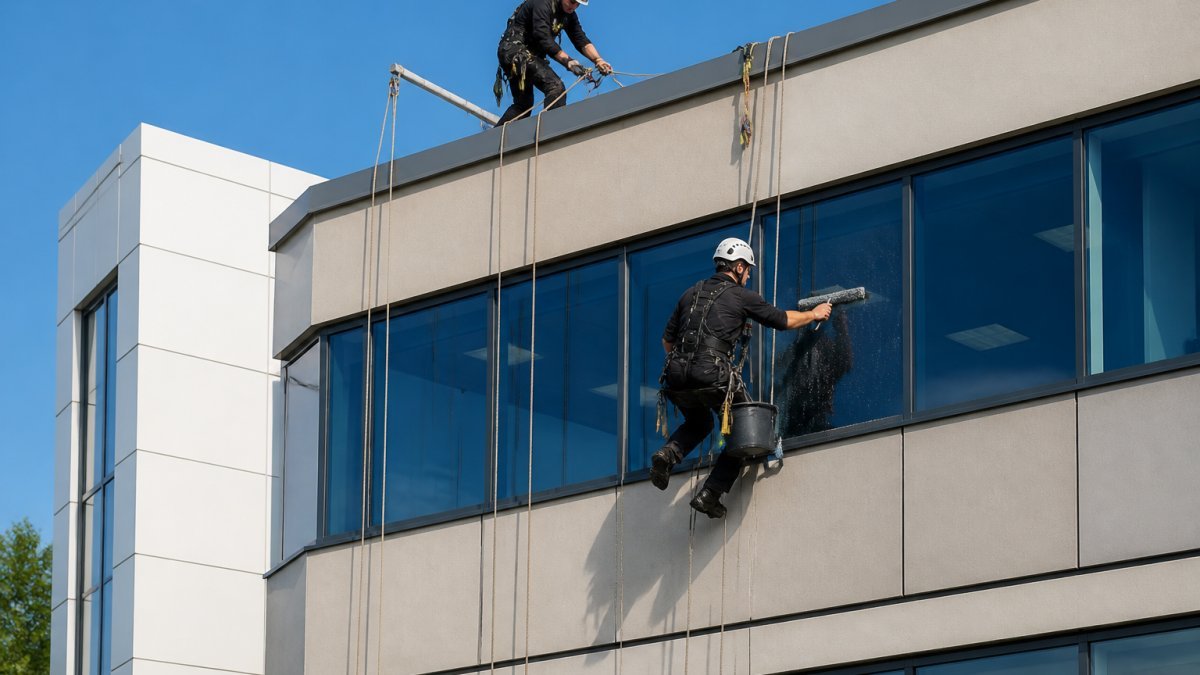
Small offices often assume height work is only for towers. It is not. A three-storey office with glass over a canopy, or a unit where the upper windows sit above a pitched roof, can need rope access just as much as a high-rise. The Health and Safety Executive guidance on working at height is clear that work at height must be properly planned and carried out by competent people, and that applies to a modest office block as much as a tower.
Our team is IRATA-trained, which is the standard rope access certification recognised across the UK. If a provider cannot show that, the job is not being done to the right standard, however cheap the quote looks.
The Commercial Window Cleaning Quote Checklist for Small Offices
A commercial window cleaning quote checklist should cover access method, frequency, what is included, insurance and certification, and how condition is reported. Use it to compare quotes like for like, because a low headline figure often excludes the parts that matter.
Work through this before you sign anything:
- Access method stated in writing – pole, water-fed pole, abseil or cradle, and who supplies it
- Exactly what is cleaned – external glass, frames, sills, internal glass, signage, cladding
- Frequency and notice – how often, and how much notice you get before a visit
- Certification – IRATA or equivalent for any rope access work, plus public liability insurance
- Method for awkward glass – atriums, glass over obstructions, recessed floors
- Condition reporting – will they flag cracked seals, failed units or damaged frames?
- Scheduling flexibility – can they work around events and busy periods?
- What is excluded – and what triggers a re-quote
The most common mistake is accepting a quote that does not state the access method. If the provider turns up and finds they need rope access, you either get a surprise charge or a job that quietly does not happen. Get it in writing first.
Benefits vs Costs: What a Small Office Actually Gets for the Money
The benefits of commercial window cleaning for a small office are cleaner presentation, longer life for glass and frames, safer access to upper floors, and a documented maintenance record. The costs are the visits themselves plus the access premium for height.
| Benefit | What It Means in Practice | Cost Consideration |
|---|---|---|
| Professional front | Clean glass reads as a well-run business to clients and visitors | Regular visits cost less per clean than one-off work |
| Glass and frame life | Dirt and traffic film held on frames accelerate wear over time | Cheaper than replacing failed units or frames |
| Safe height access | Trained, certified technicians handle upper floors | Adds cost versus a pole, but removes the risk of DIY |
| Maintenance record | Condition notes flag problems early | Often included, worth asking for |
The honest limitation: for a single-storey office with easy ground-level access and no client-facing frontage, the case is weaker. You can reach the glass safely yourself, and the presentation stakes are lower.
What most reviews miss is that the value of a regular contract is not the individual clean. It is the fact that someone competent is looking at your building's glass and frames every few weeks and telling you when something is failing.
When It Is Not Worth It, and What to Do Instead
Commercial window cleaning is not worth it when the glass is all safely reachable from the ground, the building has no client-facing frontage, and budget is genuinely tight. In that case, a simple in-house routine can keep things presentable.
What to do instead:
- Ground-floor only, low footfall: clean the glass yourself on a set rota with a water-fed pole, and keep it consistent.
- Occasional client visits: book a one-off clean before events rather than a contract.
- Mixed building: clean the reachable glass in-house and bring in a specialist only for the upper floors and any rope access work.
The line to watch is height. The moment glass sits above safe pole reach, or the elevation is obstructed, DIY stops being a sensible saving and becomes a risk. That is the point to call in a provider, and it is where a specialist earns the fee.
For offices in Cheadle and across Greater Manchester, we are happy to look at photos and tell you honestly whether you need us or not. If a pole will do the job, we will say so.
Conclusion: Making the Call for Your Office
The decision comes down to height, frontage and how much a well-kept building matters to your business. If your glass is all reachable from the ground and no one sees it, a simple routine is fine. If any of it sits above safe reach, or your frontage is your shop window, a proper contract is the sensible call.
At Lion Cleaning Group, our IRATA-trained team handles working at height window cleaning, rope access and cladding work for offices and managed buildings, with flexible scheduling and a safety-first approach. If you are weighing up whether it is worth it near you, get in touch and we will give you a straight answer.
Frequently Asked Questions
How often should a small office have its windows cleaned?
Most small offices do well on a four to eight week cycle, depending on how exposed the building is to traffic film, pollen and weather. A ground-floor office on a quiet street may only need quarterly visits, while a unit facing a busy road or sitting near trees often needs monthly attention. The right small office window cleaning frequency comes down to how quickly the glass visibly dulls and whether clients visit the space. Ask a provider to walk the building with you and recommend a schedule rather than accepting a fixed plan.
What should a small office check before hiring a window cleaning company?
Work through a short commercial window cleaning quote checklist before signing anything. Confirm the quote covers internal and external glass, frames and sills, and any high-level panes. Ask how the team is trained for working at height, what insurance they hold, and whether they can work around your opening hours. Get the visit frequency and what counts as a missed visit in writing. Ask for references from similar-sized offices, and check whether the price includes removing builders' film, bird mess or hard-water marks.
Can a small office clean its own windows?
Staff can usually manage ground-floor glass with a squeegee and pure water, and doing so saves money on very small premises. The limit is height. Anything above reach with a pole, any glass over an entrance canopy, and any pane accessed from a roof should be left to trained operatives. Working at height window cleaning carries genuine risk, and a fall from even a low roof can be serious. If your office has upper floors, a professional visit is the safer and often cheaper route once equipment and time are counted.
How can a small office compare window cleaning quotes fairly?
Compare like with like. Check that each quote covers the same glass, the same frequency and the same extras, because a cheap price often excludes frames, sills or high-level panes. Ask whether access equipment is included or charged separately, and whether the provider is insured for working at height. Look at how quickly they respond and how clearly they explain the schedule. A slightly higher quote that includes proper training, insurance and a written scope is usually better value than the lowest number on the page.
If your office has upper-floor glass you have been putting off, that is usually the sign it is time to bring in a specialist. Lion Cleaning Group offers working at height window cleaning, rope access cleaning and flexible scheduling across Cheadle and Greater Manchester, delivered by an IRATA-trained team. Book a clean with Lion Cleaning Group and get a proper assessment of what your building actually needs.