Category: How-to

  • Risk Assessment for Working at Height Cleaning

    Risk Assessment for Working at Height Cleaning

    Table of Contents

    Last Updated: 2 October 2026

    What is a Risk Assessment for Working at Height Cleaning?

    A risk assessment for working at height cleaning is a systematic process of identifying hazards, evaluating the risks they pose, and implementing control measures to keep your team safe. When your building has windows above ground level, this assessment becomes essential.

    Working at height means any work where a person could fall more than 2 metres and suffer injury. For window cleaning on apartment blocks, offices, or commercial properties, this applies to most exterior work. The assessment isn't a one-time box to tick, it's an ongoing evaluation that changes with weather, building condition, and equipment wear.

    Lion Cleaning Group conducts these assessments before every high-rise cleaning project. The process identifies what could go wrong, who might be affected, and what controls prevent harm. It's straightforward but thorough.

    The Work at Height Regulations 2005 (as amended) is the UK law that governs all work at height. It applies to any work where a person could fall and suffer injury. Your legal obligation is clear: you must ensure the safety of anyone working above ground level on your property.

    Under these regulations, you must:

    • Avoid work at height where reasonably practicable
    • Use the proper equipment and procedures when height work is necessary
    • Plan and supervise all work at height
    • Ensure workers are competent and properly trained
    • Inspect and maintain all equipment regularly

    The Health and Safety Executive (HSE) enforces these regulations. Failure to comply can result in enforcement action, fines, or prosecution. More importantly, it puts your staff and contractors at real risk.

    For property managers in Greater Manchester and across the UK, this means vetting your cleaning contractors carefully. Ask whether they operate under these regulations. Ask for evidence of risk assessments, training records, and equipment maintenance logs. A contractor who cannot show these documents is operating illegally.

    HSE Hierarchy of Control for Working at Height

    The HSE sets out a clear hierarchy for controlling risks at height. This hierarchy should guide every decision you make about how to manage the work safely.

    The hierarchy works like this:

    1. Elimination – Remove the need for work at height altogether. Can the window be cleaned from ground level? Can permanent protective systems be installed?
    2. Engineering controls – Use equipment or design to reduce the risk. This includes guardrails, safety nets, or work platforms.
    3. Administrative controls – Implement procedures and training. Use permits to work, supervision, and competency checks.
    4. Personal protective equipment (PPE) – Use harnesses, helmets, and lanyards as a last resort when other controls cannot eliminate the risk.

    Most window cleaning at height relies on a combination of engineering controls and administrative controls. PPE alone is never enough.

    The hierarchy matters because it forces you to think systematically. Don't jump to "buy harnesses and rope." Start by asking whether the work is necessary at all. If it is, ask what engineering controls can help. Only then should you rely on PPE and procedures.

    Common Hazards in Working at Height Cleaning

    Understanding the specific hazards on your building helps you plan effective controls. Hazards aren't theoretical, they're the real conditions your team faces.

    Fall risks and exposure

    Falls are the primary hazard in height work. A person can fall from a ladder, platform, or whilst secured to a rope if the equipment fails or the attachment point gives way.

    Common fall scenarios include:

    • Loss of balance on a ladder or platform
    • Slip on wet or dirty surfaces
    • Equipment failure (harness, lanyard, or anchor point breaking)
    • Entanglement of rope or lanyard
    • Failure to clip in or use equipment correctly

    Each scenario requires a different control. A wet surface calls for improved grip or non-slip footwear. An unsecured rope requires a backup lanyard. Incorrect use requires better training and supervision.

    Weather and environmental factors

    Wind, rain, and temperature affect safety at height. Strong winds can push a person off balance. Rain makes surfaces slippery. Ice in winter creates hazardous conditions.

    Weather hazards include:

    • High winds increasing fall risk
    • Rain reducing grip and visibility
    • Frost or ice on surfaces
    • Extreme heat affecting concentration and physical capability
    • Poor visibility in fog or low light

    Your risk assessment must specify wind speed limits for work. Many contractors stop work above 40 km/h wind speed. Rain may require work to stop or additional safety measures like non-slip footwear.

    Equipment failure and maintenance

    Harnesses, ropes, lanyards, and anchor points all wear out. A harness used regularly may degrade faster than one used occasionally. Rope exposed to UV light becomes brittle. Metal anchor points corrode in damp conditions.

    Get a Quote →

    Equipment hazards include:

    • Worn or damaged harnesses
    • Frayed or degraded rope
    • Corroded metal fittings
    • Unsuitable anchor points
    • Inadequate backup systems

    Window Cleaning Safety Equipment Requirements

    Working at height demands specific equipment. The right gear, properly maintained and correctly used, is your primary defence against falls.
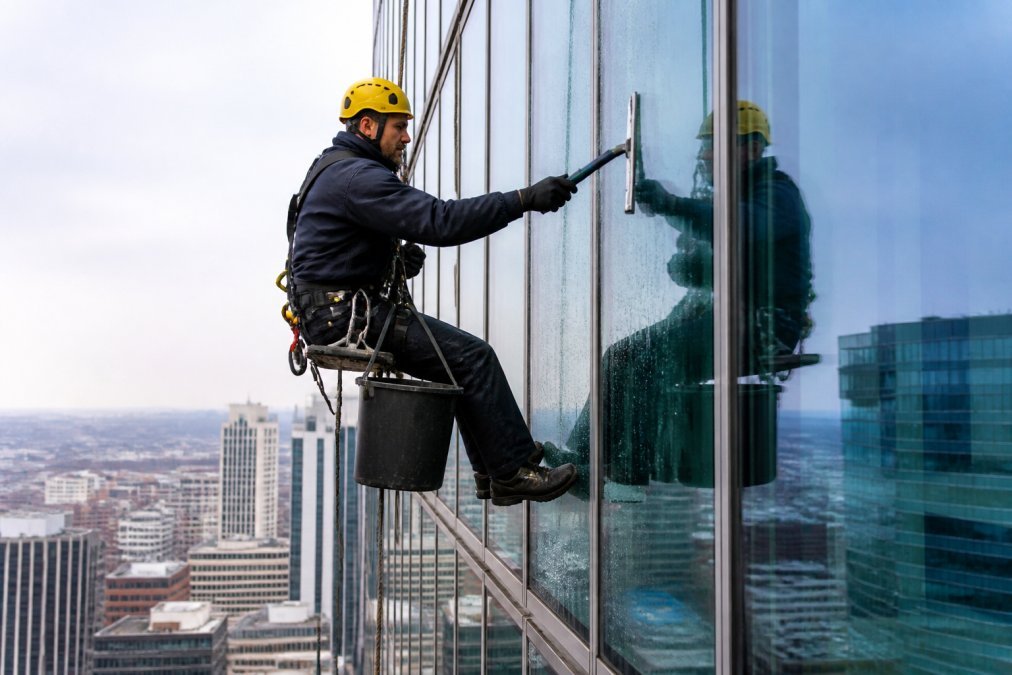
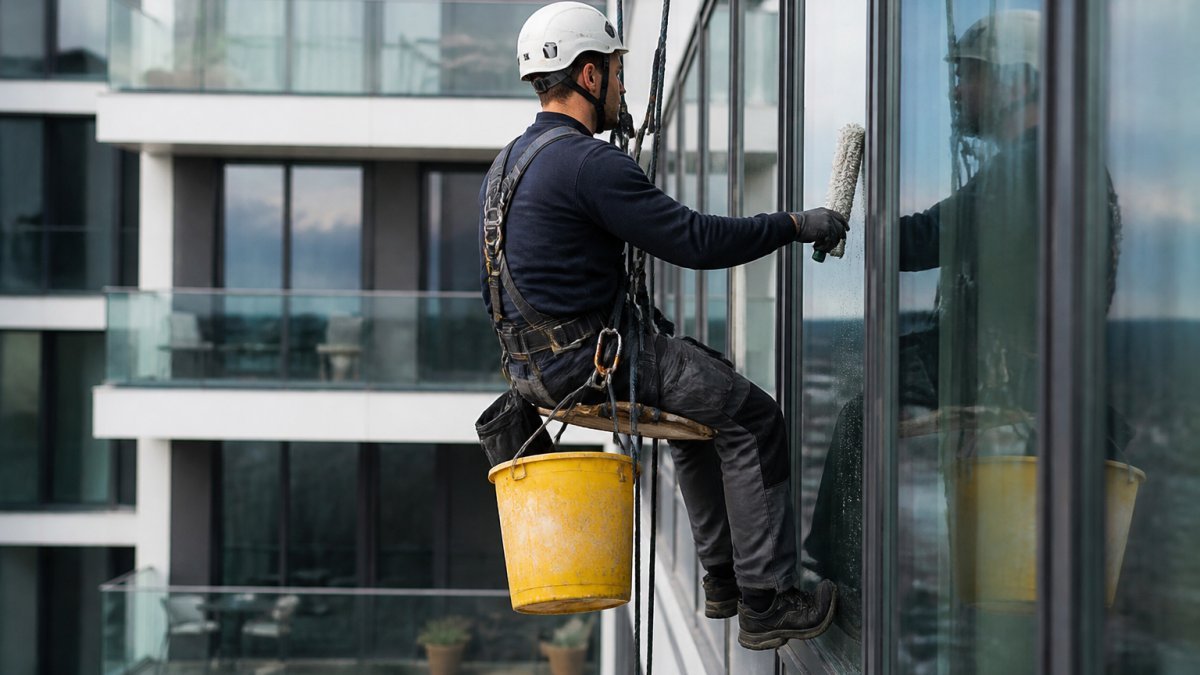
    Rope access technician using safety harness for working at height cleaning on a high-rise building facade.
    Rope access technician using safety harness for working at height cleaning on a high-rise building facade.

    Essential equipment includes:

    • Safety harness – A full-body harness distributes fall forces across the body, reducing injury. It must fit properly and be inspected regularly.
    • Lanyard or rope – Connects the harness to a secure anchor point. A shock-absorbing lanyard reduces the force of a sudden stop.
    • Anchor point – A fixed structure strong enough to hold a falling person. Building design, roof edges, or temporary systems can serve as anchor points.
    • Helmet – Protects against head injury from falling objects or impact during a fall.
    • Non-slip footwear – Reduces slip risk on wet or dirty surfaces.
    • Gloves – Improve grip and protect hands from cuts or abrasion.

    Equipment alone doesn't ensure safety. It must be:

    • Correctly selected for the task
    • Properly fitted and adjusted
    • Regularly inspected and maintained
    • Used by trained personnel
    • Combined with other control measures

    Risk Assessment Template for Window Cleaning

    A practical risk assessment follows a simple four-step structure. You can adapt this template for your building and cleaning schedule.

    Step 1: Identify the hazards

    Walk the building and list everything that could cause harm during window cleaning. Don't assume, look at the actual conditions.

    • Height and fall distance
    • Building surfaces (smooth glass, slippery ledges, rough concrete)
    • Weather exposure (wind, rain, temperature)
    • Building features (protruding ledges, sharp edges, unstable surfaces)
    • Nearby hazards (power lines, traffic, pedestrians below)
    • Access routes (stairs, roof access, external platforms)

    Step 2: Decide who might be harmed and how

    Identify everyone affected by the work and describe how they could be injured.

    Affected people include:

    • Window cleaners performing the work
    • Supervisors or managers overseeing the work
    • Other building occupants or staff
    • Members of the public below the work area
    • Maintenance staff who may use the same anchor points later

    Step 3: Evaluate the risks and existing controls

    For each hazard, assess the current level of risk and what controls already exist.

    Use a simple scale:

    • High risk – Serious injury likely if hazard occurs
    • Medium risk – Injury possible but not certain
    • Low risk – Minor injury likely

    Step 4: Record your findings and action plan

    Document the assessment in writing. Include:

    • Hazards identified
    • People at risk
    • Current controls and their effectiveness
    • Any additional controls needed
    • Who is responsible for each action
    • When actions will be completed
    • Date of next review

    Keep records for at least three years. They demonstrate compliance with regulations and provide evidence if an incident occurs.

    A simple one-page form works well:

    Hazard Who is at risk Current controls Additional controls needed Responsible person Target date
    Fall from height Window cleaners Harness, lanyard, anchor point inspection Additional backup lanyard for work above 10m Supervisor 15 October 2026
    Wet surfaces Window cleaners Non-slip footwear Daily surface inspection before work Team lead Ongoing
    Equipment failure Window cleaners Annual harness inspection Monthly visual inspection log Safety officer Ongoing

    Control Measures and Safe Working Practices

    Effective control measures include:

    Pre-work inspection
    Inspect all equipment before every job. Check harnesses for tears or worn stitching. Examine ropes for fraying or brittleness. Test anchor points for stability. Document findings. If anything fails inspection, remove it from service immediately.


    Frequently Asked Questions

    What are the legal requirements for working at height cleaning in the UK?

    The Work at Height Regulations 2005 require employers to ensure anyone working at height is properly trained, supervised, and equipped. You must conduct a risk assessment before work begins, identify all hazards, and implement control measures following the HSE hierarchy. The Health and Safety Executive (HSE) enforces these regulations, and failure to comply can result in enforcement action and fines. Your risk assessment must be documented and reviewed regularly.

    What must be included in a risk assessment template for window cleaning?

    A thorough risk assessment for window cleaning should identify specific hazards (falls, weather exposure, equipment failure), determine who might be harmed, evaluate existing controls, and document findings with action plans. It must assess the building's condition, access points, weather patterns, and worker competence. Include details of the equipment to be used. The assessment should be reviewed annually or whenever working conditions change.

    How does the HSE hierarchy of control apply to working at height cleaning?

    The HSE hierarchy prioritises elimination first (avoid the work), then substitution (use safer methods), engineering controls (guardrails, platforms), administrative controls (procedures, training), and finally personal protective equipment as a last resort. For window cleaning, this means exploring if work can be done from ground level, using alternative methods, installing permanent controls, and only relying on personal protective equipment when higher controls aren't feasible. Each level must be considered before moving to the next.

    What window cleaning safety equipment requirements must be met?

    All equipment must comply with relevant British Standards and be regularly inspected and maintained. Essential items include harnesses, lanyards, helmets, and anchor points. Rope access work requires IRATA certification. Equipment must be certified, stored correctly, and replaced after damage or expiry. Any defective equipment must be removed from service immediately. Staff must receive training on proper use and care of all safety equipment.

  • Commercial Cleaning Audit Checklist for Managers

    Commercial Cleaning Audit Checklist for Managers

    Table of Contents

    Last Updated: September 30, 2026

    Why a Commercial Cleaning Audit Checklist Matters

    A commercial cleaning audit checklist for managers is your first line of defence against poor facility standards and hidden compliance risks.

    Without clear inspection standards, surfaces get missed, high-traffic areas deteriorate, and staff don't know what "clean" means, leading to complaints, reputational damage, and compliance violations.

    A structured audit checklist transforms cleaning into measurable, documented performance. Facility managers who implement rigorous audits see immediate improvements in consistency and accountability.

    A proper cleaning audit checklist does three things:

    • Sets clear standards so your team knows exactly what passes inspection
    • Creates documented evidence of compliance for auditors and regulators
    • Identifies problems early, before they become expensive fixes

    Setting Up Your Audit Methodology and Framework

    Your audit methodology is the foundation. Without a clear framework, audits become subjective.

    Segment your audit into three layers instead of auditing everything at once:

    • Daily inspections: Quick visual checks of high-traffic areas and restrooms
    • Weekly audits: Deeper assessment of surfaces, floors, and common spaces
    • Monthly deep-dives: Detailed inspection of low-traffic areas, equipment, and compliance markers

    Conduct at least one audit per month yourself to spot patterns supervisors might miss and signal that cleanliness matters at leadership level.

    Document your methodology in a one-page audit guide explaining purpose, frequency, and process.

    Pro Tip
    Schedule audits at random times, not on predictable days. If your team knows you always inspect on Friday mornings, they'll clean extra on Thursday. Random audits reveal actual performance standards.

    Cleaning Audit Frequency Best Practices

    Audit frequency depends on facility type, occupancy, and risk profile.

    Residential complexes: daily inspections of common areas, weekly audits of units, monthly assessments of building systems.

    Corporate offices: daily checks of restrooms and high-traffic zones, weekly audits of workspaces, monthly reviews of storage areas.

    Watch Out
    Skipping weekly audits is where most facility managers go wrong. You think you'll save time, but missed audits lead to accumulated problems that require expensive corrective action later. Weekly audits prevent that spiral.

    Document audit frequency in your cleaning contract, specifying how often audits occur and who conducts them.

    Building Your Commercial Cleaning Quality Assurance Template

    Your commercial cleaning quality assurance template is the actual document you use during inspections. It should be simple enough to complete in 10-15 minutes, detailed enough to catch real problems.

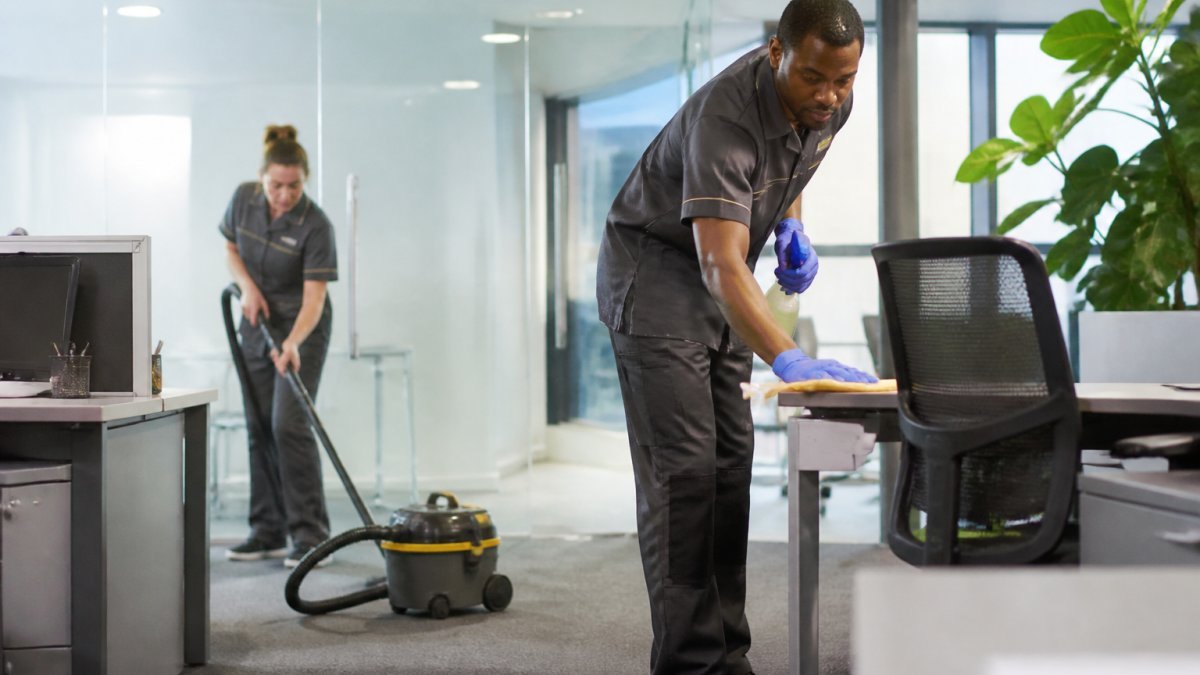
    Facility manager using a cleaning audit checklist to inspect office surfaces with a cloth and clipboard.
    Facility manager using a cleaning audit checklist to inspect office surfaces with a cloth and clipboard.

    Daily Inspection Checklist

    Daily inspections focus on visible cleanliness in high-traffic areas. Use a simple yes/no format:

    • Floors free of visible debris and spills
    • Restrooms stocked with supplies (soap, paper towels, tissue)
    • Rubbish bins emptied and lined
    • Surfaces wiped down (reception desks, tables, handles)
    • Toilets clean and flushed
    • Mirrors and glass streak-free
    • Odours absent or minimal

    Weekly Audit Points

    Weekly audits go deeper. You're assessing cleaning quality, not just presence. Include these areas:

    • Floors: Swept, mopped, or vacuumed with no visible dirt or marks
    • Surfaces: Desks, tables, and counters dusted and wiped
    • Restrooms: Toilets scrubbed, sinks cleaned, mirrors polished
    • Corners and edges: Baseboards and corners checked for dust accumulation
    • High-touch points: Door handles, lift buttons, and railings sanitised
    • Waste management: Recycling separated correctly, bins lined and emptied
    • Air quality: No visible dust, no unpleasant odours

    Monthly Deep-Dive Assessment

    Monthly audits examine low-traffic areas to catch deterioration early:

    • Low-traffic spaces: Storerooms, equipment areas, back corridors
    • Cleaning frequency compliance: Verify that cleaning schedules are actually being followed
    • Consumable replenishment: Check that supplies are stocked appropriately
    • Preventative maintenance: Look for signs of damage or wear that need addressing
    • Compliance markers: Verify that health and safety standards are being met

    Scoring Systems and Performance Benchmarking

    A scoring system transforms subjective observations into measurable data, enabling you to track improvement, hold staff accountable, and demonstrate compliance.

    Building a Scoring Framework

    Here's a simple framework that works across facility types:

    Scoring Level Definition Action Required
    Pass (90-100%) All or nearly all items meet standards Document and acknowledge
    Needs Attention (70-89%) Some items below standard; minor issues Plan corrective action within 1 week
    Fail (Below 70%) Multiple items below standard; serious issues Immediate corrective action required

    Calculate your score as a percentage: (items that pass ÷ total items) × 100.

    Key Takeaway
    Your cleaning audit checklist is only useful if you actually use it consistently and act on the results. A perfect checklist gathering dust in a drawer helps nobody.

    Benchmarking and Realistic Performance Targets

    Benchmark targets for most commercial spaces: daily inspections 95%+, weekly audits 90%+, monthly assessments 85%+. If consistently below these, your provider may need training, resources, or schedule adjustment.

    Translating Audit Scores into Executive Dashboards

    Create a simple monthly dashboard that shows:

    Book a Clean →

    1. Overall facility score trend (line graph) showing 12-month average, target benchmark, and corrective actions taken.

    Adjusting Audit Rigour Based on Budget and Contract Tier

    Not all facilities have the same budget or cleaning intensity. Tier your audit approach accordingly.

    Tier 1 (Premium/High-Risk Facilities)

    • Daily inspections of all high-traffic areas and restrooms
    • Weekly deep audits of all zones
    • Monthly compliance and equipment checks
    • Target: 92%+ on weekly audits
    • Suitable for: corporate headquarters, healthcare facilities, luxury residential

    Tier 2 (Standard Commercial)

    • Daily spot-checks of restrooms and reception areas
    • Weekly audits of high-traffic zones; fortnightly for secondary areas
    • Monthly compliance checks
    • Target: 88%+ on weekly audits
    • Suitable for: typical office buildings, retail, standard residential

    Tier 3 (Budget/Low-Occupancy Facilities)

    • Daily visual checks of restrooms only
    • Fortnightly audits of main areas
    • Quarterly deep assessments
    • Target: 85%+ on fortnightly audits
    • Suitable for: storage facilities, low-occupancy buildings, newly acquired properties pending upgrade

    Using Audit Data to Inform Budget and Resource Decisions

    Use audit scores to inform budget and staffing decisions. Consistent underperformance may signal understaffing or unrealistic schedules.

    Watch Out
    If you're consistently auditing below your target benchmark, don't just accept it as "the new normal." Either adjust your benchmark to match reality (and document why), or invest in improving performance. Drifting standards create liability and damage your facility's reputation.

    How to Evaluate Commercial Cleaning Contracts

    When reviewing a cleaning contract, reference your audit checklist and scoring system. Your contract should state:

    • Specific areas to be cleaned and cleaning frequency
    • Quality standards (e.g., "floors must be free of visible debris")
    • Audit schedule and who conducts audits
    • Consequences for failing audits (e.g., corrective action plan required)
    • Performance metrics (e.g., 90% pass rate on weekly audits)

    Documenting Findings and Planning Corrective Actions

    Documentation is where most facility managers fall short. The real challenge lies in how you communicate audit failures and translate them into lasting improvement.

    The Corrective Action Form: Structure and Discipline

    Create a corrective action form that captures:

    1. What failed (specific area or standard, not vague language like "restroom was dirty")
    2. Root cause analysis (insufficient training, inadequate time allocation, unclear standards, supply shortages, scheduling conflicts, or staff capability gaps)
    3. Corrective action (specific, measurable task, e.g., "Retraining on tile-grout cleaning technique" rather than "improve cleaning quality")
    4. Responsible party (cleaning supervisor, facilities team, external provider, or manager)
    5. Deadline (realistic timeframe based on complexity)
    6. Verification method (how you'll confirm the fix worked, e.g., follow-up audit on specific date)
    7. Root cause prevention (what systemic change prevents recurrence)

    Communicating Audit Failures Without Damaging Morale

    Adopt a three-step communication approach:

    Step 1: Frame as collaborative problem-solving. Start with what passed, then address the gap and invite input.

    Tracking Corrective Actions and Identifying Patterns

    File all audit reports and corrective action forms for at least 12 months for compliance and dispute protection.

    Review your corrective action log quarterly for patterns:

    • Same area failing repeatedly: the standard may be unrealistic or the underlying cause unaddressed.
    • Same failure across multiple staff: signals a training or systemic process problem.
    • Corrective actions taking longer than expected: you may be underestimating complexity or resources.
    Pro Tip
    When a corrective action fails a second time, don't reassign the task or increase pressure. Stop and ask: "What did we miss about why this is difficult?" The pattern tells you where to focus resources and support.

    Building Sustainable Change, Not Just Compliance

    The goal of corrective action is to build capability so failures don't recur.

    Health, Safety and Compliance in Your Audit Process

    Your audit checklist must include health and safety compliance markers:

    • COSHH compliance: products stored safely, hazard data sheets accessible, staff trained
    • Hygiene standards: restrooms and food areas meet sanitation requirements
    • Waste management: hazardous waste separated correctly
    • Accident prevention: slip hazards addressed, equipment stored safely

    Address compliance gaps immediately and document your actions.


    Frequently Asked Questions

    What should be included in a commercial cleaning audit checklist?

    A comprehensive cleaning audit checklist covers surface sanitation across all areas, waste management procedures, consumable replenishment (soap, paper towels, bin liners), inspection of high-traffic zones, staff performance monitoring, and compliance with health and safety regulations. Include sections for daily visual checks, weekly detailed inspections, and monthly deep assessments. Document findings against your facility's cleaning protocols and standard operating procedures to track performance against agreed hygiene standards.

    How often should managers conduct commercial cleaning audits?

    Cleaning audit frequency depends on facility type, footfall, and contractual obligations. Most facilities benefit from daily visual inspections, weekly detailed audits of key performance indicators, and monthly comprehensive reviews. High-traffic areas like retail or hospitality venues may need more frequent spot checks. Your audit frequency should be documented in your commercial cleaning contract and reviewed quarterly to ensure it aligns with your operational efficiency goals and compliance monitoring requirements.

    What are the key performance indicators for commercial cleaning services?

    Essential KPIs include surface cleanliness scores, waste management compliance, consumable availability, staff attendance and punctuality, corrective action response times, and customer satisfaction ratings. Measure these against your cleaning quality assurance template using a consistent scoring framework. Track audit documentation over time to identify trends, benchmark performance, and justify budget allocation. Regular performance benchmarking helps identify whether your cleaning protocols are delivering the hygiene standards your facility requires.

    How do I know if a cleaning provider can handle my facility's specific needs?

    When evaluating commercial cleaning contracts, assess their audit methodology, staff training certifications, experience with your facility type, and flexibility for scheduling adjustments. Ask for references from similar operations and review their approach to health and safety compliance, particularly COSHH regulations if chemicals are used. Request their quality assurance template and scoring system to understand how they monitor their own performance. Ensure they can accommodate your facility's peak times and special requirements without compromising service quality.

  • Commercial Window Cleaning for High-Rise Buildings

    Commercial Window Cleaning for High-Rise Buildings

    Table of Contents

    Last Updated: September 23, 2026

    Why Commercial Window Cleaning for High-Rise Buildings Matters

    Commercial window cleaning for high-rise buildings isn't a luxury, it's essential maintenance that directly affects your property's value, safety, and tenant satisfaction. When windows on a 20-storey office block go uncleaned for months, the building's professional image deteriorates rapidly. More importantly, dirty windows obscure structural issues and create genuine safety hazards that inspectors flag during compliance audits.

    The challenge is finding a provider with the technical expertise, certifications, and equipment for high-rise work. Most standard cleaning companies lack these capabilities, leading property managers to face incomplete work, safety violations, or scheduling conflicts.

    High-rise window maintenance requires specialized access methods, rigorous risk assessment, and certified technicians. The Work at Height Regulations 2005 governs every aspect of this work, from the initial site survey through final documentation. Understanding these requirements isn't optional, it's a legal obligation for building owners and facility managers.

    High-Rise Window Maintenance Checklist for Property Managers

    A structured maintenance checklist prevents deterioration, ensures compliance documentation, and avoids reactive problem-solving.

    Pre-cleaning assessment

    Before work begins, walk the building exterior and document window condition, water damage, sealant failures, and architectural features (setbacks, balconies, ledges) that affect access method selection and pricing.

    Identify obstacles (satellite dishes, HVAC units, signage), windows requiring exclusion (recently painted, loose frames), and environmental factors (wind direction, nearby construction, seasonal patterns) affecting scheduling.

    Verify BMU or cradle systems are certified and operational. Confirm building structure accommodates planned access methods. Document total window area and special requirements (tinted glass, heritage windows, sensitive spaces).

    During-cleaning inspection points

    Monitor water quality (deionized water leaves no residue; hard water leaves streaks) and verify technicians use fall protection equipment continuously, brief lapses represent unacceptable risk.

    Verify cleaning method matches the type of glass (low-emissivity glass requires gentler techniques) and that technicians clean entire frames, not just glass panes.

    Monitor progress against schedule and document damage discovered (loose caulking, failed seals, frame deterioration) requiring repair before the next cycle.

    Post-cleaning documentation

    Request a detailed report with before-and-after photographs, completion date/time, weather conditions, issues identified, and areas requiring special attention. This documentation provides legal protection and baseline for future cycles.

    Record access method used, technician count, and hours spent to track budgets and efficiency. Document any safety incidents, near-misses, or environmental concerns for your health and safety file.

    Record cleaning products used, especially for buildings with environmental or health sensitivity requirements, for sustainability reporting and tenant communications.

    Work at Height Regulations 2005 Compliance for Window Cleaning

    The Work at Height Regulations 2005 is statutory law enforced by the HSE. Non-compliance exposes your business to enforcement action, fines, and personal director liability.

    Risk assessment requirements

    Every project requires a formal risk assessment identifying building-specific hazards (wind exposure, traffic proximity, pedestrian areas, weather patterns, structural features) and evaluating team competence, equipment suitability, and emergency procedures.

    The assessment must address fall distances, weather exposure (high-rise buildings experience stronger winds), and how these factors are managed.

    The assessment must document control measures: access method, fall protection equipment, rescue procedures, and communication systems. This becomes your legal evidence of reasonable precautions.

    Method statements and site-specific planning

    Every project requires a site-specific method statement detailing access method, equipment, personnel qualifications, work sequence, and contingency procedures for your building.

    The method statement must address environmental factors (wind speeds halting work, suspension conditions), communication protocols, rescue procedures, and nearest emergency facility.

    A proper method statement is building-specific, not a generic template. Request it in advance; inability to produce one indicates non-compliance with the Work at Height Regulations 2005.

    Access Methods for High-Rise Window Cleaning

    Different high-rise buildings require different access approaches. The method you choose affects cost, scheduling, safety risk profile, and the frequency at which cleaning can realistically occur. Understanding these methods helps you make informed decisions about your building's maintenance strategy.

    Rope access and abseiling

    Rope access (abseiling) is the most flexible method for high-rise window cleaning. Technicians rappel from roof anchor points while secured with harnesses, working on virtually any building shape including irregular façades and setbacks.

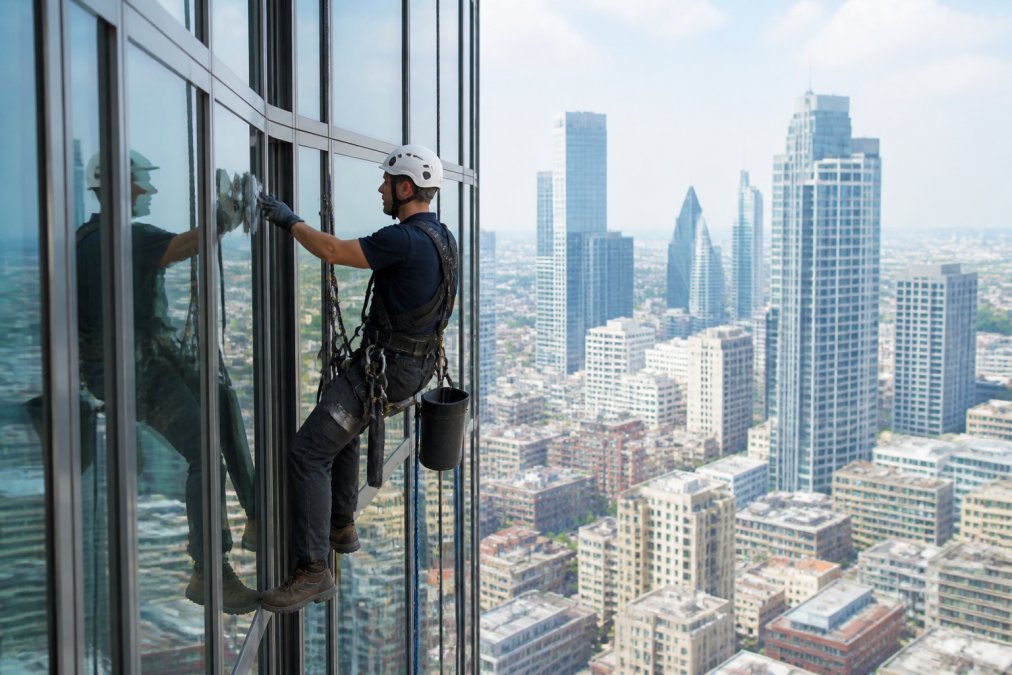
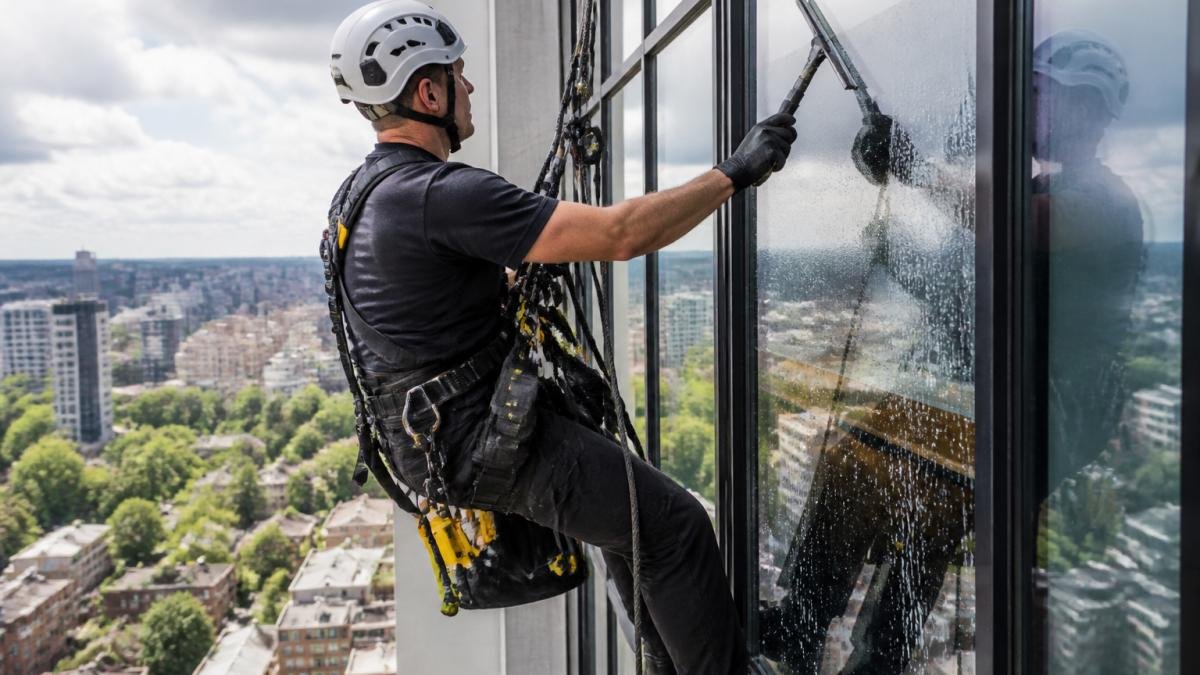
    Professional technician secured with full harness and safety equipment performing rope access abseiling on a high-rise building façade, with city skyline visible in background and safety lines anchored to roof structure
    Professional technician secured with full harness and safety equipment performing rope access abseiling on a high-rise building façade, with city skyline visible in background and safety lines anchored to roof structure

    Rope access requires IRATA (Industrial Rope Access Trade Association) certification, representing genuine competence in rope systems, rescue procedures, and working-at-height safety.

    Rope access requires no building modifications or permanent equipment, works in most weather except extreme winds, and is often the only option for buildings without BMUs or MEWP access.

    Rope access is labour-intensive; each technician covers limited area daily, making it expensive for large buildings or frequent cleaning cycles.

    Book a Clean →

    Building Maintenance Units (BMU)

    A BMU is a permanent roof-mounted mechanical system with a powered cradle that lowers technicians along the façade, controlled by an operator from the roof.

    BMU systems allow multiple simultaneous technicians and faster progress than rope access, delivering best cost-per-clean for buildings requiring frequent maintenance.

    BMU installation requires structural engineering and roof modifications. Systems are practical only for buildings over 15 storeys requiring quarterly or more frequent maintenance.

    Mobile Elevating Work Platforms (MEWP)

    Mobile Elevating Work Platforms (MEWPs) are self-propelled platforms with extending booms (scissor or boom lifts) suitable for mid-rise buildings (4-10 storeys) with ground-level access space.

    MEWPs offer speed and simplicity with straightforward setup and widely available hire equipment. For buildings with adequate ground clearance and moderate height, they're often most cost-effective.

    MEWPs require clear ground space and become unstable in strong winds, limiting use in dense urban areas and during windy conditions.

    Water-fed pole systems

    Water-fed poles are telescoping poles (10-20 metres) with brush heads delivering deionized water that leaves no mineral residue, operated from ground level.

    Water-fed poles are ideal for low to mid-rise buildings (up to 6 storeys) and most cost-effective, requiring no installation, harnesses, or extensive training.

    Water-fed poles are impractical beyond 6 storeys and depend on weather conditions. For large window areas, they're labour-intensive.

    Frequency of Commercial Window Cleaning for High-Rise Properties

    Optimal cleaning frequency depends on building type, location, environmental exposure, and business objectives. Most commercial properties follow quarterly schedules.

    Quarterly maintenance schedules

    Quarterly cleaning maintains professional appearance, prevents environmental deposit accumulation, and identifies emerging problems (failed seals, frame deterioration) before costly repairs.

    Quarterly frequency suits office buildings where window condition affects lease value, retail/hospitality venues requiring professional appearance, and residential complexes preventing tenant complaints.

    Quarterly maintenance provides predictable annual costs, enabling single-provider contracts with negotiated pricing and consistent building appearance year-round.

    Environmental and weather factors

    Environmental exposure affects frequency: motorway-adjacent buildings accumulate diesel particulates; coastal buildings experience salt spray requiring quarterly cleaning plus additional winter cycles.

    Safety Compliance and Equipment Requirements

    Safety is foundational in high-rise window cleaning. Cutting corners creates liability exposure, HSE enforcement risk, and genuine injury/death risk.

    Fall protection and PPE standards

    Every technician must wear harness, safety line, and PPE (mandatory under Work at Height Regulations 2005). Harnesses distribute fall forces; safety lines prevent free fall.

    Certified technician qualifications

    Technicians must hold IRATA Level 1, 2, or 3 certification (depending on complexity), requiring formal training, practical assessment, and annual refresher training.

    Public liability insurance and HSE compliance

    Your cleaning provider must carry public liability insurance covering damage to your building, injury to your staff or tenants, or damage to neighbouring properties. Minimum coverage should be £10 million for high-rise work. Request a copy of their insurance certificate before work begins and verify it covers the specific work being performed.

    Choosing a Professional High-Rise Window Cleaning Provider

    Selecting the right provider is critical. The wrong choice creates safety risks, schedule disruptions, and quality issues that consume your time managing problems instead of focusing on your business.

    Verifying credentials and experience

    Ask potential providers for references from other property managers managing similar buildings. Call those references and ask specific questions: Did the provider complete work on schedule? Was quality consistent across all building sections? How did they handle unexpected issues? Did they respond quickly to concerns?

    Evaluating flexibility and nationwide coverage

    Can the provider accommodate your scheduling needs? If you need cleaning on specific dates to avoid tenant disruption, can they guarantee availability? Do they have backup crews if their primary team is delayed? For multi-site portfolios, can they coordinate work across multiple locations efficiently?


    Frequently Asked Questions

    High-rise window cleaning must comply with the Work at Height Regulations 2005, which requires a formal risk assessment before work begins. A site-specific method statement must be prepared, detailing the access method, fall protection systems, and emergency procedures. All work must be carried out by certified technicians trained in working at height. Public liability insurance is mandatory, and the Health and Safety Executive (HSE) standards for façade maintenance must be followed throughout the project.

    How often should commercial windows on high-rise buildings be professionally cleaned?

    Quarterly maintenance schedules are standard for most high-rise commercial properties, though frequency depends on environmental exposure, location, and building type. Properties near coastal areas or industrial zones may require cleaning every 6-8 weeks due to salt spray and pollution. Urban office buildings typically benefit from quarterly cleaning to keep the glass in good condition and the building looking sharp. Weather conditions and seasonal accumulation of dirt should inform your cleaning frequency decision.

    What access methods are safest for high-rise window cleaning?

    The safest method depends on building design and access points. Rope access (abseiling) suits buildings without existing access equipment and offers flexibility for complex façades. Building Maintenance Units (BMUs) provide permanent solutions for regular cleaning on large commercial properties. Mobile Elevating Work Platforms (MEWPs) work well for moderate heights with safe ground-level positioning. Water-fed pole systems can clean lower floors safely from ground level. Professional providers assess your building's specific requirements and select the most appropriate method.

    How do I know if a window cleaning contractor is properly qualified for high-rise work?

    Verify that technicians hold current certifications in rope access (IRATA certification), MEWP operation, or BMU training as relevant to your project. Confirm they carry adequate public liability insurance (typically £10 million minimum for high-rise work) and hold HSE-compliant method statements for your building type. Ask for references from other property managers managing similar multi-site portfolios or apartment complexes. Ensure they conduct a formal risk assessment and provide documentation before work begins.

  • Maintaining Cleaning Standards in Apartment Blocks

    Maintaining Cleaning Standards in Apartment Blocks

    Table of Contents

    Last Updated: September 27, 2026

    Why Cleaning Standards Matter in Apartment Blocks

    Maintaining cleaning standards in apartment blocks goes far beyond aesthetics. When residents walk through a clean, well-maintained lobby or stairwell, they feel valued. They're more likely to stay, renew leases, and recommend the building to others. Poor cleaning standards damage reputation and create genuine health risks for everyone inside.

    The real issue isn't just dirt, it's consistency. A building that's spotless one week and neglected the next erodes trust faster than one that's reliably adequate. Residents notice. They talk. And property managers end up fielding complaints that could have been prevented with a structured approach.

    At Lion Cleaning Group, we've worked with property managers across the country who discovered that the difference between a problem building and a thriving one often comes down to one thing: a clear, documented cleaning standard that everyone understands and follows. Without it, cleaning becomes reactive. With it, cleaning becomes predictable.

    This guide covers the practical steps for maintaining cleaning standards in apartment blocks. We'll show you how to build a system that works, how to monitor it, and how to adapt it as your building's needs change.

    Understanding Health and Safety Regulations for Residential Buildings

    Health and safety regulations exist to protect residents and staff. The Health and Safety at Work etc. Act 1974 sets the baseline for workplace safety, and it applies to communal areas in residential buildings. As a property manager or landlord, you're responsible for ensuring communal areas meet these standards.

    The key regulation is the Workplace (Health, Safety and Welfare) Regulations 1992, which covers things like cleanliness, temperature, lighting, and ventilation in communal spaces. Neglecting these isn't just poor practice, it can create liability if someone is injured or falls ill due to poor hygiene.

    Beyond legislation, many councils and housing associations follow guidance from the Housing Ombudsman or their local authority. Some buildings operate under service charge agreements that specify exact cleaning frequencies. Understanding what applies to your building is step one.

    Here's what regulators typically require:

    • Communal areas must be kept clean and free of debris
    • High-touch surfaces must be disinfected regularly
    • Floors must be safe (no trip hazards, spills cleaned promptly)
    • Waste must be managed so it doesn't attract pests or create odours
    • Ventilation must work to prevent mould and damp

    The standard isn't "perfect", it's "reasonably clean and safe." What that means in practice depends on foot traffic, the building's age, and local expectations. A high-rise apartment block in a city centre faces different pressures than a converted Victorian house with six flats.

    Watch Out
    Failing to maintain basic hygiene standards in communal areas can expose you to enforcement action from local authorities and complaints to the Housing Ombudsman. More importantly, it puts residents' health at risk. Mould, pest infestations, and poor sanitation spread quickly in shared spaces.

    Creating a Communal Area Cleaning Checklist

    A cleaning checklist is your foundation. Without one, cleaning becomes guesswork. With one, it becomes measurable.

    Your checklist should cover every communal area in your building. Start by listing each space: lobby, stairwells, corridors, lifts, communal gardens, bin storage, parking areas, and any shared facilities. Then, for each space, identify what needs cleaning and how often.

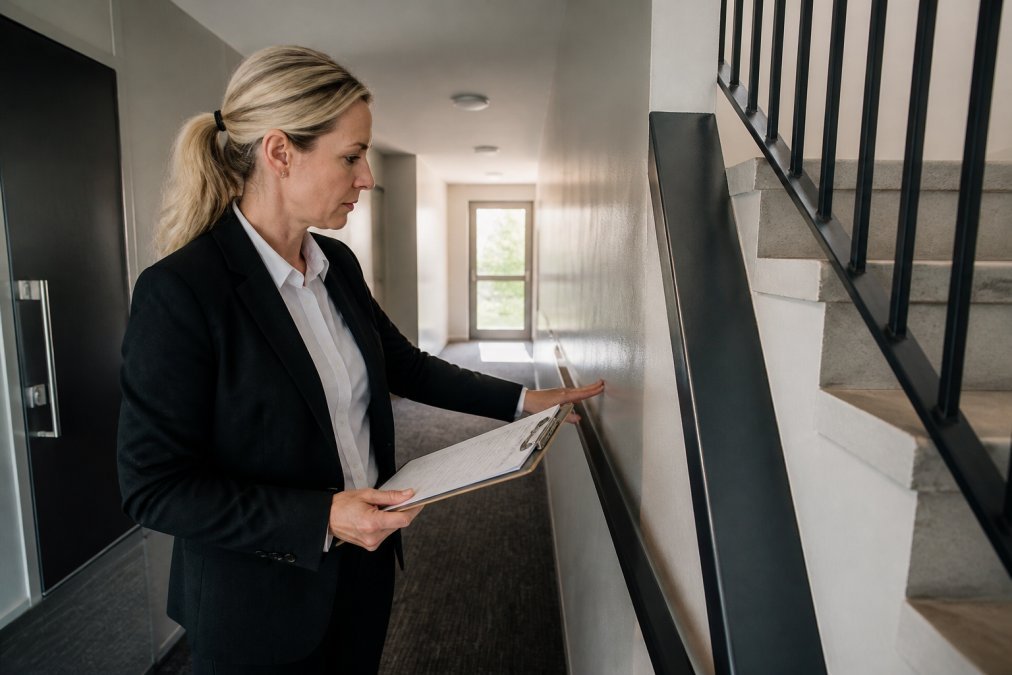
    Professional property manager in business attire holding clipboard with cleaning checklist, inspecting a communal apartment hallway with neutral-coloured walls, examining surfaces and high-touch points for dust and debris under natural daylight
    Professional property manager in business attire holding clipboard with cleaning checklist, inspecting a communal apartment hallway with neutral-coloured walls, examining surfaces and high-touch points for dust and debris under natural daylight

    A practical checklist includes:

    Daily tasks:

    • Empty bins and replace liners
    • Sweep lobby and main corridors
    • Wipe high-touch surfaces (door handles, lift buttons, handrails)
    • Check for spills or hazards

    Weekly tasks:

    • Mop hard floors in communal areas
    • Clean windows (ground floor and lobby)
    • Disinfect lift interior
    • Inspect stairwells for litter and damage

    Monthly tasks:

    • Deep clean carpeted areas
    • Wash communal walls and paintwork
    • Check graffiti and arrange removal if needed
    • Inspect ventilation grilles and vents

    Quarterly tasks:

    • Professional carpet cleaning
    • High-level window cleaning (working at height)
    • Deep clean of lift machinery and mechanics
    • Pressure wash external areas

    The checklist should include who is responsible for each task, what products or equipment are needed, and any safety precautions. If you work with a cleaning contractor, they should sign off on each task as it's completed.

    Pro Tip
    Use a digital checklist app or a simple printed sheet. The format matters less than consistency. What matters is that someone checks it every single day and records what was done. Missing tasks become obvious quickly, and you can address them before residents complain.

    Developing an Apartment Block Cleaning Schedule Template

    A cleaning schedule transforms your checklist into a real plan. It tells your cleaning team exactly what happens on which days, at what times, and who does it.

    Start with your building's constraints. High-rise blocks need different timing than low-rise. A building with 200 residents has different needs than one with 40. A building with a busy lobby needs more frequent cleaning than a quieter one. Your schedule must fit your building's actual use patterns.

    Book a Clean →

    Here's a practical template structure:

    Monday through Friday:

    • 06:00-07:00: Lobby sweep, bin collection, high-touch surface wipe
    • 10:00-11:00: Corridor inspection and spot cleaning
    • 16:00-17:00: Stairwell sweep, lift interior clean

    Saturday:

    • 08:00-12:00: Deep floor clean (mop and disinfect)
    • 12:00-14:00: Window cleaning (ground floor)

    Sunday:

    • 10:00-12:00: Communal garden maintenance and litter removal

    The times matter because residents expect certain tasks to happen when they won't be disrupted. Early morning cleaning (6-7 a.m.) catches overnight mess and sets the tone for the day. Afternoon cleaning (4-5 p.m.) addresses accumulated dirt before evening. Avoid peak times when residents are coming and going.

    For larger buildings, you might need two cleaning staff working different shifts. For smaller buildings, one person might cover all tasks but need to adjust timing based on what's realistic.

    Your schedule should also include contingencies.

    Key Takeaway
    A schedule that's realistic beats one that's perfect on paper but never happens. Build in buffer time, account for staff absences, and adjust based on what actually works in your building.

    How to Monitor Cleaning Performance and Compliance

    Beyond sign-offs, do visual inspections. Walk the building yourself at least twice a week, ideally at different times of day. Check:

    • Are floors clean and free of debris?
    • Are high-touch surfaces visibly clean?
    • Are bins properly managed?
    • Is there any damage, graffiti, or hazards?
    • Are communal areas well-lit and properly ventilated?

    Many property managers use a simple scoring system:

    • Green: All tasks completed to standard
    • Amber: 1-2 minor tasks missed or done poorly
    • Red: Multiple tasks missed or significant issues
    Watch Out
    Monitoring isn't about being punitive, it's about catching problems early. A building that's monitored consistently stays clean. A building that isn't monitored gradually deteriorates as standards slip.

    For larger buildings or multi-site operations, software tools can help. But a spreadsheet and a camera phone work just as well if you're consistent.

    Managing Tenant Responsibilities and Landlord Duties

    The law is clear: landlords are responsible for maintaining communal areas. Tenants are responsible for their own flats. But the line gets blurry in practice.

    Common disputes arise over:

    • Litter in corridors (landlord's responsibility to clean, but tenant shouldn't be leaving it)
    • Damage to communal paintwork (landlord repairs, but tenant pays if they caused it)
    • Pest infestations (landlord's responsibility to manage, but tenants must report quickly)
    • Blocked drains (usually landlord, unless caused by tenant misuse)

    Implementing Sustainable and Cost-Effective Cleaning Practices

    Consider these cost-saving approaches:

    Use microfibre cloths instead of disposable ones. They clean better with less product, last months, and wash easily. Initial cost is higher, but you save money within weeks.

    Pro Tip
    Track your cleaning costs monthly. Break them down by category: labour, products, equipment, waste disposal. Look for patterns. If one area costs significantly more than others, investigate why. Small changes often yield big savings.

    Conclusion


    Maintaining cleaning standards in apartment blocks requires three things: a clear standard, consistent monitoring, and the right support. Without any one of these, standards slip.

    Task Frequency Responsibility Compliance Check
    High-touch surface disinfection Daily Cleaning staff Daily sign-off
    Floor sweep and mop Daily/Weekly Cleaning staff Visual inspection
    Communal area deep clean Monthly Cleaning staff Photographic record
    Graffiti removal As needed Landlord/contractor Within 48 hours
    Pest prevention inspection Quarterly Landlord Documented report
    Health and safety audit Quarterly Property manager Compliance checklist

    Frequently Asked Questions

    How often should communal areas in apartment blocks be cleaned?

    Communal areas require cleaning at least weekly, with high-traffic zones like lobbies, stairwells, and lift areas cleaned 2-3 times per week or daily depending on foot traffic and building size. High-touch surfaces such as handrails, door handles, and lift buttons need daily disinfection to reduce hygiene risks. Your cleaning schedule should reflect your building's specific usage patterns and tenant density. A professional cleaning audit can determine the optimal frequency for your property.

    What should a communal area cleaning checklist include?

    A comprehensive checklist must cover floor maintenance (sweeping and mopping), high-touch surface disinfection, waste collection and bin storage areas, stairwell and lobby cleaning, graffiti removal protocols, and ventilation checks. Include specific tasks for each zone, required products, time allocations, and sign-off procedures. Document cleaning frequency for each task, safety hazards to watch for, and contractor compliance requirements. Regular visual inspections against this checklist ensure consistent hygiene standards across all residential areas.

    How can property managers monitor whether cleaning contractors are meeting standards?

    Implement a formal cleaning audit process using your checklist as the baseline. Conduct unannounced visual inspections weekly, photograph high-risk areas to track consistency, and establish a sign-off system where staff or residents report missed spots. Set clear contractor compliance expectations in your tenancy agreement or service charge terms. Track detritus levels, sanitization effectiveness, and preventative maintenance completion. Regular feedback loops and performance metrics help identify trends and address issues before they affect tenant satisfaction or health and safety compliance.

    What are the legal requirements for cleanliness in residential common areas?

    Landlords must maintain communal areas to a safe and hygienic standard under the Health and Safety at Work etc. Act 1974 and the Housing Act 2004. Buildings must comply with fire safety regulations and ensure adequate ventilation and waste management. Service charges can be used to fund professional cleaning, provided costs are reasonable and transparent. Local environmental health departments may inspect residential blocks for compliance. Documented cleaning schedules, audits, and contractor records demonstrate your commitment to regulatory compliance and protect against liability claims.

  • Flexible Cleaning Schedules for Office Buildings

    Flexible Cleaning Schedules for Office Buildings

    Table of Contents

    Last Updated: September 28, 2026

    Why Flexible Cleaning Schedules Matter for Modern Offices

    The modern office is nothing like it was five years ago. Hybrid work has transformed how buildings get used. Some days your office is full. Other days it's half-empty. Fixed cleaning schedules made sense when everyone came in five days a week. They don't anymore.

    Flexible cleaning schedules for office buildings adapt to how your space is actually used. Instead of cleaning the same way every single day, you adjust based on occupancy. You clean more thoroughly on busy days. You scale back on quieter ones. This approach cuts waste, improves hygiene, and saves money.

    At Lion Cleaning Group, we've worked with facility managers across the UK who have seen the benefits of flexible cleaning schedules. They found that aligning cleaning efforts with actual usage can lead to more efficient resource allocation and improved hygiene.

    The challenge most facilities face is figuring out where to start. How do you measure occupancy? Which areas need daily attention? How do you actually schedule around fluctuating patterns? Below, we'll show you exactly how to build a flexible cleaning schedule that works for your building.

    Assessing Your Office Cleaning Needs

    Before you change anything, you need to understand what your building actually needs. This starts with two questions: How full is your office on any given day? Which areas matter most?

    Measuring occupancy patterns

    Your occupancy pattern is the foundation of everything. Track how many people use your building each day for two to four weeks. Look at patterns by day of the week. Mondays often see higher occupancy than Fridays in hybrid offices.

    Use simple tools to measure:

    • Badge access logs from your building entry system
    • Desk booking data if you use hot-desking software
    • Parking occupancy counts
    • Manual headcount during peak hours

    Once you have the data, you'll spot the pattern. Many offices see 30-40% occupancy on Mondays, climbing to 60-70% by mid-week, then dropping again Friday. Some see the opposite. Your pattern is unique to your business.

    Document these numbers. They become your baseline for scheduling decisions.

    Identifying high-priority cleaning areas

    Not every part of your office needs the same level of attention. Some areas are touched by dozens of people daily. Others sit empty most of the time.

    High-priority areas include:

    • Reception and entry points
    • Toilet facilities and washrooms
    • Kitchen and break areas
    • Lift buttons and handrails
    • Shared meeting room tables and chairs
    • Door handles throughout the building

    Lower-priority areas might include:

    • Individual desk spaces (especially in hot-desking setups)
    • Rarely-used storage rooms
    • Hallways with minimal foot traffic
    • Outdoor areas unless they're customer-facing

    The key insight here: focus your effort where people actually are. If occupancy is low, don't deep-clean empty desks. Concentrate on the spaces where germs spread fastest.

    Hybrid Office Cleaning Requirements and Task Allocation

    Hybrid working creates a specific challenge. You can't predict exactly who will be in the building or when. Your cleaning schedule needs to be flexible enough to handle that uncertainty while maintaining standards.

    Daily tasks versus weekly deep cleans

    A practical approach separates tasks by frequency. Daily tasks keep the building hygienic day-to-day. Weekly deep cleans handle what daily cleaning misses.

    Daily tasks focus on high-touch surfaces and visible dirt:

    • Emptying bins in all areas
    • Restocking toilet paper, soap, and hand towels
    • Wiping down high-touch surfaces (door handles, lift buttons, handrails)
    • Spot-cleaning visible spills or marks
    • Cleaning toilet seats and urinals
    • Mopping entrance areas where dirt accumulates

    Weekly deep cleans go deeper:

    • Vacuuming all carpeted areas thoroughly
    • Cleaning under and behind furniture
    • Washing windows and glass partitions
    • Deep-cleaning kitchen appliances
    • Sanitising meeting room chairs and tables
    • Cleaning air vents and light fixtures

    The split lets you maintain hygiene daily without the cost of a full deep clean every single day. On low-occupancy days, you can skip some daily tasks. On high-occupancy days, you might add extra passes through high-traffic areas.

    High-touch surface disinfection protocols

    High-touch surfaces are where germs concentrate (Checking your browser). These areas need regular attention, especially in shared spaces.

    Your disinfection protocol should identify which surfaces need attention and how often:

    • Door handles: at least twice daily in high-occupancy areas
    • Lift buttons: three times daily minimum
    • Toilet flush handles: after each use or at minimum twice daily
    • Handrails: twice daily
    • Shared desk equipment (printers, scanners): daily
    • Meeting room tables and chairs: after each use or daily
    • Kitchen appliances and handles: twice daily

    The frequency depends on occupancy. On days when occupancy is above 60%, increase the frequency. On days below 40%, you can maintain once-daily passes for most surfaces.

    Environmentally friendly products are used by Lion Cleaning Group. They are designed to meet hygiene standards while being safer for staff and building users.

    Book a Clean →

    Commercial Cleaning Frequency Standards and Best Practice

    The cleaning frequency your office needs depends on several factors: industry type, occupancy levels, customer-facing areas, and regulatory requirements.

    Most office buildings benefit from a baseline of daily cleaning for high-traffic and high-touch areas, with weekly deep cleans. Some industries need more frequent sanitisation. Healthcare facilities, for example, require more rigorous disinfection protocols than general offices.

    For a typical hybrid office, this framework works well:

    • High-touch surfaces: daily disinfection
    • Common areas (kitchens, toilets, breakrooms): daily cleaning
    • Floors in high-traffic zones: daily mopping
    • General office areas: twice-weekly vacuuming
    • Deep cleans of all areas: weekly
    • Carpet shampooing and window cleaning: monthly
    • HVAC vent cleaning and deep sanitisation: quarterly

    The best practice approach is to adjust these frequencies based on your occupancy data. If your office hits 70% occupancy on Tuesdays and Wednesdays, those days get your full cleaning schedule. If occupancy drops to 20% on Fridays, you scale back to essential tasks only.

    This flexibility is what makes modern cleaning schedules work. You're not locked into a one-size-fits-all approach.

    Creating an Office Cleaning Checklist Template

    A good checklist ensures nothing gets missed and gives your cleaning team clear direction. It also creates accountability and makes it easy to spot where standards might slip.

    Your checklist should break down by area and frequency.

    Area Daily Task Frequency Notes
    Entrance/Reception Sweep, mop, bin empty Daily Increase frequency on high-occupancy days
    Toilet Facilities Clean, disinfect, restock Daily Check after lunch and end of day
    Kitchen/Breakroom Wipe surfaces, clean appliances Twice daily Morning and evening
    High-touch surfaces Disinfect door handles, lifts, rails Daily minimum 2-3 times on high-occupancy days
    Meeting rooms Wipe tables, chairs, check bins Daily Clean after scheduled bookings
    Office floors Vacuum carpets, mop hard floors 2x weekly Daily in high-traffic zones
    Windows/Glass Clean interior surfaces Weekly Monthly deep clean outside
    Deep clean all areas Full sanitisation Weekly Saturday or after-hours

    Implementing Occupancy-Based and Variable-Day Scheduling

    This is where theory becomes practice. You've measured occupancy and identified priorities. Now you build a schedule that adapts to actual usage patterns.

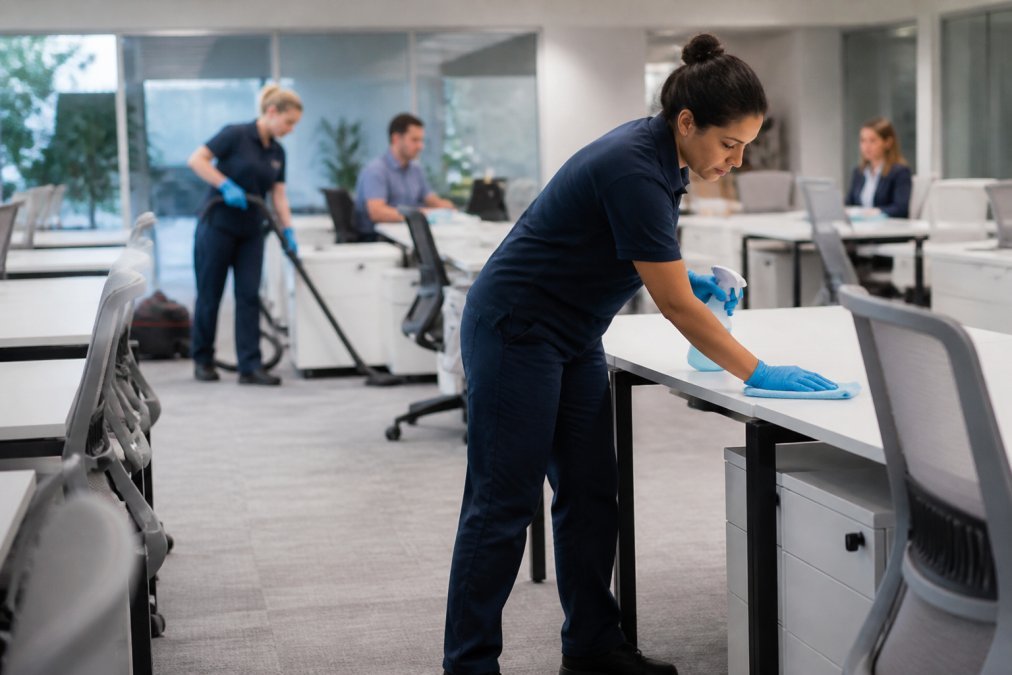
    Professional cleaning team using flexible cleaning schedules to sanitize office desks and surfaces
    Professional cleaning team using flexible cleaning schedules to sanitize office desks and surfaces

    Adapting schedules to fluctuating office occupancy

    Start with your occupancy data. Plot it by day of the week and time of day if possible. You'll see patterns emerge.

    Most hybrid offices follow one of these patterns:

    • Peak mid-week (Monday-Wednesday high, Thursday-Friday low)
    • Consistent mid-week, quiet Fridays
    • Unpredictable (varies week to week based on projects)

    On high-occupancy days (60%+ occupancy):

    • Full daily cleaning of all areas
    • Three passes on high-touch surfaces
    • Extra attention to break areas and toilets
    • Immediate spot-cleaning of spills

    On medium-occupancy days (40-60% occupancy):

    • Standard daily cleaning schedule
    • Two passes on high-touch surfaces
    • Focus on areas where people actually are
    • Skip deep cleaning of empty zones

    On low-occupancy days (below 40% occupancy):

    • Maintenance cleaning only (bins, toilets, high-touch surfaces)
    • Skip some daily tasks in quiet areas
    • Use the time for weekly deep-clean tasks
    • Reduce team size if possible

    Managing downtime and resource allocation

    Flexible scheduling only works if you manage resources efficiently. You can't have a full team standing around on quiet days, and you can't scramble to find staff on busy ones.

    The solution is variable staffing:

    • Core team: always present, handles essential daily tasks
    • Flex team: scheduled based on occupancy forecast
    • Specialist team: handles weekly deep cleans and detailed work

    Measuring ROI and Operational Efficiency Gains

    Flexible scheduling delivers financial and operational benefits. Measuring them shows whether the approach is working and where you might adjust.

    Track these metrics:

    • Cost per square metre per week (should decrease as you optimise)
    • Staff hours used per week (should align more closely with actual need)
    • Cleanliness audit scores (should stay consistent or improve)
    • Occupant satisfaction with cleanliness (survey quarterly)
    • Absenteeism due to illness (track over time)
    • Energy use for cleaning equipment and supplies (should decrease)

    Frequently Asked Questions

    How often should an office building be cleaned?

    Commercial cleaning frequency standards depend on occupancy levels, foot traffic, and industry type. Most offices require daily cleaning of high-touch areas such as door handles, lift buttons, and kitchen surfaces, combined with weekly deep cleans of carpets and less-frequented zones. Hybrid offices may benefit from occupancy-based schedules that adjust cleaning intensity on days when fewer staff are present, reducing unnecessary resource allocation while maintaining workplace hygiene standards.

    What should be included in a professional office cleaning checklist template?

    A comprehensive office cleaning checklist template must cover daily tasks (emptying bins, sanitising surfaces, mopping floors), weekly tasks (carpet cleaning, window wiping, deep-cleaning bathrooms), and monthly preventative maintenance. For hybrid workplaces, prioritise high-touch surfaces. Include task frequency, assigned staff, and sign-off procedures to ensure accountability.

    What are the benefits of flexible cleaning schedules for hybrid offices?

    Flexible cleaning schedules for hybrid offices align cleaning intensity with actual occupancy levels, and maintain consistent disinfection protocols on days when staff are present. Variable-day scheduling allows facility managers to redirect resources to high-priority areas and supports workplace hygiene.

    How do you adapt cleaning schedules for fluctuating office occupancy?

    Track occupancy data weekly to identify patterns in when staff are present, then adjust task frequency accordingly. On high-occupancy days, increase cleaning of high-touch surfaces and common areas. On low-occupancy days, prioritise preventative maintenance and deep cleans of less-used zones. Use occupancy-based cleaning to shift resources toward areas that need them most and maintain hygiene standards.