
Last Updated: 30 October 2026
Quick Summary
A high-rise window maintenance checklist should cover pre-start safety checks, anchor points and fall protection, ground control and public protection, the cleaning schedule, a post-work inspection, and a written record of every visit. Build it section by section so you can hand it to a contractor or use it to review theirs.
- Confirm the access method for each elevation: rope access, powered access or water-fed pole.
- Anchor point locations and their last inspection dates belong on the checklist.
- Size the exclusion zone to the work above and post barriers at every entry point.
- Record defects with photos and get sign-off from the contractor and your site contact.
- Ask any contractor about IRATA certification before they work on your building.
Table of Contents
- Why a High-Rise Window Maintenance Checklist Matters
- High-Rise Window Cleaning Safety Checks Before Any Work Starts
- Building a Property Manager Window Cleaning Schedule
- The Window Cleaning Inspection Checklist for Property Managers
- When to Bring In Rope Access Window Cleaning
- What to Record After Every High-Rise Window Maintenance Visit
- Book a High-Rise Window Maintenance Visit
- Frequently Asked Questions
Why a High-Rise Window Maintenance Checklist Matters
A high-rise window maintenance checklist is a written record of what gets checked, cleaned and signed off on a tall building's glass, frames and access systems. It turns a vague instruction to "get the windows done" into a repeatable job that a property manager can schedule, inspect and audit.
At Lion Cleaning Group, we work at height on apartment blocks, offices and managed portfolios across the UK. The checklist is where that work starts.
Why does it matter so much? Because high-rise window maintenance sits at the meeting point of three risks: people working at height, the public below, and the building's long-term condition. A missing line on a checklist is how a seal gets missed for two years, or how a contractor turns up with the wrong access method for your façade.
Below, we break down exactly what belongs on the checklist, section by section, so you can hand it to a contractor or use it to review the one they bring.
High-Rise Window Cleaning Safety Checks Before Any Work Starts
Safety checks come first, before a single squeegee touches glass. A high-rise window cleaning safety check confirms the building is ready for the work, the access method suits the facade, and the crew has a clear plan for the day.
The Health and Safety Executive guidance on working at height is clear that working at height should be planned, supervised and carried out by competent people. That principle should show up on the checklist as a set of pre-start items:
- Confirm the access method for each elevation: rope access, powered access or water-fed pole
- Check weather conditions and wind speed against the limits for the method in use
- Verify the crew's training and certification for the access method
- Confirm the building's own rules on access, keys and site induction
- Walk the route from the access point to the work area
Anchor Points, Access Equipment and Fall Protection
Anchor points, harnesses, ropes and fall protection are the equipment that keeps a technician safe at height. Each item needs checking before use and recording afterwards.
Property managers often ask who signs off anchor points. Before signing off anchor points and fall protection, read this guide to risk assessment for working at height cleaning. The honest answer is that it is a shared responsibility: the building owner or manager should know where the anchors are and their inspection history, and the contractor should verify them before attaching.
Your checklist should capture:
- Anchor point locations, and when each was last inspected
- Harness, helmet and connector condition
- Rope condition, age and retirement dates
- Powered access equipment inspection records, where used
- A named person responsible for the final sign-off
Ground Control and Public Protection
Ground control is the part of the job the public actually sees, and it is where most complaints start. Cones, barriers and exclusion zones keep pedestrians, residents and vehicles clear of the work area below.
Build these into the checklist:
- Exclusion zone marked and sized to the work above
- Barriers and signage in place at every entry point
- A banksman or ground person on duty while work is live
- Residents and building users told in advance
- Vehicles and deliveries rerouted away from the drop zone
Watch out: a barrier that covers the pavement but not the building entrance is a common gap. Anyone stepping out mid-job is directly under the work.
Building a Property Manager Window Cleaning Schedule
A property manager window cleaning schedule sets out how often each building's windows are cleaned, by which method, and on what notice. The right frequency depends on the building, not a one-size template. For guidance on how often commercial buildings should have window cleaning, see our article.
As a starting point, the checklist should record:
- Cleaning frequency for each elevation and each glass type
- Access method planned for each visit
- Seasonal adjustments, such as more frequent cleans on busy road frontages
- Access windows that suit the building, not just the contractor
- Notice period for residents and tenants
Flexibility is where many schedules fall down. If your building has events, deliveries or a busy entrance, the schedule should allow the crew to work around them rather than forcing a fixed slot.
| Schedule item | What to record | Why it matters |
|---|---|---|
| Frequency | Visits per year, per elevation | Sets realistic expectations |
| Access method | Rope, powered access or pole | Matches method to facade |
| Access windows | Days and times that suit the building | Avoids clashes with events |
| Notice | Days of advance warning to residents | Reduces complaints |
| Seasonal notes | Extra cleans for road grime or pollen | Keeps glass readable year-round |
The Window Cleaning Inspection Checklist for Property Managers
A window cleaning inspection checklist is what you use to check the finished work, not the process. It answers one question: is this building actually clean, and is anything damaged or deteriorating?
Walk the building with the contractor, or review their report, and check:
- Glass is free of streaks, smears and dried water spots
- Frames, seals and gaskets are intact and free of mould or cracking
- Cladding and facade panels are clean and undamaged
- Sills, ledges and recesses are clear of debris
- Any cracked panes, failed seals or loose fixings are flagged, not ignored
The inspection is also your early-warning system. A seal that is starting to fail shows up as water marks or condensation between panes. Catching that on an inspection saves a much bigger repair later.
When to Bring In Rope Access Window Cleaning
Rope access window cleaning uses technicians suspended on ropes to reach glass that ladders, poles or platforms cannot safely reach. It suits tall, complex or awkward facades where setting up powered access is impractical or costly. Read rope access window cleaning: what property managers need to understand what it involves.
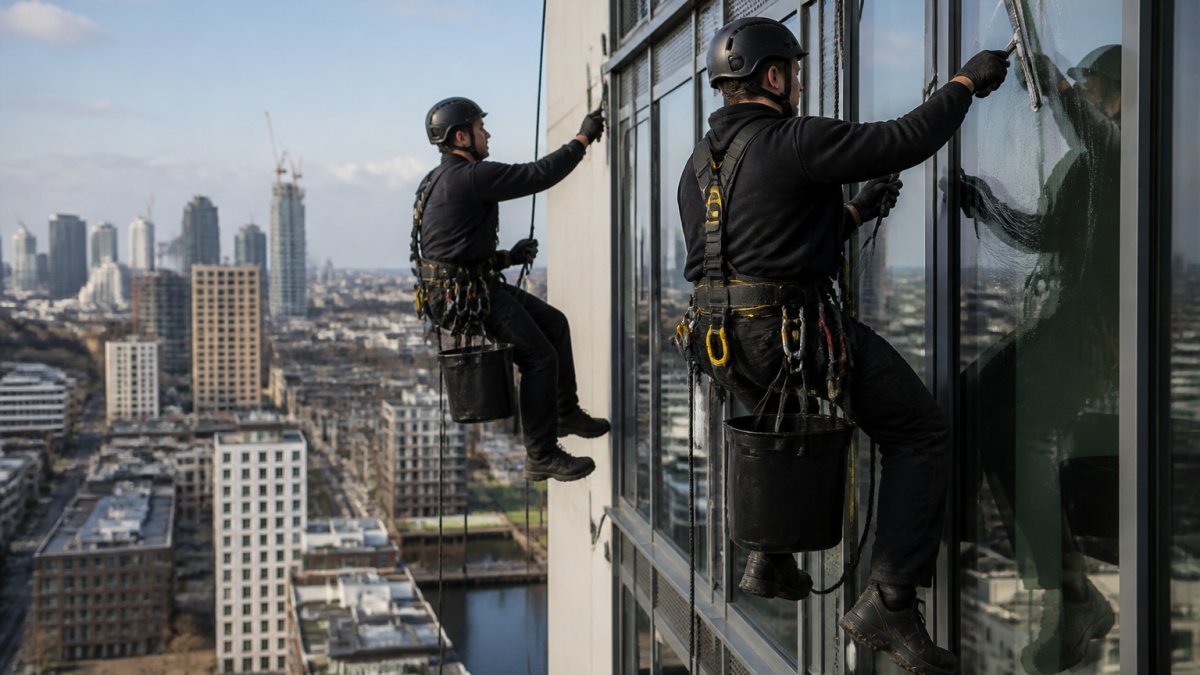
Bring in rope access when:
- The building is too tall or too irregular for water-fed poles
- Powered access would block entrances, roads or loading bays
- The facade has recesses, balconies or set-backs that platforms cannot reach
- You need a fast, targeted clean on one elevation
Lion Cleaning Group's team is IRATA-trained, which is the certification to ask any contractor about before they work on your building.
What to Record After Every High-Rise Window Maintenance Visit
A visit is not finished when the crew packs up. The record you keep afterwards is what protects you at the next budget review, the next audit, or the next contractor handover.
Record these after every visit:
- Date, time and duration of the work
- Elevations and areas cleaned
- Access method used and equipment checked
- Any defects spotted, with photos
- Sign-off by the contractor and by your site contact
Keep the records together, building by building. When a manager asks why a facade needs attention, or a new contractor takes over, that file answers the question in minutes rather than a day of phone calls.
Book a High-Rise Window Maintenance Visit
If your building's windows have been put off for months, the checklist above is the place to start. It gives you a clear brief to hand to any contractor, and a way to check the work when it is done.
At Lion Cleaning Group, we handle high-rise window maintenance for apartment blocks, offices and managed portfolios across the UK. Our team is IRATA-trained, and we work at height as specialists.
Get started with Lion Cleaning Group and put your high-rise window maintenance on a schedule you can actually rely on.
Frequently Asked Questions
What should a high-rise window maintenance checklist include?
A working checklist covers four things: pre-work safety checks (anchor points, harnesses, ground control), the property manager window cleaning schedule, a window cleaning inspection checklist for the glass and frames, and a record of what was done after each visit. Add the access method used, who attended site, and any defects spotted so you have a clear paper trail for the next booking.
How often should high-rise windows be cleaned?
Most apartment blocks and office buildings sit well on a four- to eight-week cycle, but it depends on the site. Buildings near busy roads, construction or trees collect dirt faster and may need monthly visits. Quieter sites can stretch to quarterly. Walk the elevations with your provider after the first clean and set the interval from what you actually see rather than a fixed guess.
What safety checks are needed for high-rise window cleaning?
High-rise window cleaning safety checks should confirm anchor points are tested and certified, harnesses and ropes are in date, and the team holds current IRATA certification. Ground control matters too: barriers, signage and a clear drop zone keep residents and pedestrians out of the work area. Ask for these checks in writing before the first visit so you know the standard is being met every time.
When should a property manager arrange specialist rope access window cleaning?
Rope access window cleaning suits buildings where cradles, MEWPs or ladders cannot reach safely, or where setting up access equipment would cost more than the clean itself. It is also the practical choice for angled façades, atriums and cladding that needs close inspection. If your block has awkward elevations or limited ground space, ask a rope access team to survey before you commit to a schedule.
