
Last Updated: October 23, 2026
Quick Summary
The 7 checks before cleaning a commercial building facade are access and height requirements, facade materials and compatible methods, whether rope access is right, equipment and water supply, weather and wind speeds at height, permits and ground security, and schedule and post-clean inspection. Run them before any rope goes over the edge.
- Measure the working height and confirm whether a MEWP or rope access is possible.
- Match the cleaning method to the surface; high pressure on render can strip it.
- Choose rope access when the building is too tall, too tight or too awkward for machines.
- Set a wind limit and stop work when conditions turn at height.
- Agree a post-clean walk-round with the site contact while the team is still on site.
Table of Contents
- Why Pre-Cleaning Checks Matter for Commercial Building Window Cleaning
- Check 1: Confirm the Building's Access and Height Requirements
- Check 2: Identify Facade Materials and Choose Compatible Facade Cleaning Methods
- Check 3: Assess When Rope Access Cleaning Is the Right Choice
- Check 4: Review the Commercial Window Cleaning Checklist for Equipment and Water
- Check 5: Check Weather Conditions and Wind Speeds at Height
- Check 6: Verify Permits, Ground Security and Building Manager Sign-Off
- Check 7: Agree the Cleaning Schedule and Post-Clean Inspection
- Frequently Asked Questions
Why Pre-Cleaning Checks Matter for Commercial Building Window Cleaning
Seven checks before cleaning a commercial building facade is the difference between a safe, clean result and a costly problem. At Lion Cleaning Group, we run these checks on every high-rise window cleaning job across Cheadle and Greater Manchester. Skip them and you risk damaged cladding, failed anchor points, or a suspended technician in wind that has turned.
A facade clean is not a bucket-and-ladder job scaled up. It is work at height, often over people, glass and expensive finishes. The checks below take an hour. Getting them wrong takes weeks to put right.
The 7 checks before cleaning a commercial building facade we cover are:
- Access and height requirements
- Facade materials and compatible cleaning methods
- Whether rope access cleaning is the right approach
- Equipment and water supply
- Weather and wind speeds at height
- Permits, ground security and sign-off
- Schedule and post-clean inspection
Below, we explain each check and why it matters on a live site.
The most common mistake is treating a facade clean as a ground-level task. A technician working at height on a windy day faces forces a ground crew never feels. Check the weather before anyone clips in, not after.
Check 1: Confirm the Building's Access and Height Requirements
Access is the first thing to confirm, because it decides everything else. Measure the working height, note the roof type, and find out whether a mobile elevating work platform (MEWP) or rope access is even possible.
Walk the perimeter and answer these:
- What is the exact height to the highest window or cladding panel?
- Can a MEWP reach the elevation, or is the ground too soft or sloped?
- Is there safe roof access for rigging, and are anchor points certified?
- Are there obstacles such as canopies, balconies or planting?
On tight city-centre sites, a MEWP may not fit. That pushes you toward rope access. Height also changes the equipment: a 30-metre building needs different rope lengths, anchor plans and rescue arrangements from a 10-metre block.
Get this wrong and the whole job stalls on day one.
Check 2: Identify Facade Materials and Choose Compatible Facade Cleaning Methods
Facade materials decide which facade cleaning methods are safe. Glass, aluminium cladding, render, stone and sealed concrete each react differently to water pressure, chemicals and brushes.
Match the method to the surface:
- Glass curtain walling: pure water and a squeegee or water-fed pole.
- Aluminium and composite cladding: low-pressure soft washing with a mild, pH-neutral cleaner.
- Render and painted finishes: gentle soft wash, never a high-pressure jet.
- Stone and concrete: test a small patch first, then use a suitable detergent.
The wrong method leaves marks that cost more to fix than the clean itself. High pressure on render can strip the surface. Harsh chemicals can stain anodised aluminium. A patch test on a hidden panel takes minutes and prevents a very public mistake.
Check 3: Assess When Rope Access Cleaning Is the Right Choice
Rope access cleaning is the right choice when a building is too tall, too tight or too awkward for a MEWP or scaffold. Technicians work from ropes and harnesses, so they reach elevations that machines cannot.
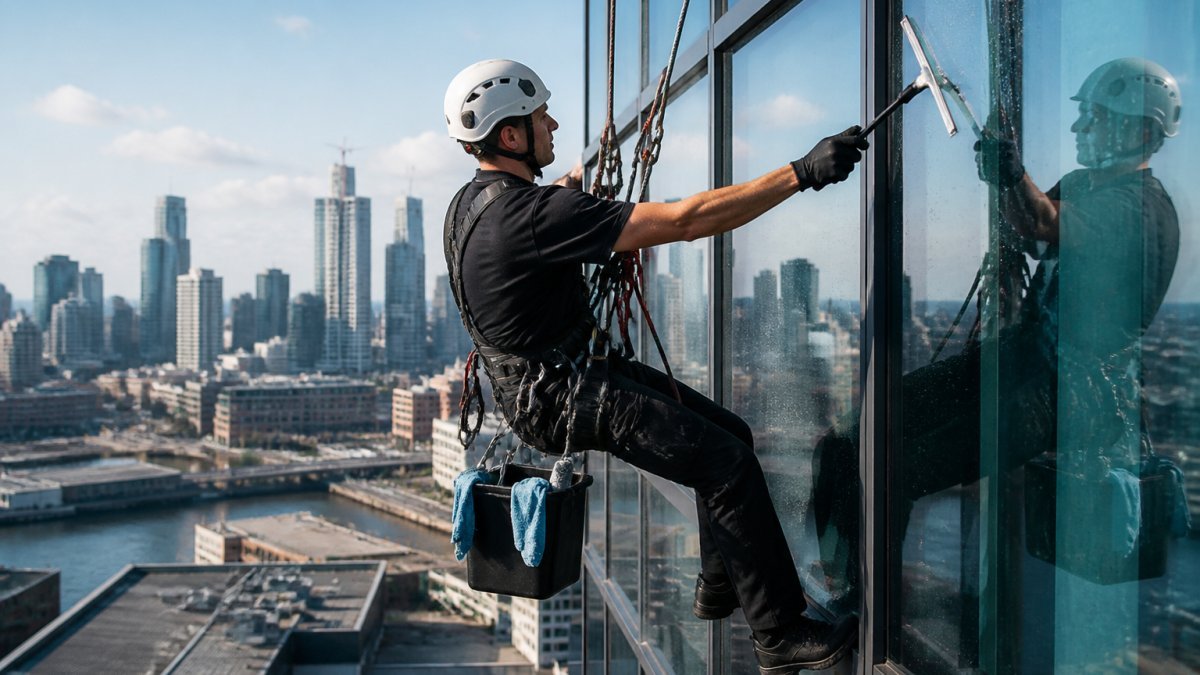
Choose rope access when:
- The building is high-rise with no practical machine access.
- Ground space is limited, such as a narrow city-centre plot.
- You need spot work on one elevation without full scaffold.
- Speed matters and scaffold would take days to erect.
Our team is IRATA-trained, and that matters. IRATA is the recognised industry standard for rope access, with graded certification and rescue training (irata.org). Ask any contractor for their technicians' IRATA levels before they rig a single rope.
Ask to see rescue plans, not just harness certificates. A rope access team without a written rescue plan is not a rope access team you want over your building.
Check 4: Review the Commercial Window Cleaning Checklist for Equipment and Water
A commercial window cleaning checklist should confirm every item of equipment and the water supply before the team arrives. Missing gear means a wasted visit.
Run through the list:
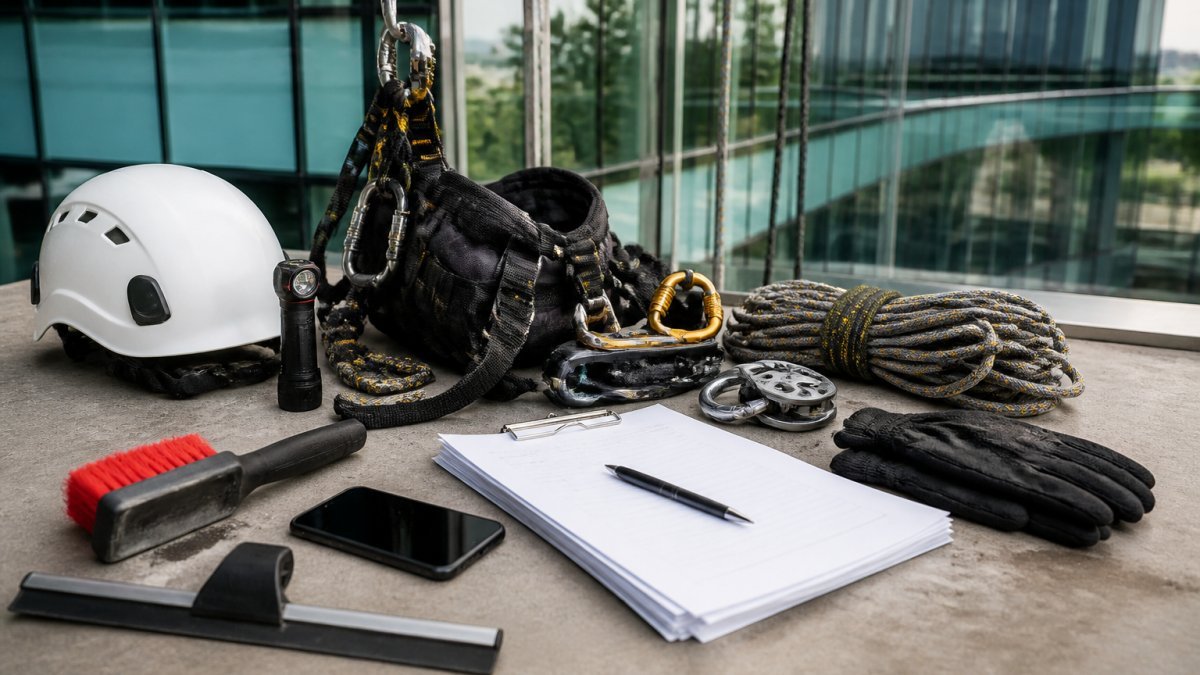
- Ropes, harnesses and helmets, all in date and inspected
- Anchor points and rigging kit
- Water-fed poles, squeegees and scrapers
- Water purification system and hose reach
- Signage, cones and barrier tape
- Two-way radios for the ground and roof crew
Pure water matters more than people think. Filtered water dries without streaks, so windows come up clear. On a tall building, hose reach and pump pressure need checking too. A short hose or a tired filter shows up as smears halfway up the elevation.
Check 5: Check Weather Conditions and Wind Speeds at Height
Weather decides whether the job goes ahead. Wind speeds at height are higher than at ground level, and gusts arrive with no warning.
Check the forecast and the live conditions:
- Wind speed and gusts at the working height
- Rain, which leaves streaks and makes surfaces slippery
- Temperature, especially near or below freezing
- Visibility for the ground crew
Set a wind limit and stick to it. Rope access and MEWP work both have safe operating thresholds, and a facade clean is never worth a fall. If conditions turn, the team stops. That is the correct call, not a delay to apologise for.
Check 6: Verify Permits, Ground Security and Building Manager Sign-Off
Permits and sign-off keep the job legal and the public safe. Confirm paperwork and ground security before any rope goes over the edge.
Confirm these:
- Building manager sign-off and a named site contact
- Permission for roof access and rigging points
- Ground closures, cones and pedestrian barriers
- Parking suspensions where a MEWP or vehicle needs space
- Any listed-building or estate conditions
The ground beneath a facade clean is a work zone. Dropped water, tools or kit can injure people. Barriers and a clear exclusion zone protect the public and the team. Get the site contact's name and number in writing, so a problem on the day has a fast answer.
Check 7: Agree the Cleaning Schedule and Post-Clean Inspection
The final check is the plan for the job and how you will check the result. Agree the schedule, then agree how the finished work gets inspected.
Set these before the first rope drops:
- Start and finish times, and any quiet hours
- The order of elevations and access points
- A post-clean inspection with the site contact
- A snagging process for any missed spots
- A written report with photos
A post-clean walk-round catches missed panes and streaks while the team is still on site. It also gives you a record. If you manage multiple buildings, that record is how you keep standards consistent across the portfolio.
| Check | What to confirm | Why it matters |
|---|---|---|
| 1. Access and height | Working height, roof access, MEWP or rope | Decides the whole method |
| 2. Facade materials | Surface type and compatible method | Prevents damage |
| 3. Rope access | Whether ropes are the right choice | Reaches what machines cannot |
| 4. Equipment and water | Kit list and pure water supply | Avoids wasted visits |
| 5. Weather | Wind, rain and temperature | Keeps the team safe |
| 6. Permits and security | Sign-off, barriers, ground closures | Protects the public |
| 7. Schedule and inspection | Times and post-clean walk-round | Confirms the result |
The 7 checks before cleaning a commercial building facade come down to one idea: plan the job around the building, the surface and the weather, not around a fixed routine. Every check protects either the team, the building or the public.
Cleaning a commercial building facade at height is not a job to improvise. If you manage apartment blocks, offices or a property portfolio around Cheadle and need a team that runs these checks every time, Lion Cleaning Group can help. We offer nationwide coverage, IRATA-trained rope access teams and flexible scheduling around your site. Our crews work with environmentally friendly products and hold the safety compliance your building manager will want to see. Get in touch to book a clean and put the checks to work on your building.
Frequently Asked Questions
What should be checked before cleaning a commercial building facade?
Start with access and height requirements, then confirm the facade materials and which facade cleaning methods suit them. Check whether rope access cleaning is needed, review the commercial window cleaning checklist for equipment and water supply, and assess wind and weather at height. Finally, verify permits, ground security and building manager sign-off, and agree the schedule and inspection. These seven checks keep the job safe and protect the building's surface.
When is rope access cleaning suitable for commercial building window cleaning?
Rope access cleaning suits tall or awkward facades where mobile elevating work platforms (MEWPs) or water-fed poles cannot reach safely. It is also useful where ground space is tight or occupied. The team must be IRATA-trained and work to a site-specific plan. It is not the right choice in high winds or where anchor points are unverified. A site survey confirms whether rope access is the best method.
How can you tell whether facade materials are suitable for pressure washing?
Check the material first: soft stone, rendered finishes and some sealants can be damaged by high pressure. Test a small, hidden area at low pressure and watch for etching, water ingress or loosened fixings. Listed or older buildings may need gentler facade cleaning methods such as soft washing or pure water. If in doubt, use low pressure and specialist cleaners. Never pressure wash near open vents, joints or damaged cladding without sealing them first.
What weather conditions affect window cleaning at height?
Wind is the main concern: most rope access and MEWP work stops when sustained wind speeds exceed the equipment or site limit, often around 15-20 mph depending on the setup. Rain, lightning and poor visibility also pause work. Cold snaps can freeze water-fed poles and make surfaces slippery. Check the forecast for the specific height and exposure of the building, not just ground level, and build flexibility into the schedule so missed days are rebooked quickly.
