
Table of Contents
- IRATA Rope Access Cleaning: What the Ticket Actually Means
- Rope Access Window Cleaning: How a Descent Works
- The Kit: What a Rope Access Team Brings On Site
- Rope Access Cleaning Safety: The Checks Before Anyone Leaves the Roof
- High-Rise Window Cleaning: When Rope Access Beats a MEWP
- Apartment Block Window Cleaning in Cheadle and Across Greater Manchester
- Choosing an IRATA Rope Access Cleaning Team
- Frequently Asked Questions
Last Updated: October 15, 2026
IRATA Rope Access Cleaning: What the Ticket Actually Means
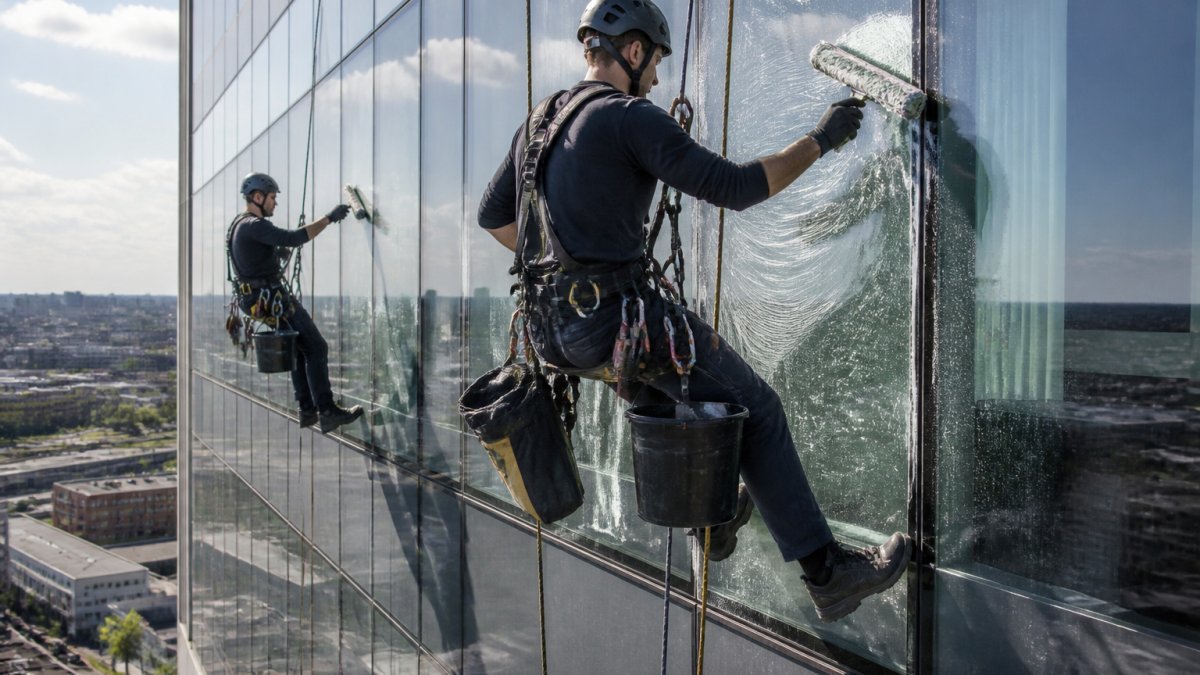
IRATA rope access cleaning is window cleaning and facade work carried out by technicians who hang from ropes fixed at roof level, using a two-rope system that has a primary line and a separate back-up line. The ticket that matters is the IRATA certificate: a training and assessment record held by the individual technician, graded from Level 1 to Level 3.
Here at Lion Cleaning Group, we run IRATA-trained teams out of Cheadle, Greater Manchester, covering apartment blocks, offices and managed property portfolios across the UK.
The system is simple once you see it. One rope takes the weight. The other is there in case the first one fails. The technician wears a harness that connects to both, and the back-up line runs through a device that grips automatically if the main line goes slack.
That single design choice is why rope access sits comfortably alongside other methods for work at height. It is not a shortcut. It is a controlled, inspected, documented way of getting a person to a pane of glass that no platform or pole can reach.
The word "ticket" trips people up, though. It is not a licence issued by a government body. It is a certification scheme run by IRATA International, the Industrial Rope Access Trade Association, and it is renewed through reassessment. A Level 1 technician works under supervision. A Level 3 technician can plan the job, set up the rigging and supervise the team. Most cleaning crews run with one Level 3 and a small number of Level 1s and 2s.
When a property manager asks whether a contractor is "IRATA certified", this is what they are really asking: are the people on the ropes trained to a recognised standard, and can the company prove it?
IRATA certification belongs to the individual technician, not the company. Always ask to see the certificates and check the expiry dates, not just the logo on the van.
Rope Access Window Cleaning: How a Descent Works
Rope access window cleaning follows a fixed sequence on every drop: anchor, rig, descend, clean, ascend, inspect. The technician never free-climbs and never works from a single line.
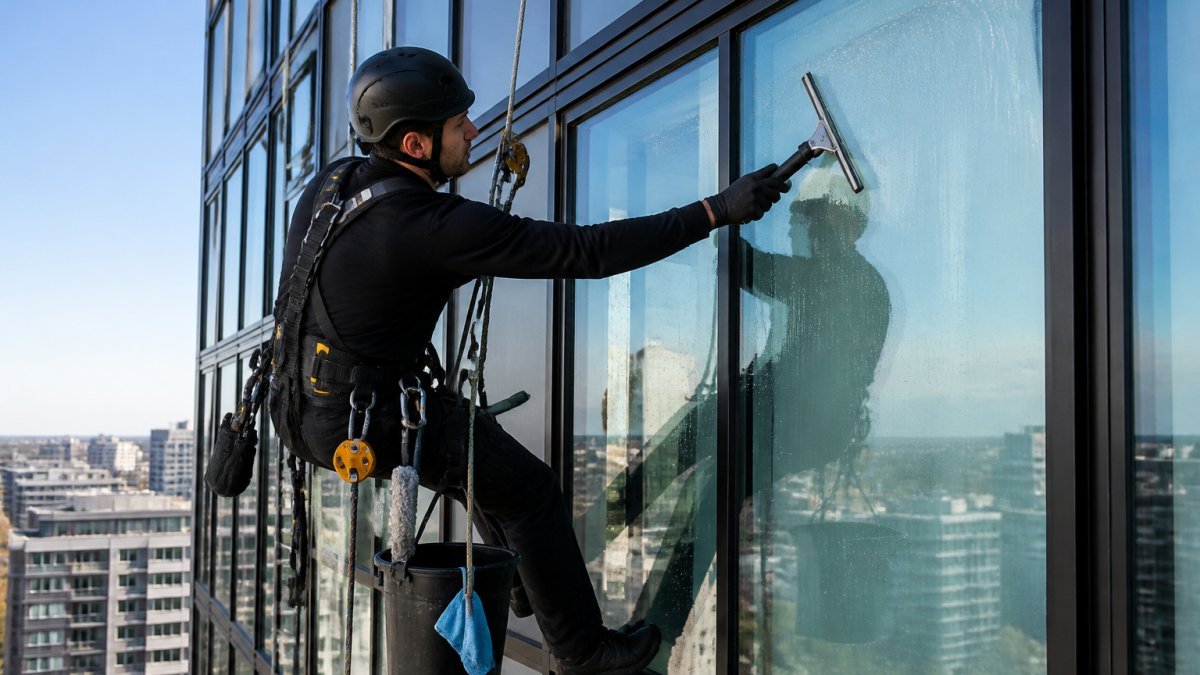
The setup starts on the roof. The team identifies anchor points that are structurally sound, then rigs the main line and the back-up line. Both run over edge protection so the rope is not rubbing on a sharp corner. The technician clips in, checks the rig, and lowers over the edge.
From there the work is methodical. The technician cleans a vertical strip, then moves across, then drops down a section and repeats. Water is fed down in a hose or carried in a bucket on the harness, depending on the building and the height.
Cleaning a full elevation of a mid-rise block usually takes a day or two with a small team. A single awkward elevation on a taller building can take longer than the whole of a straightforward one, because access, wind and window spacing all slow the descent.
The ascent is the part people forget. Going up takes longer than going down, and the technician is working against gravity the whole way. Good crews plan the drop so the hardest cleaning happens early, while arms are fresh.
The Kit: What a Rope Access Team Brings On Site
A rope access team's kit splits into three groups: the rope system, the personal protective equipment, and the cleaning tools. Every item is inspected before use and logged.
The rope system carries the load:
- Main line, usually 11mm semi-static rope
- Back-up line, matched to the main line
- Descender device for controlled lowering
- Back-up device that grips the second line automatically
- Edge protection pads at the roof lip
- Anchor slings and connectors rated for the load
- Rope bags to keep lines clean and tangle-free
The technician wears a full-body harness, a helmet with a chin strap, and gloves. A small tool bag hangs from the harness so both hands stay free.
Cleaning tools are chosen for the job:
- Squeegees with different blade widths for large panes and narrow frames
- Water-fed poles for reach where a full descent is not needed
- Scrapers for paint spots and builders' residue
- Microfibre cloths for frames, sills and detailing
- A pure-water system for streak-free glass on tall elevations
What most guides miss is that the cleaning kit is the cheap part. The rope system and PPE get replaced on a schedule whether or not they look worn. That cost sits in the job, and it is why a proper rope access quote is not the same as a ground-level window clean.
Rope and hardware have fixed service lives. A contractor who cannot show inspection records is a contractor you should not put on your building.
Rope Access Cleaning Safety: The Checks Before Anyone Leaves the Roof
Rope access cleaning safety rests on three checks: the anchor, the rig and the technician. All three are verified before anyone goes over the edge, and the same checks repeat at the end of the drop.
The anchor check confirms the fixing point is sound and rated. On modern apartment blocks this is often a designed anchor or a certified structural point. On older buildings it may need a sling around a suitable column or beam.
The rig check covers the rope path. Are both lines over edge protection? Is the descender threaded correctly? Is the back-up device positioned above the descender, where it can actually catch a fall?
The technician check is the human one. Harness buckles, helmet, connectors, and a final look at the tool bag so nothing heavy is loose.
Then there is the plan for the day. Wind speed matters more than most people realise. Glass cleaning on a tall elevation in a strong gust is miserable work and unsafe work, so crews stop when conditions turn. Rain is less of a problem than wind, but it still affects the finish.
A competent team also runs a rescue plan. If a technician cannot get themselves back to the roof, someone needs to reach them. That plan is written before the first descent, not improvised after an incident.
High-Rise Window Cleaning: When Rope Access Beats a MEWP
High-rise window cleaning usually comes down to a choice between rope access and a mobile elevating work platform, or MEWP. Rope access wins on tall, awkward or tightly packed buildings. A MEWP wins on low, open elevations with room to set up.
Here is how the two compare in practice:
| Situation | Rope Access | MEWP |
|---|---|---|
| Height above 20 metres | Practical and fast to set up | Reach limits apply |
| Tight or landscaped ground | No ground footprint needed | Needs level standing space |
| Glass atria and recessed facades | Reaches any pane | Often cannot reach |
| Low single-storey elevations | Slower to rig | Quicker and cheaper |
| Busy public pavement below | Ropes only | Needs cordon and permits |
The ground footprint is the big one. A MEWP needs a level, stable base, and on a residential site that often means closing a car park, a path or a loading bay. Rope access needs nothing at ground level except a safe zone under the work area.
Where a building has a mix of heights, most crews use both. A MEWP for the low frontage, ropes for the tower behind it. That is a planning decision, not a loyalty to one method.
Apartment Block Window Cleaning in Cheadle and Across Greater Manchester
Apartment block window cleaning is really a people problem as much as a technical one. Residents live behind the glass you are cleaning, and they notice everything.
The practical issues are predictable:
- Balconies with furniture, plants and washing that block access
- Windows left open, especially in warm weather
- Pets and children in rooms where a technician appears at the glass
- Residents who want advance notice before anyone is outside their window
Good crews post notice in the communal areas a few days ahead. We find a short note in the lobby and a message through the managing agent covers most buildings. On larger schemes, working a floor at a time in a set order keeps things calm.
Scheduling matters too. Many blocks want the front elevation done in a quieter window, or the whole job moved around a resident event. Flexible scheduling is normal for us, not a favour.
For blocks in Cheadle and the wider Greater Manchester area, weather adds its own rhythm. Damp, grey spells mean more spotting on glass.
If you are searching for rope access window cleaning near you, the questions to ask are the same wherever the building sits: who is on the ropes, what is their level, and how do they handle residents?
Choosing an IRATA Rope Access Cleaning Team
Choosing an IRATA rope access cleaning team comes down to proof, not promises. Certificates, insurance, method and references. Ask for all four.
Work through this before you appoint anyone:
- Ask for each technician's IRATA certificate and check the level and expiry date
- Confirm the company holds current public liability and employers' liability insurance
- Ask how anchors are selected and who signs off the rigging plan
- Request the rescue plan for your specific building
- Ask what happens if wind stops the job partway through
- Get two references from buildings similar to yours
- Confirm who supervises on site and at what level
- Check how residents will be notified and when
The references matter more than the paperwork. A block manager will tell you whether a crew turned up when they said they would, whether residents complained, and whether the glass was actually clean at the end.
At Lion Cleaning Group, our teams are IRATA-trained, we work to a documented safety standard, and we use environmentally friendly cleaning products. We cover apartment blocks, offices and managed portfolios nationwide, with flexible daily and weekly schedules. Block managers we work with, including Emma Riley at CPM, tell us the courtesy shown to residents is what keeps us on site.
Frequently Asked Questions
What is IRATA rope access cleaning?
It is window and facade cleaning carried out by technicians suspended on ropes rather than from a cradle, boom or scaffold. IRATA is the industry body that sets the training and certification standard, so an IRATA-trained operative has passed assessed modules in rope manoeuvres, rigging and rescue. For buildings where a MEWP cannot reach, or where putting one on site is impractical, rope access cleaning gives a safe route to every pane and panel.
What qualifications should rope access cleaners have?
Ask for current IRATA certification, a valid medical certificate and evidence of regular refresher training, since IRATA tickets need renewing. Beyond the rope ticket, the team should be able to show public liability insurance and a working-at-height approach that follows the Work at Height Regulations 2005. Lion Cleaning Group's team is IRATA-trained, and staff hold the certifications that go with it.
Is IRATA rope access suitable for apartment blocks?
It often suits apartment blocks better than a MEWP or scaffold, because there is no large machine to park, no road closure and no equipment blocking entrances for weeks. Apartment block window cleaning by rope can be phased, and the team can move between elevations as access allows. Where balconies, planters or fragile roof edges get in the way, the rigging plan is adjusted before the visit.
When is rope access preferable to a MEWP for window cleaning?
Rope access tends to win on tall or awkward buildings: narrow courtyards, stepped facades, glazed atria and elevations a boom lift cannot safely reach. A MEWP needs firm level ground, a clear footprint and often a permit or traffic management, which adds time and cost. Rope access needs only a safe anchor point and roof access, so high-rise window cleaning can be completed in a fraction of the setup time on the right building.
A high-rise facade does not clean itself, and the wrong crew on your building is a problem you will feel for months. Lion Cleaning Group brings IRATA-trained rope access teams, nationwide coverage and flexible scheduling to apartment blocks, offices and managed property portfolios, with environmentally friendly products and a safety standard we can evidence. Get started with Lion Cleaning Group and put your building in the hands of a team that works at height every week.